
A branch aggregator reaches the provider cloud across the public internet. Policy says that path must be encrypted. A dedicated facility or a tunnel header alone must not be treated as encryption. Which design meets the policy?
Select an answer to reveal the explanation.
Short Explanation
A locked truck is not the same as a private road or a shipping label. You encrypt the internet path with IPsec. A dedicated interconnect, an MPLS label path, or a GRE tunnel alone does not provide that encryption.
Full Explanation
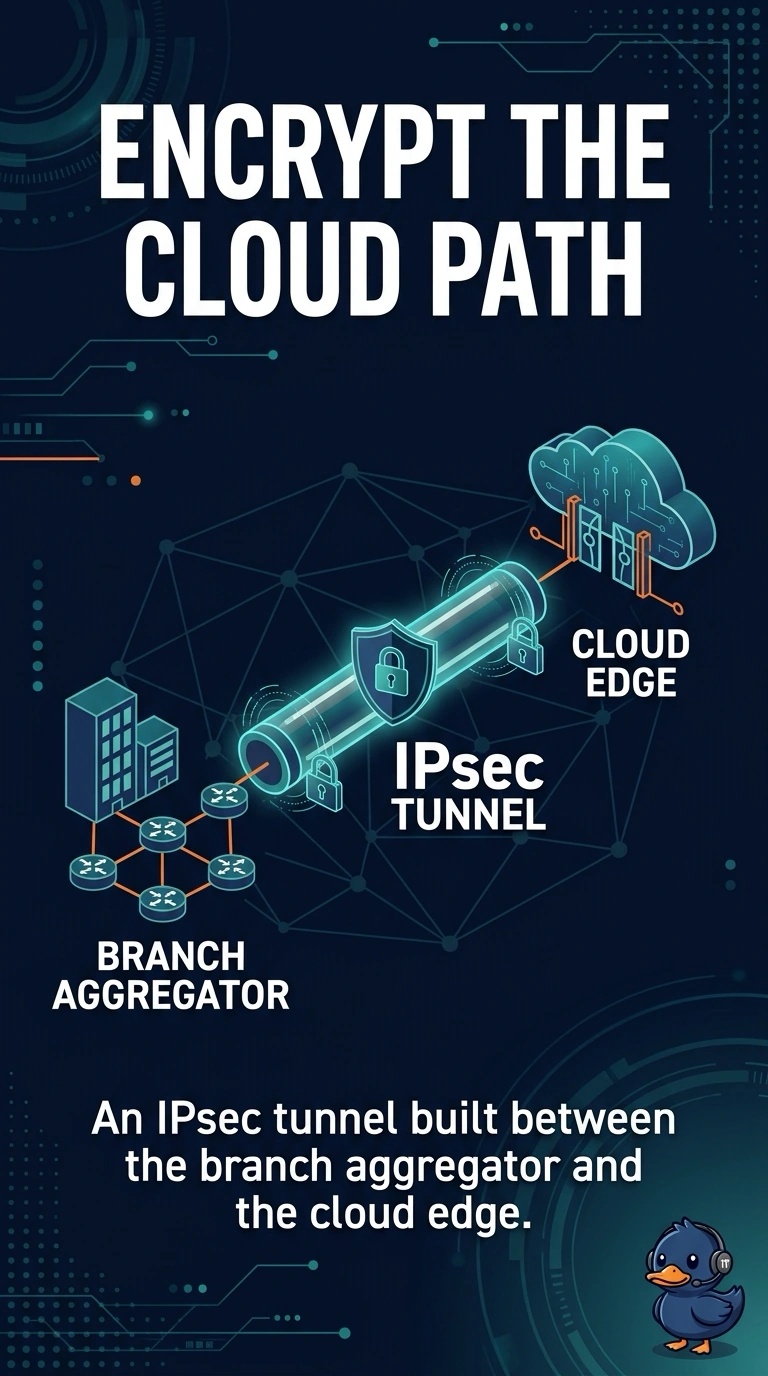
The path in this requirement is the public internet, and the missing property is encryption. An IPsec tunnel built between the branch aggregator and the cloud edge encrypts that path, so it meets the policy. A private interconnect that is dedicated but is not an encrypted tunnel provides a dedicated handoff; dedication by itself does not encrypt traffic. An MPLS label path used only to steer traffic across the provider core uses labels to direct provider transport, not to encrypt the payload. A GRE tunnel that only encapsulates packets adds a tunnel header but leaves the payload readable to anyone who can see the path. The key distinction is that a dedicated facility, traffic steering, and encapsulation do not provide confidentiality; encryption does. Exam caveat: use IPsec ESP with encryption wherever policy requires network-layer confidentiality, including on a private circuit. A dedicated attachment alone does not guarantee end-to-end encryption. Practical check: capture traffic on the internet link, confirm it is IPsec rather than readable GRE traffic, and verify that the cloud edge decrypts it.