
Two leaves in a data-center fabric can ping each other across the underlay, but hosts on an extended VLAN no longer learn remote MAC addresses. The design extends those hosts with EVPN and VXLAN. Where should the operator look first?
Select an answer to reveal the explanation.
Short Explanation
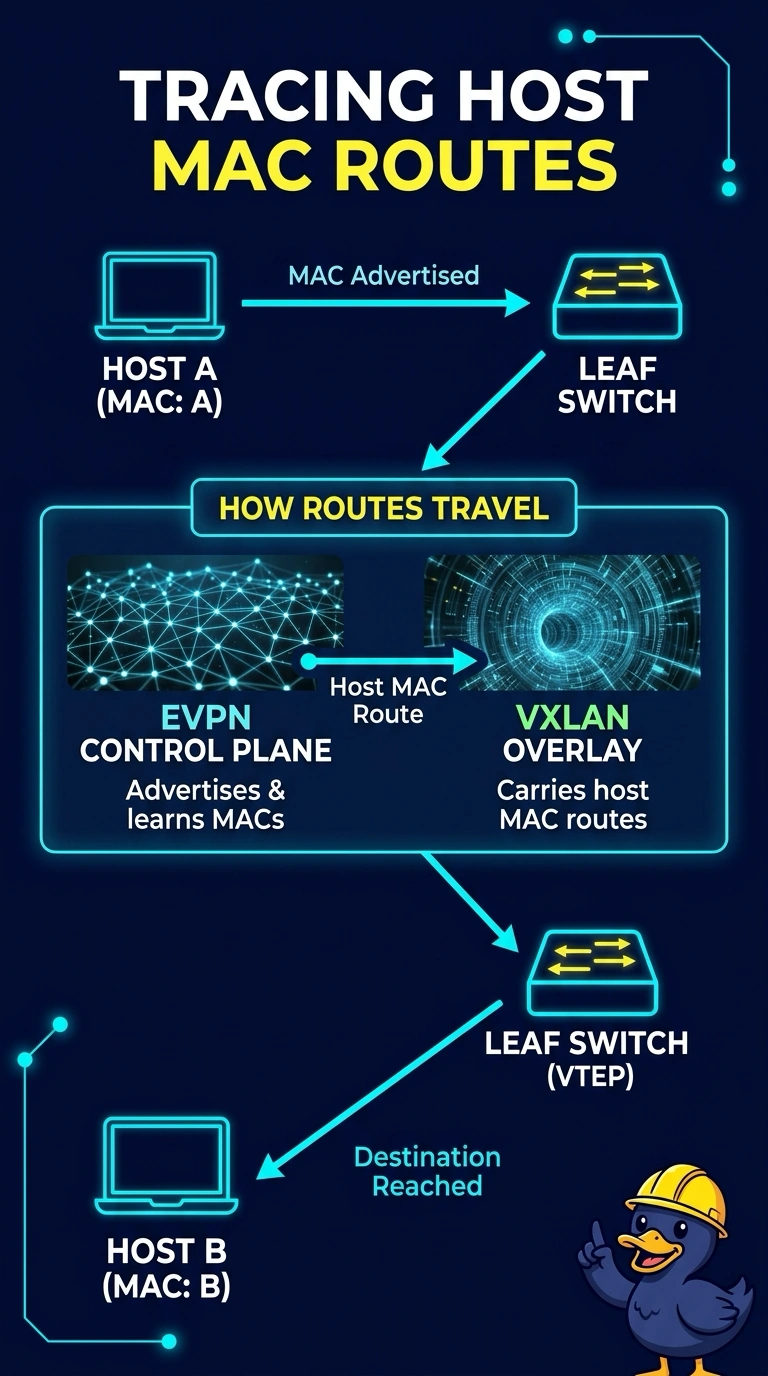
MP-BGP EVPN Type 2 routes advertise remote MAC reachability. VXLAN carries the Ethernet data plane. Check local learning, advertisement, route-target import, and VNI mapping as you sort the overlay while underlay ping still works.
Full Explanation
MP-BGP EVPN Type 2 routes advertise remote MAC reachability. VXLAN carries the Ethernet data plane. Check local learning, advertisement, route-target import, and VNI mapping. Underlay pings show that leaf-to-leaf IP reachability is intact, so the break is in the overlay control plane or the VXLAN path. A segment-routed EVPN core, an ACI contract, or a pseudowire is the right place to look only when that encapsulation is the one actually in the path. The EVPN control plane and VXLAN overlay that carry the host MAC routes is the design that meets this requirement. An EVPN session riding a segment-routed core that this fabric does not use is the wrong fit because segment-routed EVPN would matter only if that core carried this overlay, and this fabric has none. An ACI policy or forwarding fault in a fabric this design does not use is the wrong fit because an ACI policy fault belongs inside an ACI fabric, and this leaf-to-leaf path is not that fabric. A point-to-point pseudowire that emulates one circuit between the two sites is the wrong fit because a pseudowire is one emulated circuit, not the EVPN and VXLAN overlay used between these leaves. Exam caveat: EVPN can ride VXLAN in a data-center fabric or segment routing in a wide-area core. Match the encapsulation that is deployed here before you chase the other one. Operational check: Compare EVPN MAC routes on the two leaves for the extended VLAN, then confirm VXLAN tunnels to the remote VTEP while the underlay ping still succeeds.