
A bank wants a dedicated path from its cage into a cloud provider, and the handoff must stay off the public internet. Encryption is not the requirement, and core traffic engineering is not the requirement. Which design fits?
Select an answer to reveal the explanation.
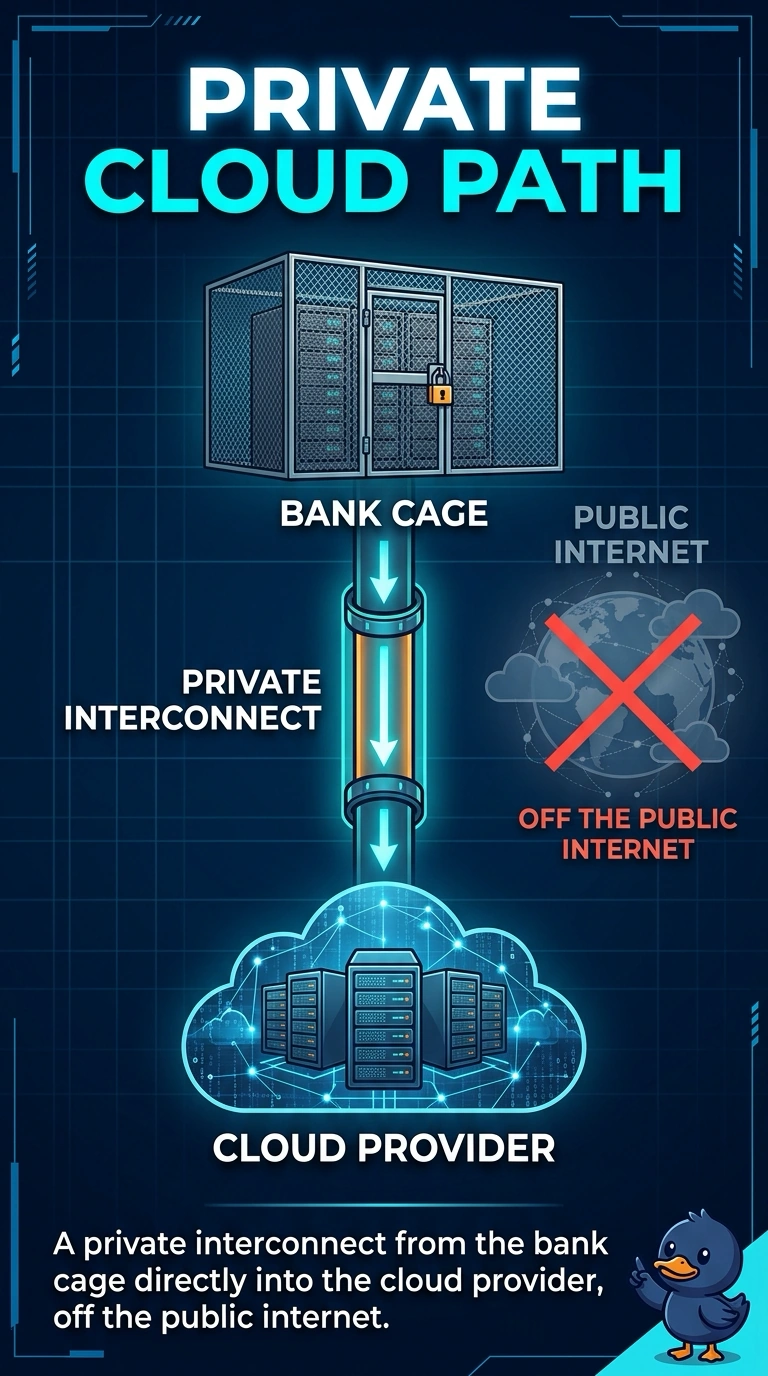
Short Explanation
A private road into the building is not a lock, and it is not the highway lane markings. You use a private interconnect for the dedicated path into the cloud. An internet IPsec tunnel, an MPLS core, or a segment-routed core answers a different requirement.
Full Explanation
A private interconnect is a dedicated path into the cloud and is not an encrypted tunnel by itself. That matches a handoff that stays off the public internet when encryption and core traffic engineering were not requested. IPsec adds encryption on a path that is not private. MPLS and segment routing steer transport in the core. They do not by themselves give the bank a dedicated cloud handoff. A private interconnect from the bank cage directly into the cloud provider is the design that meets this requirement. An IPsec tunnel built across the public internet as the path into the cloud is the wrong fit because IPsec encrypts an untrusted path, and this requirement is a dedicated handoff off the internet. An MPLS core that steers provider transport but is not the cloud handoff is the wrong fit because MPLS steers traffic in the provider core, and that core steering is not the dedicated cloud handoff. A segment-routed core that steers transport and does not replace the handoff is the wrong fit because segment routing steers the core with segments, and it is not the private path into the cloud. Exam caveat: A private interconnect is not confidentiality. If policy later requires an encrypted payload, that is a separate requirement on top of the handoff. Operational check: Confirm the bank cage meets the cloud on a private interconnect, confirm that path is not an internet VPN, and confirm core segment routing is not being used as the handoff.