
Geneve encapsulation adds header bytes to every overlay frame on the municipal underlay. What implication should operators identify?
Select an answer to reveal the explanation.
Short Explanation
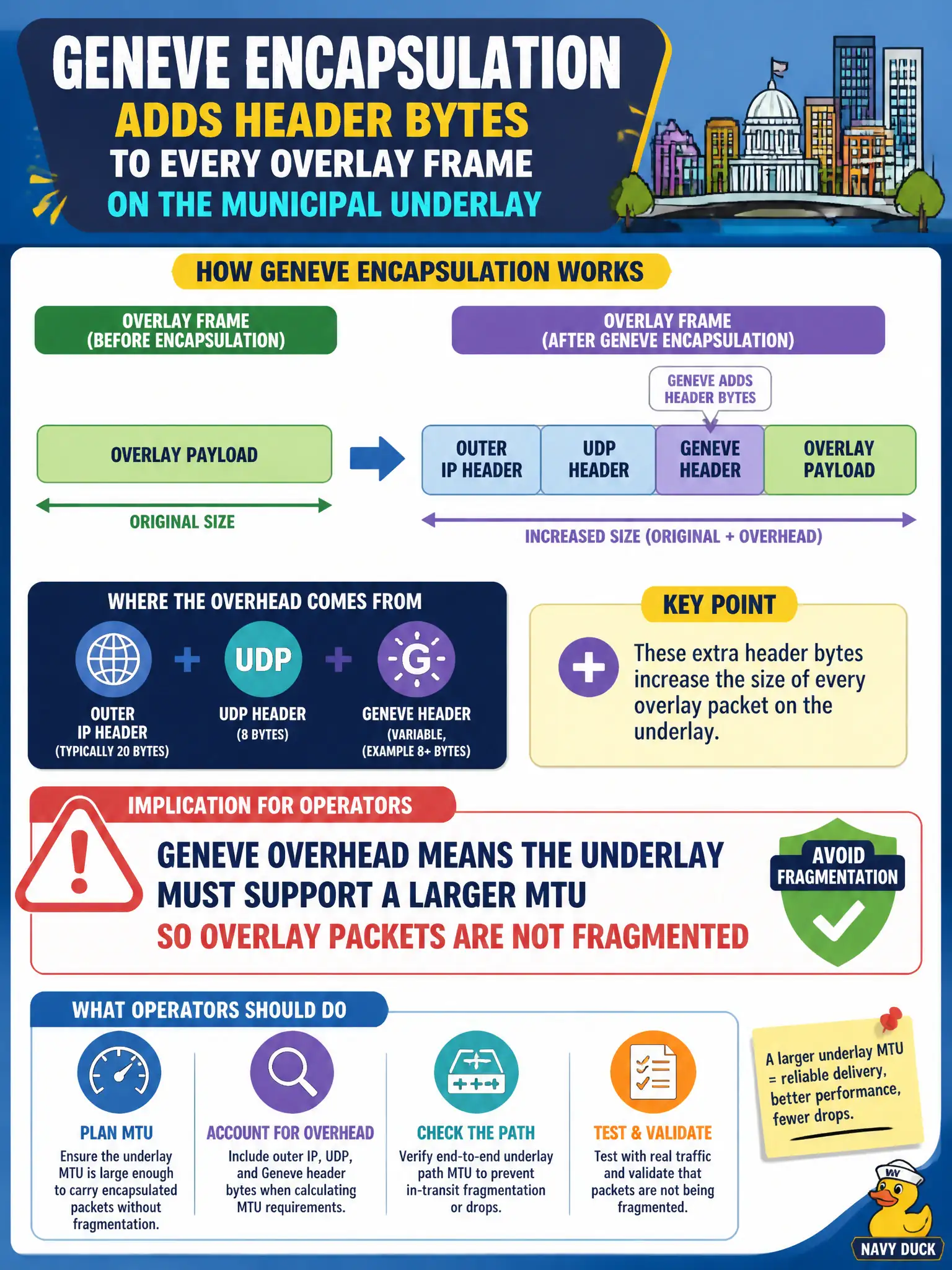
Wrapping a letter in a thicker envelope makes the package bigger. Geneve adds header bytes, so the physical underlay needs a larger MTU—or overlay packets fragment. BLAST settings and sensors do not cancel that overhead.
Full Explanation
Geneve encapsulation adds header bytes to every overlay frame on the municipal underlay, so operators must identify that the underlay needs a larger MTU than the guest MTU or else encapsulated packets fragment. Overlay wrapping makes the on-wire package bigger; underlay headroom is therefore required for reliable civic overlay transport. Overlay does not shrink the required underlay MTU so top-of-rack switches can stay at very small frame sizes—the opposite is true. Horizon BLAST requiring jumbo frames on every guest vNIC is not the Geneve underlay rule and is not a prerequisite that replaces host/uplink MTU planning. Carbon Black sensors do not set host MTU in a way that removes Geneve overhead. Exam caveat: this exam typically asks you to identify the overhead implication, not to calculate a precise MTU arithmetic answer. Still, production designs commonly raise underlay MTU (for example toward 9000) end to end between TEPs. Operational check: verify VDS/uplink and physical switch MTU along the TEP path, run overlay throughput or large-ping tests without fragmentation, and compare with a too-small underlay MTU that shows fragmentation or poor performance—independent of BLAST or sensor settings.