
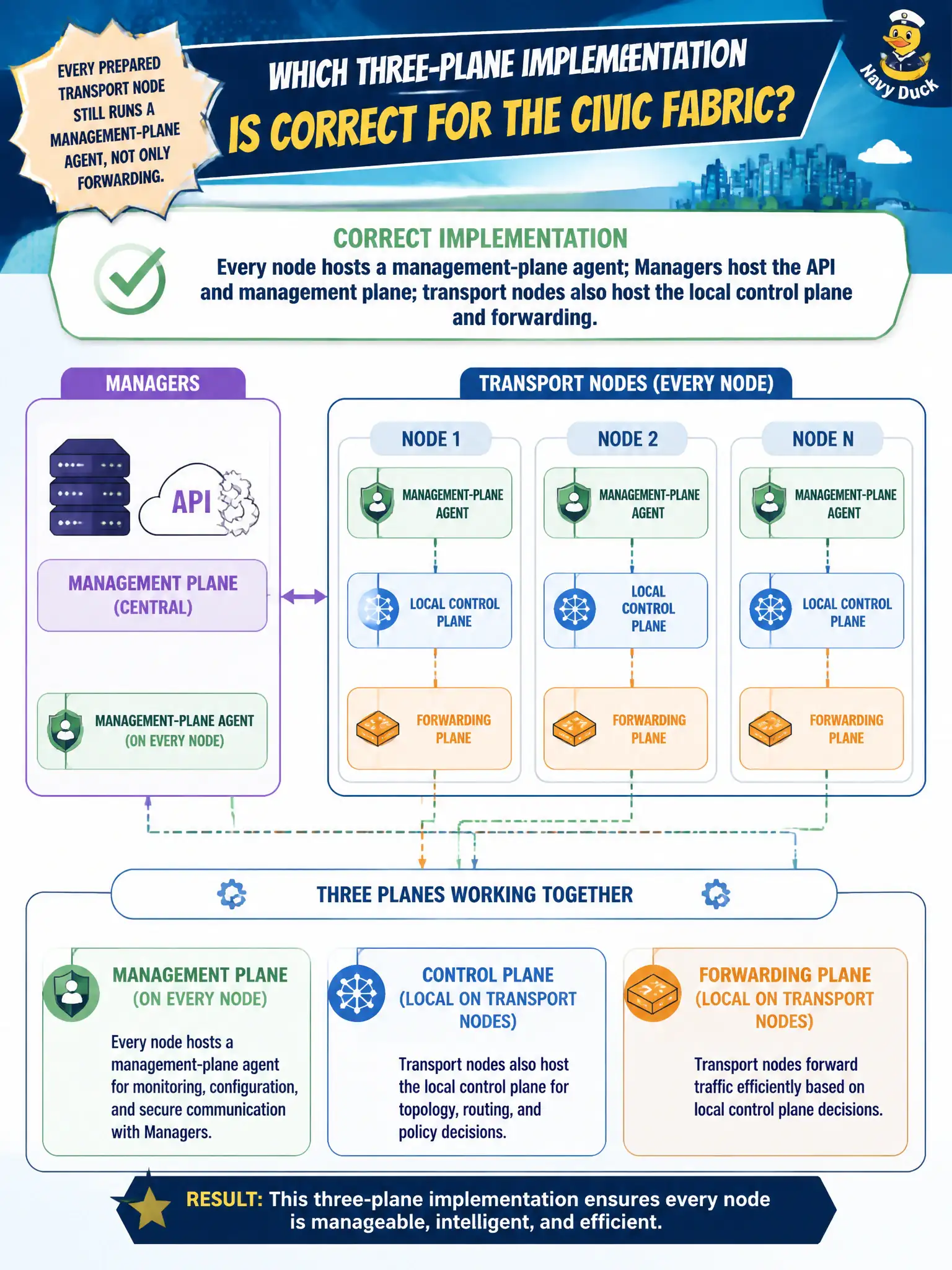
Every prepared transport node still runs a management-plane agent, not only forwarding. Which three-plane implementation is correct for the civic fabric?
Select an answer to reveal the explanation.
Short Explanation
NSX planes are processes, not just slide labels. Every prepared node keeps a management-plane agent; Managers hold the API; hosts also run local control and the forwarding engines. vCenter alone, Horizon agents, or sensors do not fill those jobs.
Full Explanation
On the civic fabric, NSX implements the three planes as real processes and agents: every transport node runs a management-plane agent; NSX Managers host the API and management-plane services (and central control); and transport nodes also host the local control plane plus forwarding engines. That distribution is the correct three-plane implementation, not a slide where only one appliance runs agents. Claiming only the vCenter appliance runs any NSX agent while prepared hosts forward with no local agents is false—transport nodes are active participants. Horizon agents replace neither management-plane nor control-plane components on ESXi for NSX. Carbon Black sensors are endpoint protection agents and are not the NSX management plane on transport nodes. Exam caveat: vCenter remains the compute manager; that role is complementary, not a substitute for NSX agents on transport nodes. Associate questions test where planes live, not deep agent troubleshooting trees. Operational check: on a prepared host, confirm NSX components/agents are present and connected; verify Manager API access for management-plane operations; induce a simple config change and confirm local control and forwarding update—without pointing at Horizon or Carbon Black agents as NSX plane evidence.