
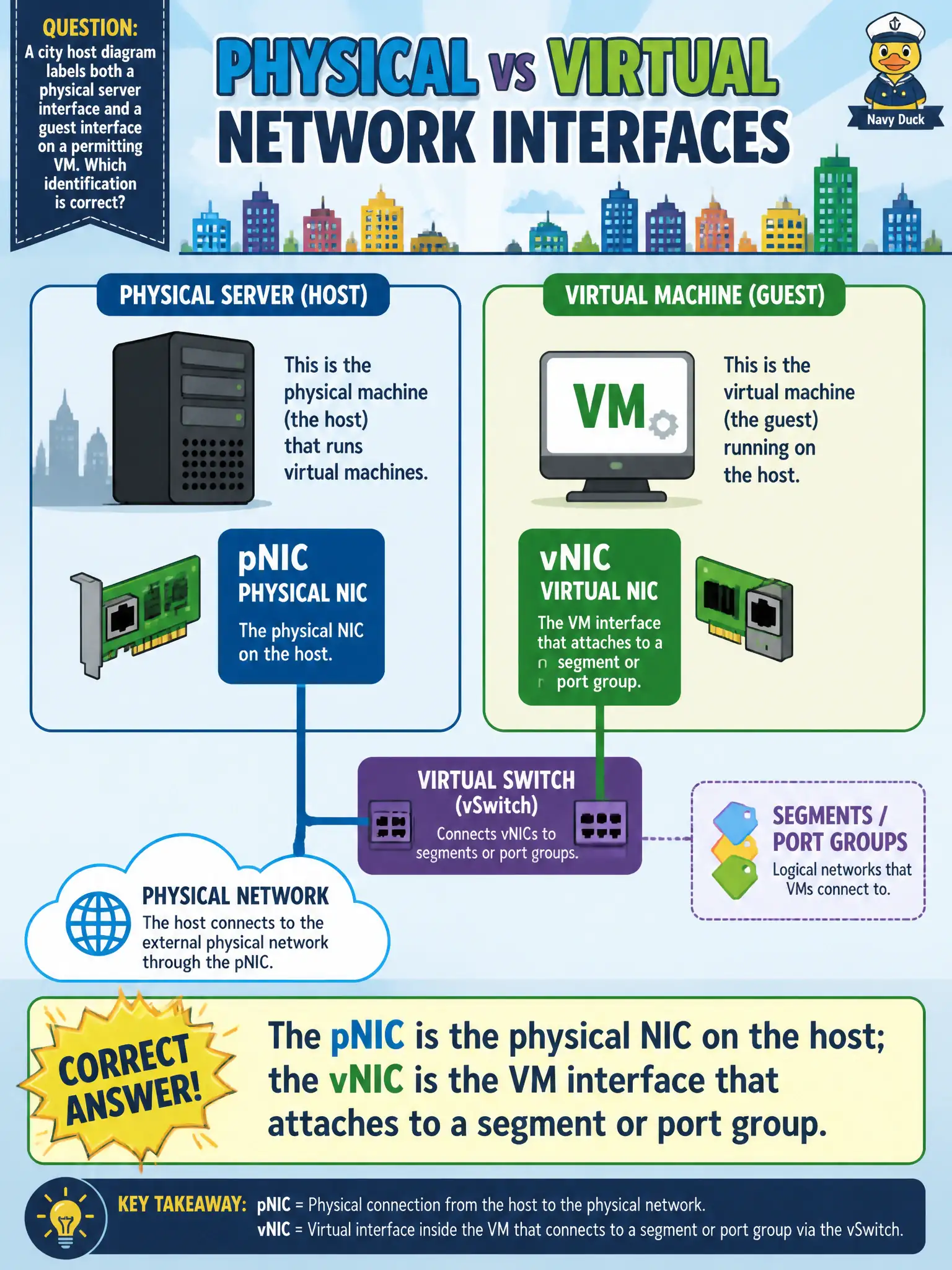
A city host diagram labels both a physical server interface and a guest interface on a permitting VM. Which identification is correct?
Select an answer to reveal the explanation.
Short Explanation
pNIC is the metal jack on the server; vNIC is the virtual jack inside the VM that plugs into a segment or port group. Do not swap those names, and do not rename them as Horizon clients or sensor ports.
Full Explanation
On a city host diagram that labels both a physical server interface and a guest interface on a permitting VM, the correct identification is that the pNIC is the physical NIC on the hypervisor host—typically used as an uplink into the host switch—while the vNIC is the virtual NIC inside the VM that attaches to a port group or an NSX segment port. Clear naming keeps underlay and guest troubleshooting on the right layer of the civic stack. Calling the pNIC the guest interface and the vNIC the top-of-rack switch port reverses the definitions and sends operators to the wrong console. Those names also do not mean Horizon client NICs on clerk laptops. The pNIC is not a Carbon Black sensor interface on the management cluster; sensor traffic may use networks, but it does not redefine pNIC versus vNIC. Exam caveat: uplink profiles and teaming apply to pNIC uplinks on transport nodes, whereas segment attachment and many Distributed Firewall views apply to vNICs. Mixing those layers causes people to “fix the guest NIC” when the underlay uplink is actually failed. Operational check: document one permitting host showing vmnic/pNIC uplinks on the VDS or N-VDS and a VM vNIC connected to a segment; fail a physical cable to observe uplink failover, then disconnect only the vNIC to drop just that guest—confirming the naming boundary in practice.