
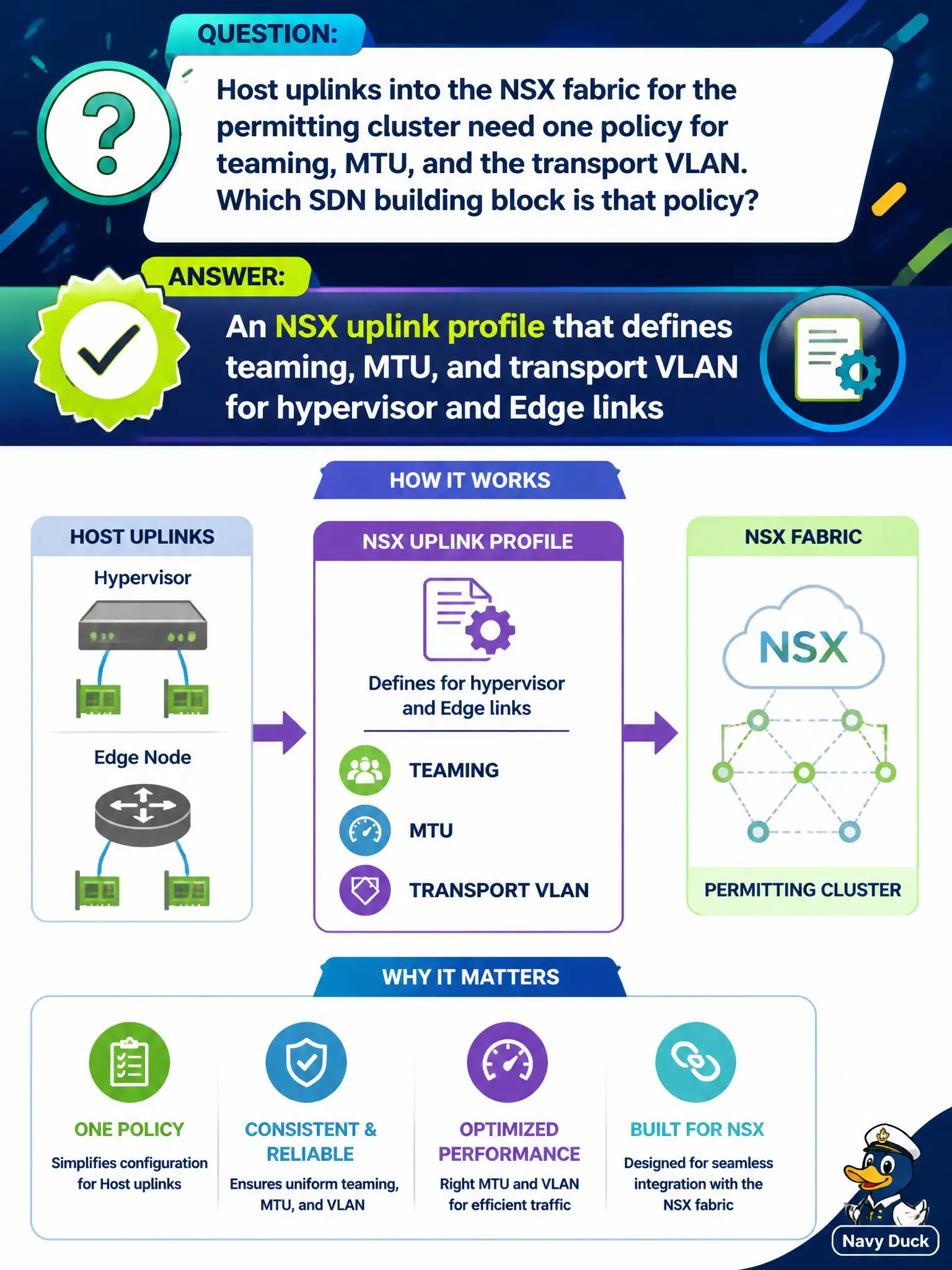
Host uplinks into the NSX fabric for the permitting cluster need one policy for teaming, MTU, and the transport VLAN. Which SDN building block is that policy?
Select an answer to reveal the explanation.
Short Explanation
The uplink profile is the fabric's dress code for the host's physical NICs: how they team, how large a frame they allow, and which VLAN carries TEPs. A vSphere host profile that only sets DNS is a different closet.
Full Explanation
Host uplinks into the NSX fabric for the permitting cluster need one reusable policy that defines how physical NICs team, what MTU they allow, and which VLAN carries tunnel endpoints. That policy is the NSX uplink profile, applied to hypervisor and Edge transport-node uplinks so TEPs join the underlay consistently across the civic cluster instead of being hand-tuned host by host. A vSphere host profile that only sets DNS and NTP configures ESXi identity and management settings; it is a different object and does not define NSX TEP teaming or the transport VLAN. A Workspace ONE UEM profile that pushes Wi-Fi settings to clerk laptops is endpoint management, not fabric uplink policy. A Carbon Black prevention policy that rate-limits endpoint behavior does not program NSX host uplinks or Geneve underlay parameters. Exam caveat: uplink profiles are consumed by transport-node or transport-node-profile configuration; editing teaming or MTU in the wrong profile can black-hole TEPs even when vSphere host profiles look fully compliant. Operational check: open the uplink profile used by permitting hosts, verify teaming, MTU (often jumbo for overlay), and transport VLAN; attach it through a consistent transport-node profile, then confirm TEP interfaces come up and Geneve connectivity works between hosts.