
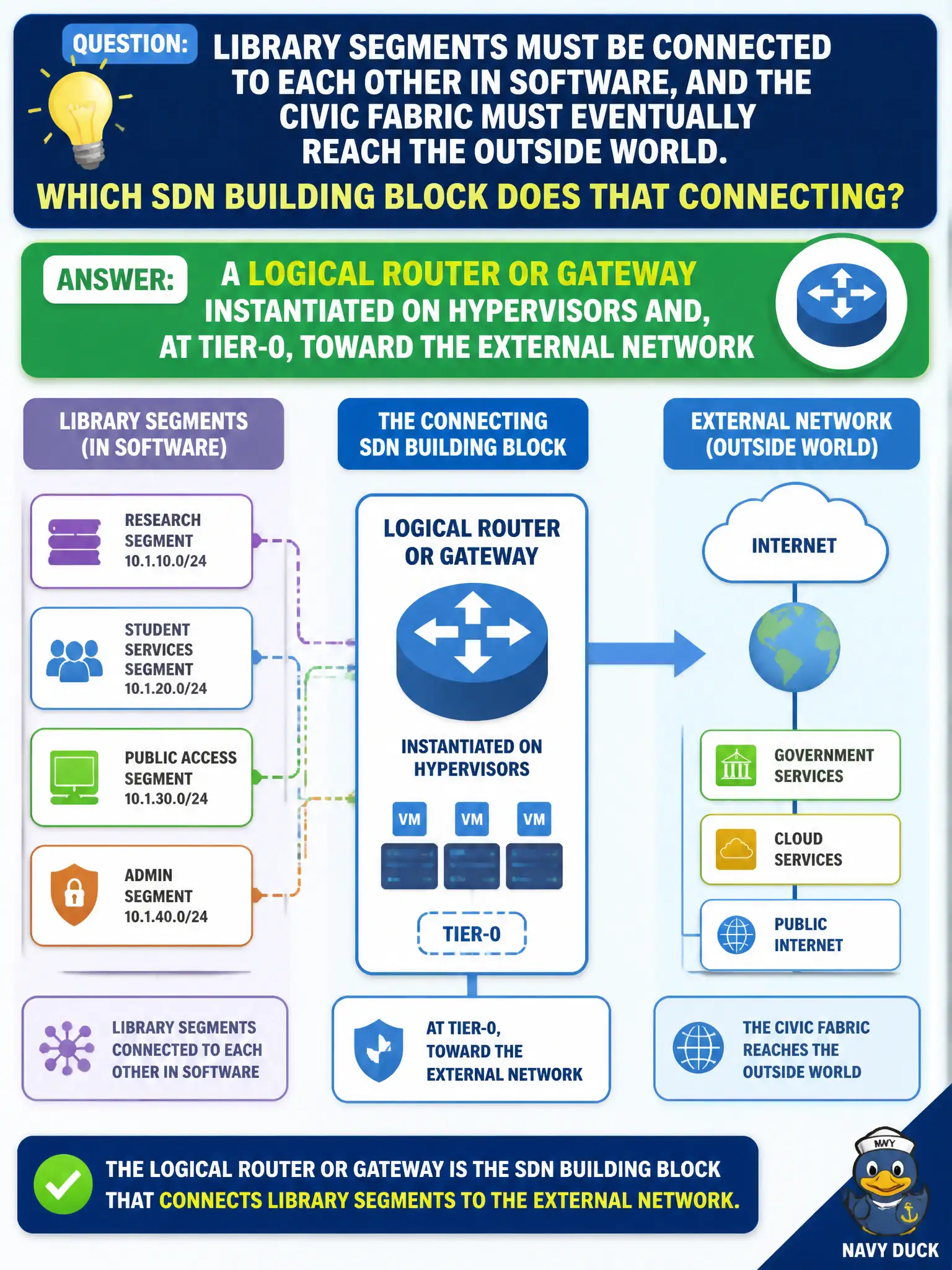
Library segments must be connected to each other in software, and the civic fabric must eventually reach the outside world. Which SDN building block does that connecting?
Select an answer to reveal the explanation.
Short Explanation
A logical router is the software intersection that joins virtual streets and, at Tier-0, the road out of town. A content library holds templates, and Horizon or Carbon Black will not route those library segments.
Full Explanation
Library segments that must interconnect in software—and eventually reach the outside world—use logical routers (gateways in Policy mode). Distributed routing instantiates on hypervisors for east-west hops, while the Tier-0 gateway provides the north-south handoff toward the external network, typically via Edge nodes. That logical router/gateway is the SDN building block that connects virtual Layer-2 networks and exits the civic fabric. A vSphere content library stores templates and ISOs; storing a router ISO does not instantiate an NSX gateway. A Horizon desktop pool may present desktops but does not bridge or route library segments in the client as the fabric router. A Carbon Black sensor group cannot route packets between NSX segments. Exam caveat: associate depth is identifying the logical router/gateway role and Tier-0’s external handoff, not designing full BGP policy. Tier-1 often fronts tenants while Tier-0 faces northbound; do not confuse those tiers with content libraries. Operational check: connect library segments to the appropriate Tier-1/Tier-0 topology, verify inter-segment routing and external reachability through the Edge, and confirm no content-library, Horizon, or Carbon Black object appears as the routing instance.