
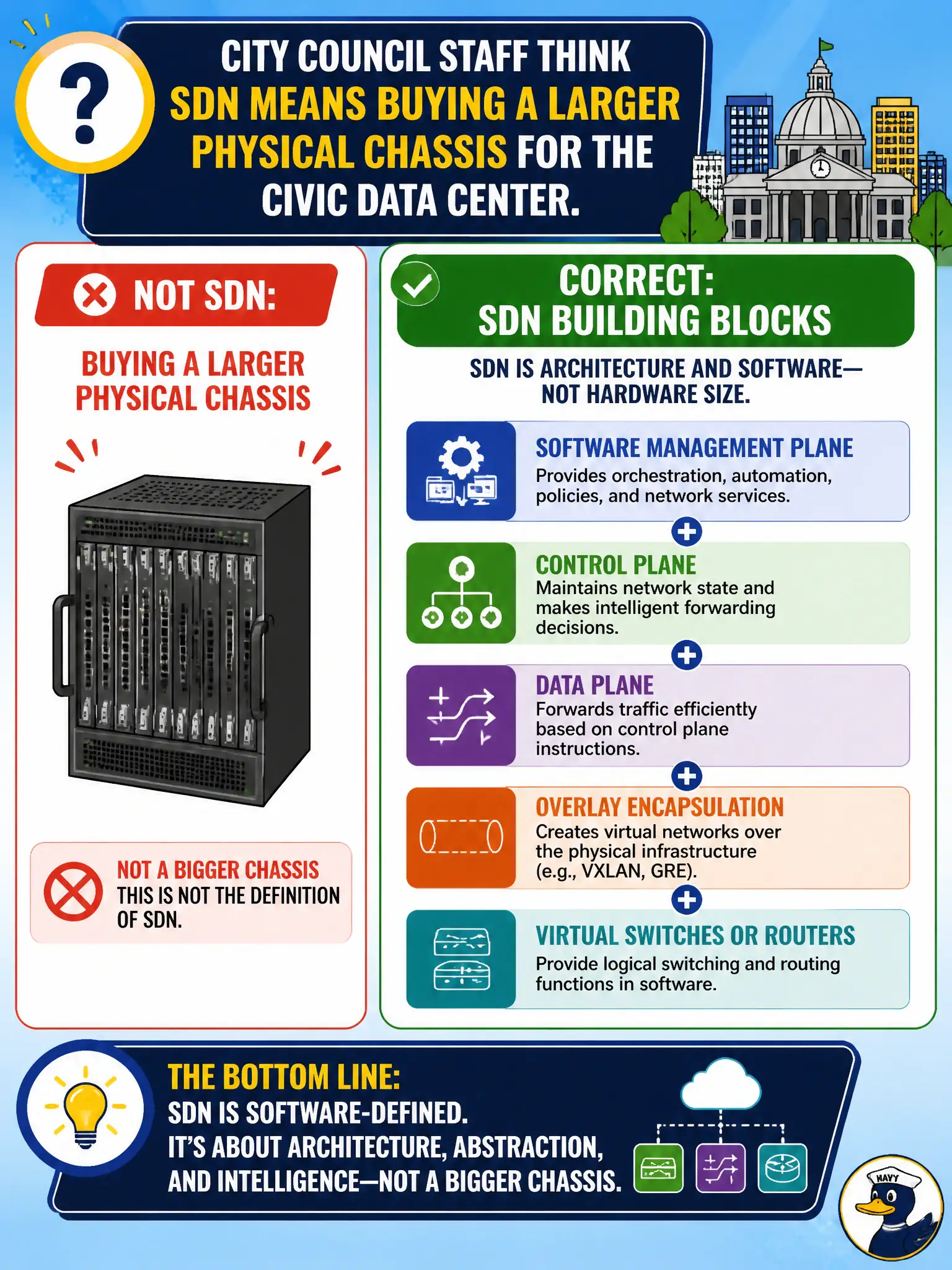
City council staff think SDN means buying a larger physical chassis for the civic data center. Which description of SDN building blocks is correct?
Select an answer to reveal the explanation.
Short Explanation
SDN is software brains and overlay tunnels, not a fatter metal box. A bigger chassis can still be a traditional switch; Horizon blades and sensor appliances do not magically become SDN building blocks.
Full Explanation
City council staff who equate SDN with buying a larger physical chassis misunderstand the definition. SDN building blocks are software management, control, and data planes plus overlay encapsulation and virtual switches or routers programmed from desired state. A fatter metal box can still be a traditional switch; size is not what makes networking software-defined for the civic data center. A 16-slot modular switch whose extra line cards are labeled “the SDN control plane” is still hardware-centric networking if desired state remains per-device CLI. Placing Horizon Cloud on a denser blade chassis addresses EUC density, not NSX planes. Relocating Carbon Black onto a larger sensor appliance changes endpoint capacity, not overlay or logical routing. Exam caveat: physical underlay upgrades can still help (bandwidth, MTU, redundancy), but they are not the definition of SDN. Exam answers should emphasize planes, overlay, and programmable virtual networking. Operational check: map the city’s NSX Manager, control services, transport-node data plane, and overlay segments in architecture docs; show council that those software objects—not chassis slot count—deliver the SDN outcomes, and keep hardware refresh tracked as underlay capacity rather than as “buying SDN.”