
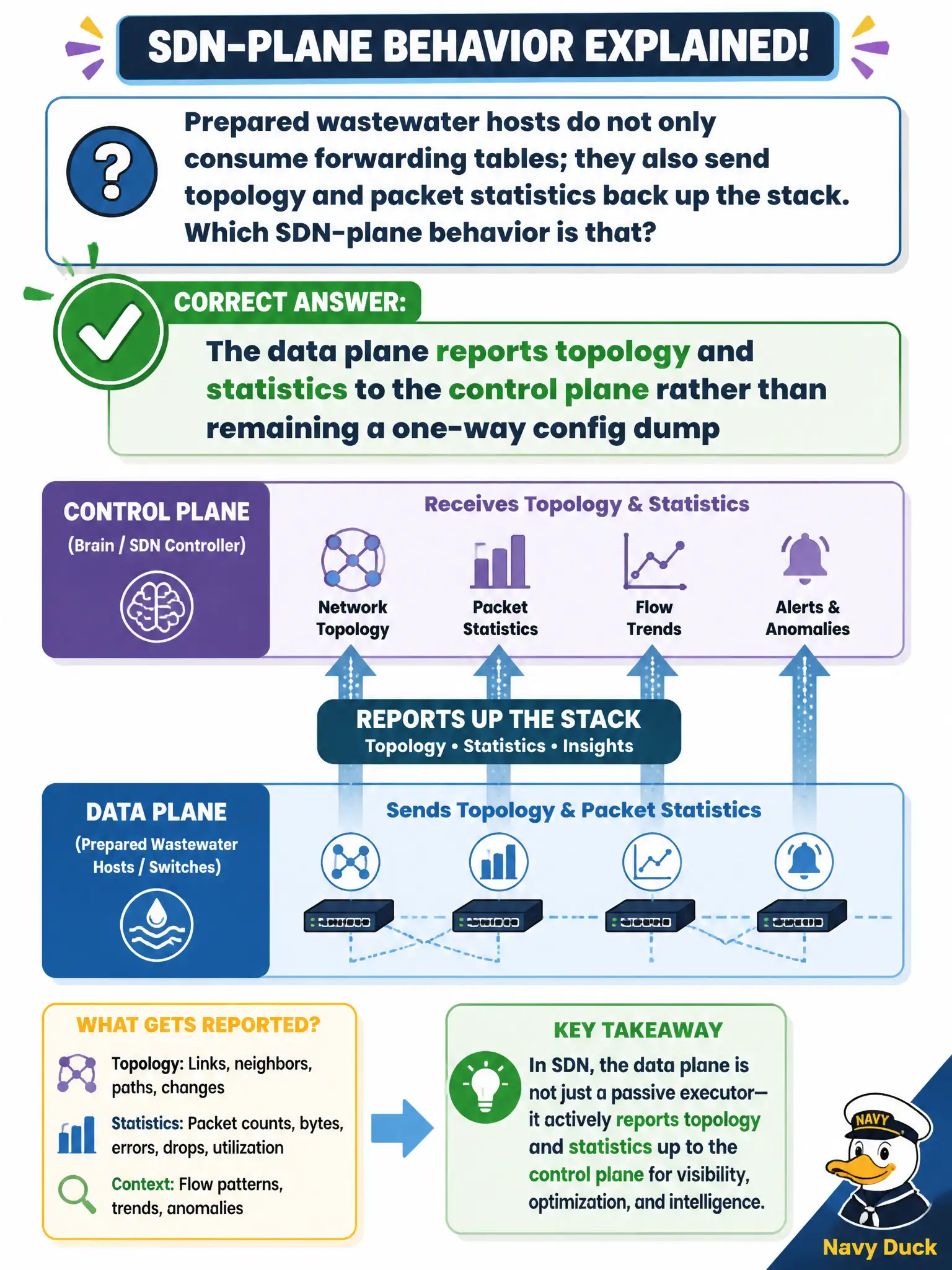
Prepared wastewater hosts do not only consume forwarding tables; they also send topology and packet statistics back up the stack. Which SDN-plane behavior is that?
Select an answer to reveal the explanation.
Short Explanation
The data plane is not a mailbox that only receives letters. Hosts also send topology and counters back upstairs to control—so the split is a conversation, not a one-way dump.
Full Explanation
Prepared wastewater hosts do more than receive forwarding tables: the data plane reports topology and packet statistics back up to the control plane. That two-way SDN-plane behavior means civic operators get operational state—not a one-way configuration dump—so controllers can reconcile desired versus realized fabric conditions. vCenter dumping VMX files into NSX Manager is not the NSX data-plane telemetry path. Horizon logging BLAST session statistics into transport zones confuses EUC metrics with fabric plane reporting. Carbon Black sensors pushing detections may create security incidents, but those detections do not create overlay segments and are not the NSX data-plane statistics channel. Exam caveat: plane theory questions often contrast unidirectional myths with the real bidirectional split. You are not asked to parse every counter; you must know reporting flows upward while programming flows downward. Operational check: in NSX monitoring or transport-node status, confirm hosts report status, tunnels, and statistics after load is applied; correlate a known traffic test with rising counters, and do not use Horizon BLAST logs or Carbon Black detections as proof of NSX data-plane health.