
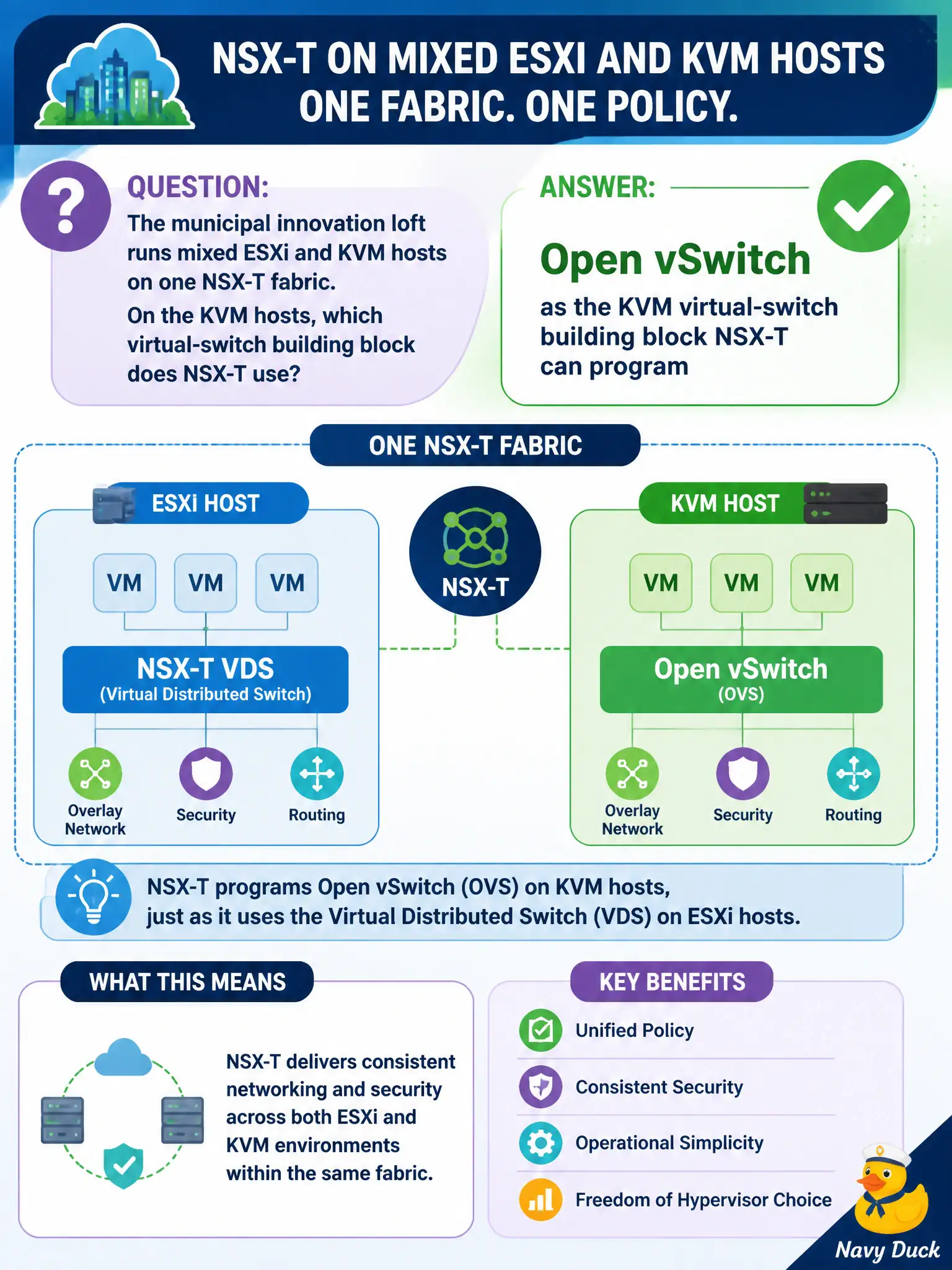
The municipal innovation loft runs mixed ESXi and KVM hosts on one NSX-T fabric. On the KVM hosts, which virtual-switch building block does NSX-T use?
Select an answer to reveal the explanation.
Short Explanation
NSX-T is the multi-hypervisor product: ESXi gets an N-VDS or prepared VDS, and KVM gets Open vSwitch. A vSphere standard switch does not move to KVM, and Instant Clone or a sensor is not that switch.
Full Explanation
When the municipal innovation loft runs mixed ESXi and KVM hosts on one NSX-T fabric, the KVM virtual-switch building block that NSX-T programs is Open vSwitch (OVS). NSX-T is the multi-hypervisor network-virtualization product for this exam era: ESXi uses an N-VDS or an NSX-prepared VDS, while KVM uses OVS as the programmable host switch that carries overlay and NSX VLAN traffic for loft workloads. A vSphere Standard Switch cannot be imported onto KVM as the NSX data plane; it exists only as an ESXi construct and is a reminder that NSX-T is broader than older ESXi-only patterns. Horizon Instant Clone is a desktop-provisioning feature and is not a KVM host switch. A Carbon Black sensor provides endpoint protection and does not become the hypervisor virtual switch that forwards overlay frames on KVM. Exam caveat: associate questions may test that NSX-T supports multiple hypervisors. OVS alone without proper NSX transport-node preparation is incomplete; the host must still be onboarded to the fabric. Operational check: verify KVM hosts appear as NSX transport nodes with OVS-based host switching, attach a test workload to an overlay segment on KVM, and confirm connectivity to an ESXi-hosted peer on the same segment while standard-switch or Instant Clone objects are absent from that data path.