
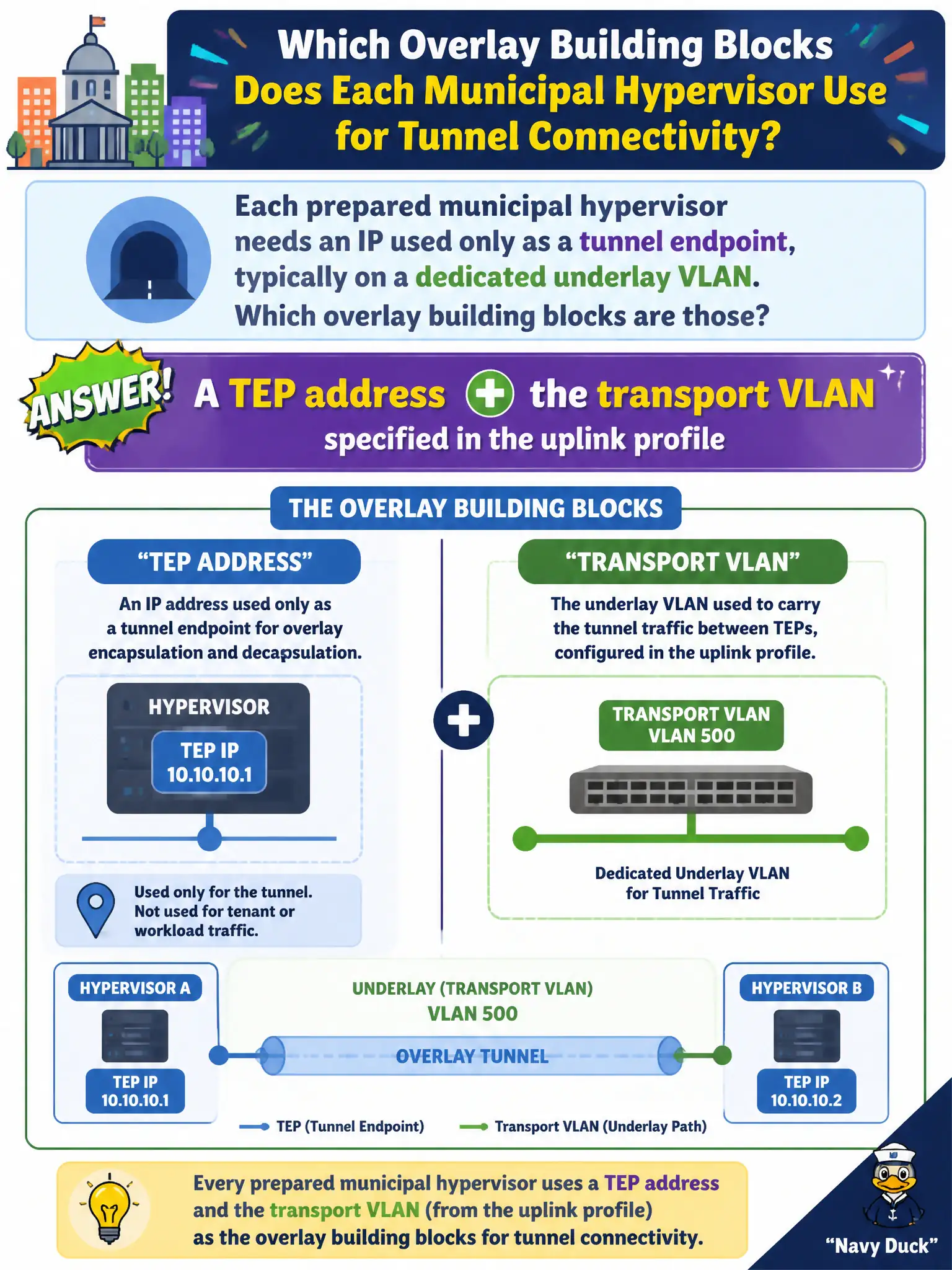
Each prepared municipal hypervisor needs an IP used only as a tunnel endpoint, typically on a dedicated underlay VLAN. Which overlay building blocks are those?
Select an answer to reveal the explanation.
Short Explanation
Geneve needs a mailbox on each host—the TEP IP—and a dedicated underlay street, usually a transport VLAN in the uplink profile. Guest IPs, witness IPs, and API keys are not those tunnel endpoints.
Full Explanation
Each prepared municipal hypervisor needs underlay addressing used only as a tunnel endpoint so Geneve packets can travel host to host across the civic data center. The overlay building blocks are a TEP address on the transport node plus the transport VLAN (or equivalent underlay connectivity) specified in the uplink profile. Guest application addresses live on segments; TEPs are the underlay mailboxes that carry encapsulation between prepared hosts and Edges. A guest vNIC address plus a Horizon Unified Access Gateway VIP serves application or EUC access paths and does not define host TEPs. A vSAN witness IP and an iSCSI target VLAN belong to storage design, not NSX overlay tunnel endpoints. A Carbon Black Cloud API key and sensor check-in URL are endpoint-security credentials and never substitute for Geneve TEPs on the host switch. Exam caveat: TEP subnets must be reachable between transport nodes with sufficient MTU; do not confuse segment CIDRs assigned to VMs with TEP addressing on the host switch. Uplink-profile mistakes commonly break TEPs even when guest IPs look fine. Operational check: inspect transport-node status for assigned TEP IPs, confirm the uplink profile’s transport VLAN matches the underlay switches, and verify TEP-to-TEP reachability across hosts while confirming guest IPs remain on segments rather than on the TEP network.