
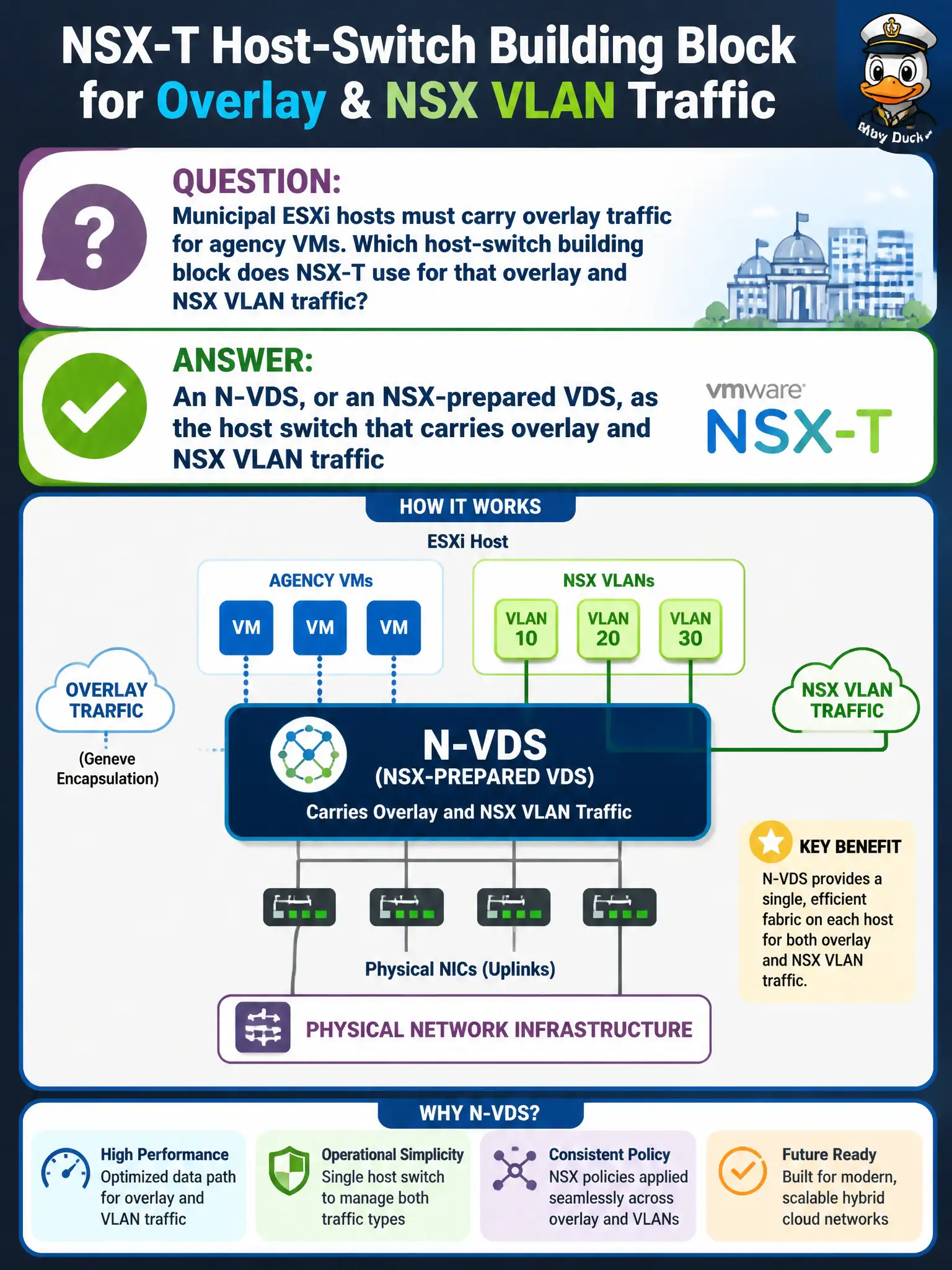
Municipal ESXi hosts must carry overlay traffic for agency VMs. Which host-switch building block does NSX-T use for that overlay and NSX VLAN traffic?
Select an answer to reveal the explanation.
Short Explanation
Overlay frames need an NSX-aware switch on the host—either the N-VDS or a VDS that NSX has prepared. A leftover standard switch, a Horizon gateway, or a sensor filter is not that host switch.
Full Explanation
Municipal ESXi hosts carry NSX overlay and NSX VLAN-backed traffic on an NSX-aware host switch: historically the N-VDS, and in the vSphere 7 / NSX-T 3.x exam era an NSX-prepared VDS can serve the same role. That host-switch building block is where Geneve TEPs and NSX VLAN segments attach on the hypervisor so agency VMs can use the civic fabric. A standalone vSphere Standard Switch that was never prepared for NSX remains host-local vSphere networking and does not become the NSX overlay host switch. A Horizon Unified Access Gateway terminates secure EUC access with protocols such as BLAST; it is not Geneve encapsulation on the hypervisor data plane. A Carbon Black sensor network filter is endpoint protection and does not replace the hypervisor virtual switch NSX programs. Exam caveat: you must recognize both N-VDS and NSX-prepared VDS as valid host-switch answers for this exam generation; do not insist that only a legacy N-VDS name is correct when the prepared VDS path is in scope. Operational check: on a prepared host, verify the NSX host switch (N-VDS or prepared VDS) shows TEP interfaces and expected uplinks; place a test VM on an overlay segment and confirm Geneve traffic between TEPs, while an unprepared standard switch cannot host that overlay attachment.