
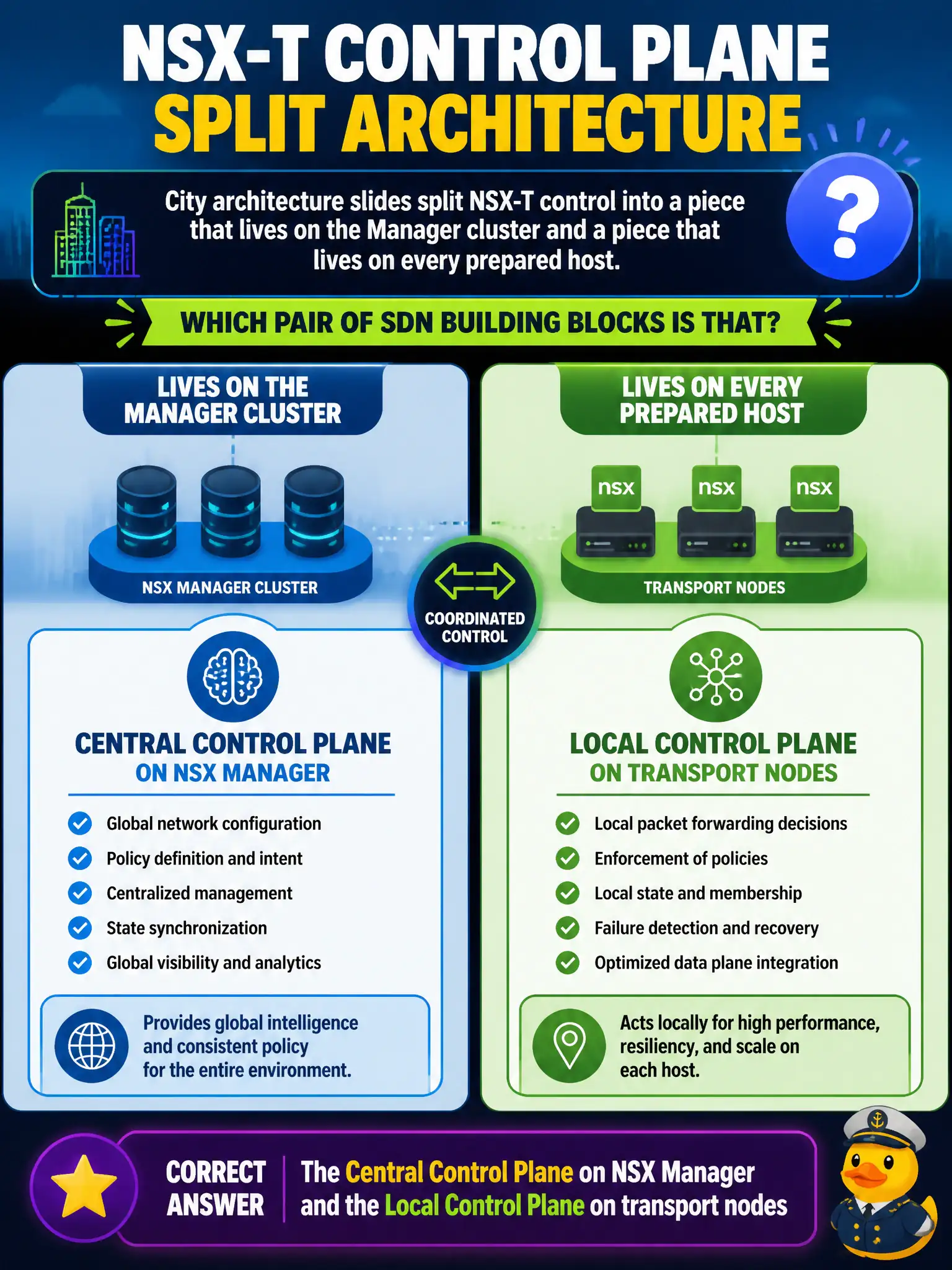
City architecture slides split NSX-T control into a piece that lives on the Manager cluster and a piece that lives on every prepared host. Which pair of SDN building blocks is that?
Select an answer to reveal the explanation.
Short Explanation
NSX control is a two-story building: the brain sits on the Manager cluster, and a local clerk sits on every prepared host. That is CCP plus LCP—not vCenter HA, not Workspace ONE, and not a sensor talking to a cloud console.
Full Explanation
City architecture correctly splits NSX-T control into a Central Control Plane that lives on the NSX Manager cluster and a Local Control Plane that runs on every prepared transport node. The CCP computes runtime state from desired configuration; the LCP on each host or Edge programs that node’s forwarding engines. That two-part control plane is the SDN building-block pair the slides are naming for the civic fabric. vCenter HA primary and secondary roles protect vCenter availability; they do not replace NSX control and do not push Geneve forwarding tables. Workspace ONE Access connectors and UEM device services enroll and authenticate endpoints; they do not program overlay tunnels. The Carbon Black Cloud console and endpoint sensors compute threat detections, not NSX overlay forwarding state. Exam caveat: associate-level questions expect you to identify CCP versus LCP placement, not to design CCP cluster sizing or protocol internals. Management-plane agents on transport nodes are related but are not the same label as the control-plane pair asked here. Operational check: in NSX Manager, verify Manager cluster health for central control services and confirm transport nodes show connected local control-plane agents; after a policy change, validate that host forwarding state updates without mistaking a vCenter HA event for NSX control recovery.