
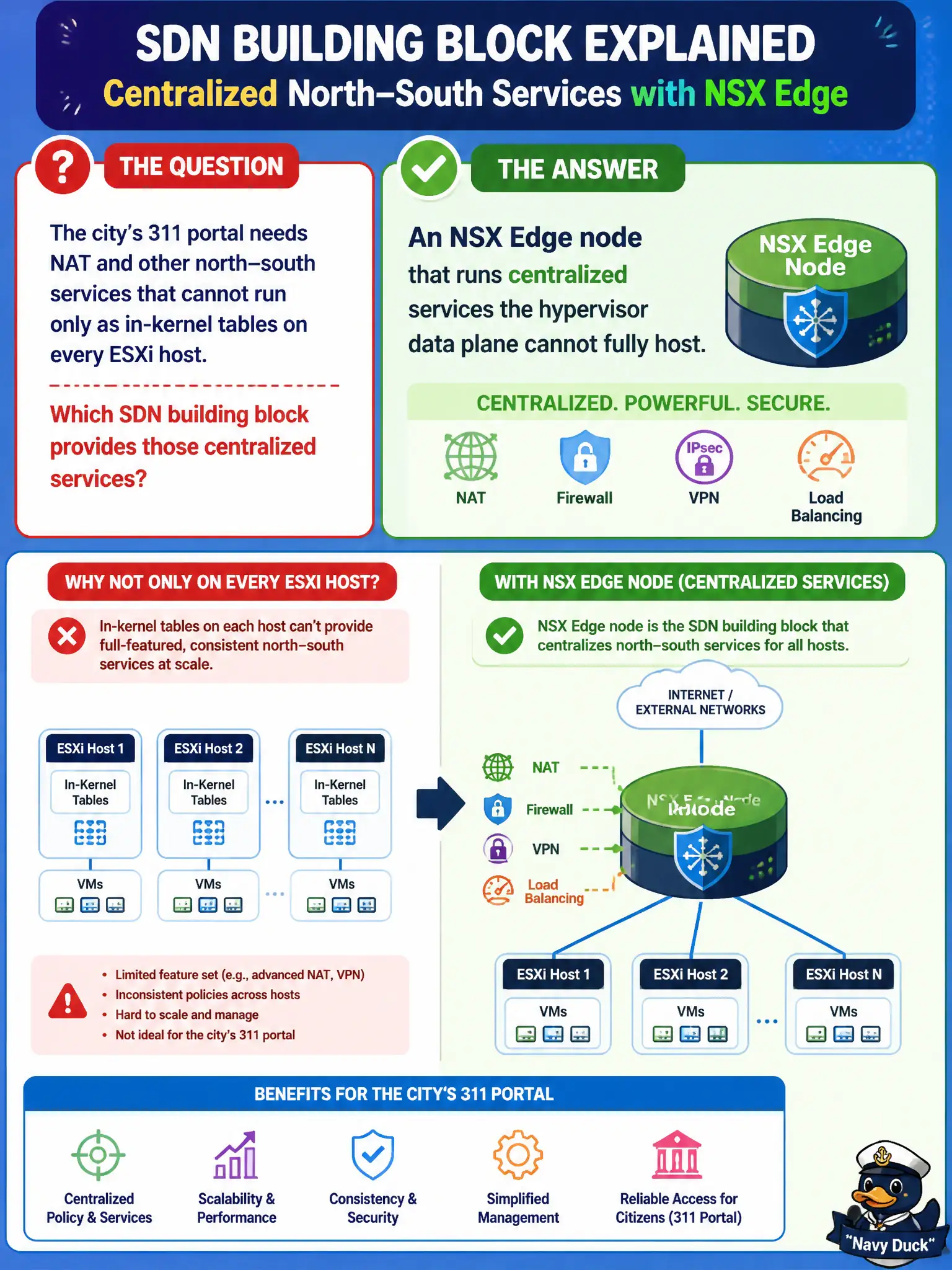
The city's 311 portal needs NAT and other north-south services that cannot run only as in-kernel tables on every ESXi host. Which SDN building block provides those centralized services?
Select an answer to reveal the explanation.
Short Explanation
Some jobs stay in the kernel on every host—switching and distributed firewalling. NAT and several north-south services need a dedicated appliance, and that appliance is the NSX Edge node, not a disk group or a VDI broker.
Full Explanation
The city’s 311 portal needs NAT and other north-south services that cannot run solely as in-kernel tables on every ESXi host. Those centralized services run on NSX Edge nodes—service appliances that host functions such as NAT, VPN, load balancing, and the Tier-0/Tier-1 services that face the physical network. The Edge is the SDN building block that fills the gap between fully distributed data-plane features and services that require a dedicated appliance form factor. A distributed firewall section at each 311 vNIC enforces east-west allow or deny decisions; it is not a NAT engine. A vSAN disk group stores virtual disks and has no role as a network services appliance. A Horizon Connection Server brokers virtual desktops and published apps; it does not provide NSX north-south NAT for the 311 portal. Exam caveat: distinguish distributed services (switching, routing on hosts, Distributed Firewall) from centralized Edge services. Associating every firewall need with an Edge is a common trap; DFW remains in-kernel even when NAT needs an Edge. Operational check: place Edge nodes in an Edge cluster, attach the Tier-0 or Tier-1 that owns the 311 NAT, verify the NAT rule hits on the Edge, and confirm return traffic from the external network reaches the portal VMs while DFW policy continues to protect east-west paths separately.