
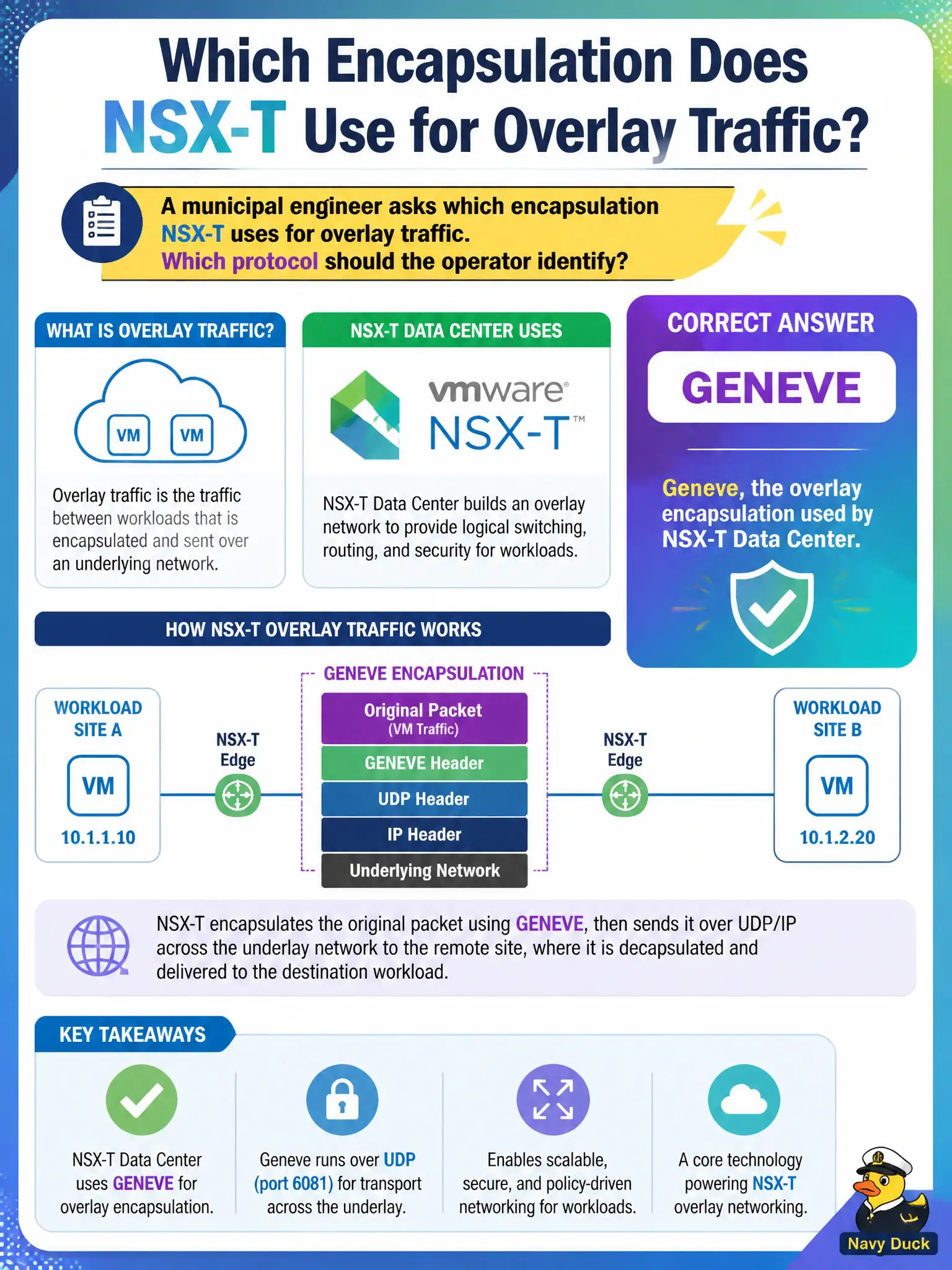
A municipal engineer asks which encapsulation NSX-T uses for overlay traffic. Which protocol should the operator identify?
Select an answer to reveal the explanation.
Short Explanation
NSX-T wraps guest frames in Geneve, not in the old NSX-V VXLAN envelope. Think of Geneve as the labeled mailer the civic hosts use between tunnel endpoints. Horizon GRE and IPsec VPN are different tunnels, not the NSX-T overlay building block.
Full Explanation
NSX-T Data Center uses Geneve as its overlay encapsulation. A municipal engineer should identify Geneve rather than assuming NSX-T reuses NSX-V VXLAN as the host overlay header. GRE from Horizon Unified Access Gateway is unrelated. IPsec site-to-site is not the only—or primary—NSX-T overlay between ESXi hosts for local fabric traffic. Exam caveat: VXLAN knowledge from NSX-V eras is a common distractor; NSX-T overlay is Geneve, and underlay MTU must account for Geneve overhead. Operational check: confirm transport-node tunnel interfaces show Geneve and validate underlay MTU is raised appropriately for civic overlays. Keep municipal naming and change tickets aligned with the software objects so civic audits can trace intent. Prefer verifying with a non-production agency workload before promoting the same pattern to life-safety systems. Record realization state and underlay health in the runbook used by on-call city operators. Keep municipal naming and change tickets aligned with the software objects so civic audits can trace intent. Prefer verifying with a non-production agency workload before promoting the same pattern to life-safety systems. Record realization state and underlay health in the runbook used by on-call city operators.