
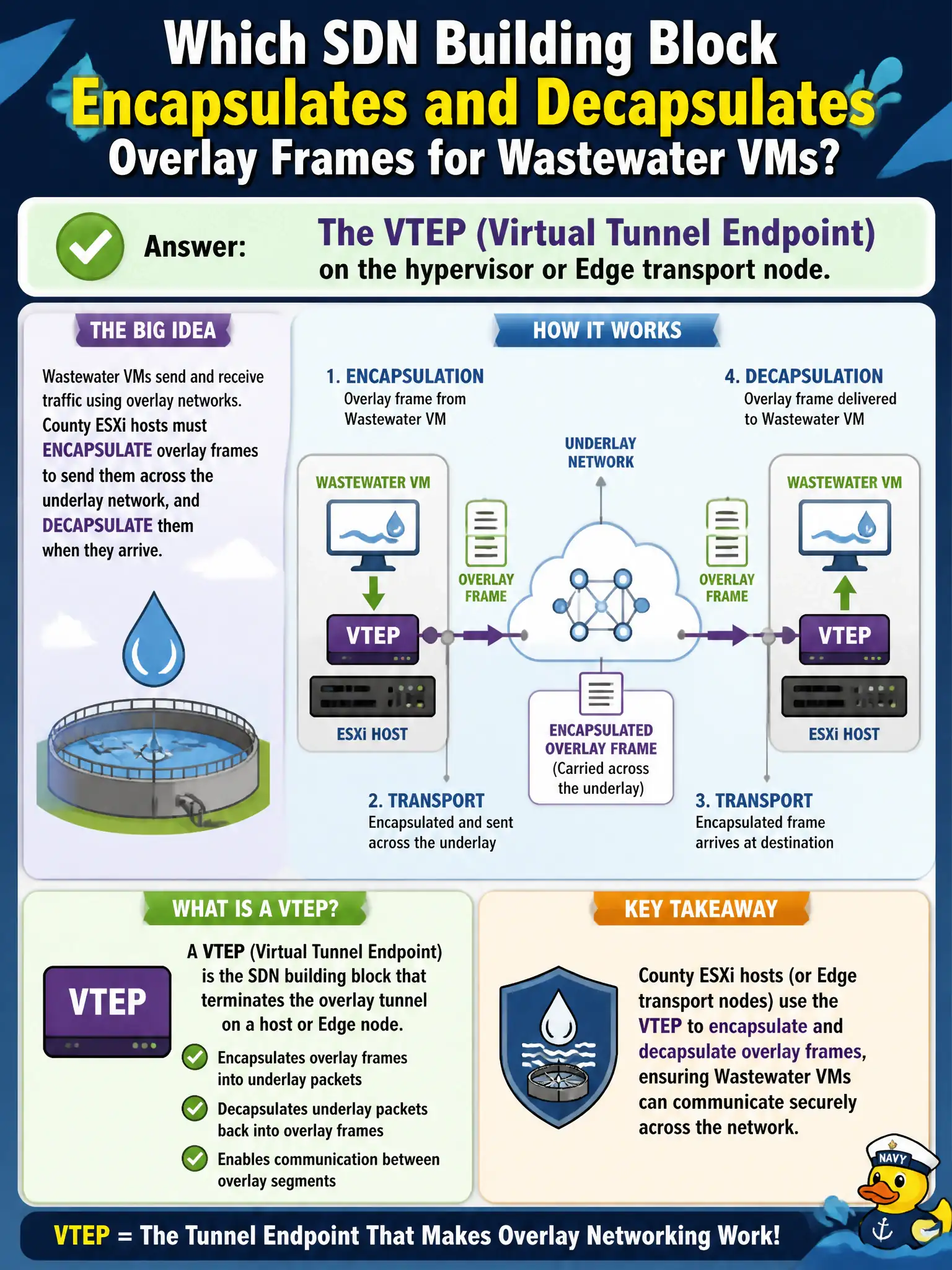
County ESXi hosts must encapsulate and decapsulate overlay frames for wastewater VMs. Which SDN building block performs that function?
Select an answer to reveal the explanation.
Short Explanation
A VTEP is the tunnel mouth on the host or Edge—it wraps and unwraps overlay packets for the wastewater VMs. vCenter and Workspace ONE do not sit in that packet path, and the ToR is not the Geneve stamper. Think of it as the civic loading dock where cargo is boxed for the underlay trip.
Full Explanation
The VTEP (Virtual Tunnel Endpoint) on the hypervisor or Edge transport node encapsulates and decapsulates overlay frames for wastewater VMs. County ESXi hosts participate in overlay networking through those VTEPs, not through the vCenter management interface encapsulating guest frames. A Workspace ONE UEM enrollment token is not an encapsulation endpoint. The physical ToR spanning-tree root does not stamp Geneve headers for NSX-T. Exam caveat: VTEP IP reachability and MTU are foundational; many "overlay down" incidents are underlay VTEP problems. Operational check: list VTEP IPs on wastewater transport nodes and verify pairwise connectivity before blaming segment configuration. Keep municipal naming and change tickets aligned with the software objects so civic audits can trace intent. Prefer verifying with a non-production agency workload before promoting the same pattern to life-safety systems. Record realization state and underlay health in the runbook used by on-call city operators. Keep municipal naming and change tickets aligned with the software objects so civic audits can trace intent. Prefer verifying with a non-production agency workload before promoting the same pattern to life-safety systems.