
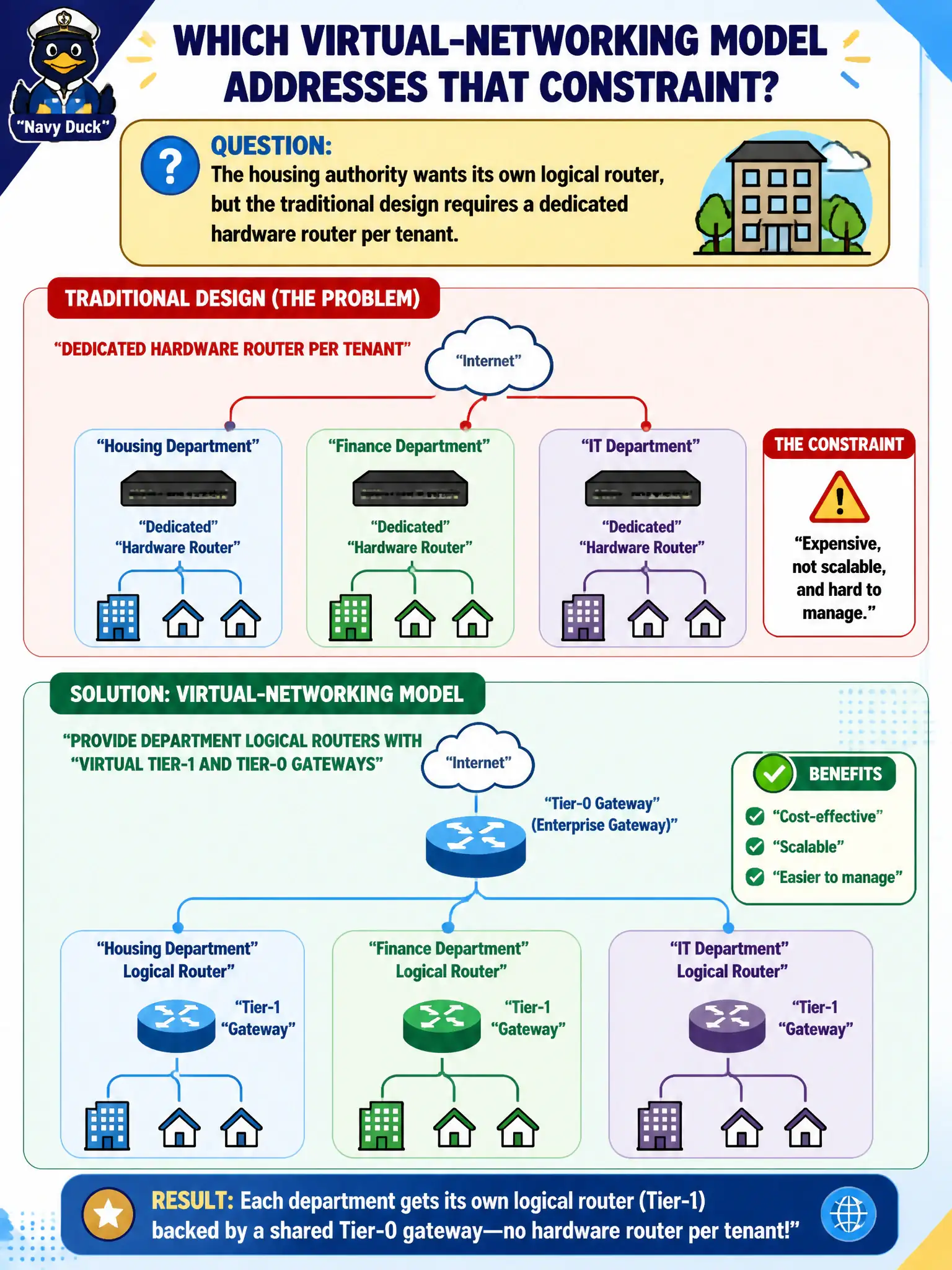
The housing authority wants its own logical router, but the traditional design requires a dedicated hardware router per tenant. Which virtual-networking model addresses that constraint?
Select an answer to reveal the explanation.
Short Explanation
A hardware router per department is like buying each housing office its own street intersection. Tier-1 and Tier-0 gateways give the authority a logical router on shared fabric. A port group or a borrowed core VLAN is still not that tenant router.
Full Explanation
Department logical routers with virtual Tier-1 and Tier-0 gateways provide the housing authority its own logical router without a dedicated hardware router per tenant. NSX multi-tenancy patterns give each department routing instantiation as software. Installing a physical router in every department closet recreates hardware sprawl. Sharing one VLAN interface on the core and calling it a tenant router lacks true tenant routing separation. Using only vSphere Standard Switch port groups does not provide tenant logical routers. Exam caveat: Tier-0/Tier-1 design, route advertisement, and VRF-like isolation still need architecture standards. Operational check: deploy a housing-authority Tier-1 connected to a shared Tier-0 and verify department routing isolation without a new hardware router. Keep municipal naming and change tickets aligned with the software objects so civic audits can trace intent. Prefer verifying with a non-production agency workload before promoting the same pattern to life-safety systems. Record realization state and underlay health in the runbook used by on-call city operators. Keep municipal naming and change tickets aligned with the software objects so civic audits can trace intent.