
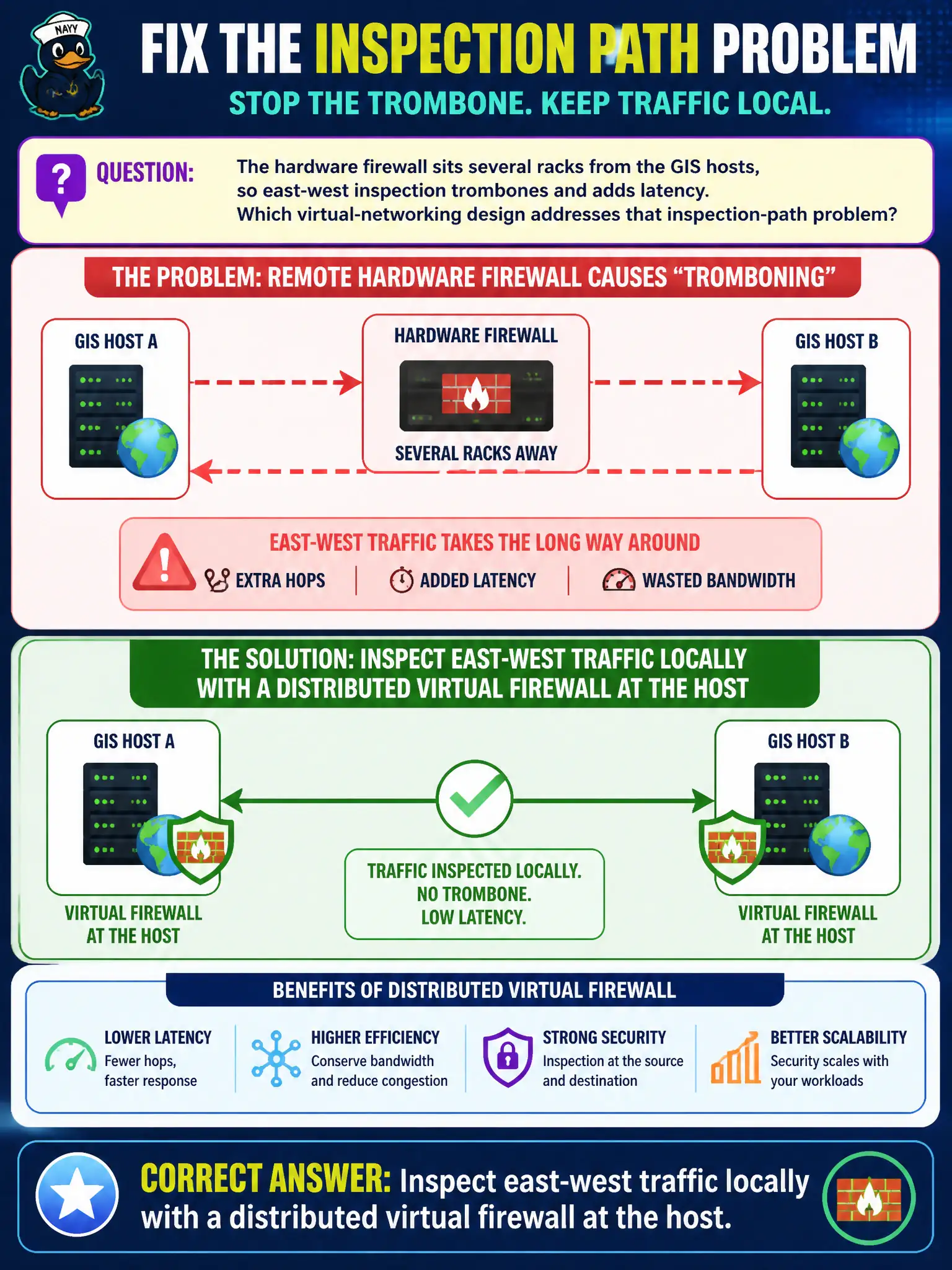
The hardware firewall sits several racks from the GIS hosts, so east-west inspection trombones and adds latency. Which virtual-networking design addresses that inspection-path problem?
Select an answer to reveal the explanation.
Short Explanation
Hairpinning GIS traffic to a far-away firewall is like sending every hallway conversation out to the parking-lot booth. A distributed firewall reads those packets on the host, so the trip is local. A fatter WAN or Horizon Cloud does not shorten that trombone.
Full Explanation
Inspecting east-west traffic locally with a distributed virtual firewall at the host addresses latency from tromboning GIS traffic to a hardware firewall several racks away. Moving the hardware firewall closer while still hairpinning every VM-to-VM packet preserves the bad path. Increasing a WAN circuit does not fix rack-local trombone delay. Routing GIS east-west through Horizon Cloud is not the inspection design. Exam caveat: some flows still need gateway services; local DFW targets host-local and fabric-local east-west. Operational check: compare RTT for GIS east-west probes with DFW local enforcement versus forced hairpin to the remote firewall. Keep municipal naming and change tickets aligned with the software objects so civic audits can trace intent. Prefer verifying with a non-production agency workload before promoting the same pattern to life-safety systems. Record realization state and underlay health in the runbook used by on-call city operators. Keep municipal naming and change tickets aligned with the software objects so civic audits can trace intent. Prefer verifying with a non-production agency workload before promoting the same pattern to life-safety systems. Record realization state and underlay health in the runbook used by on-call city operators.