
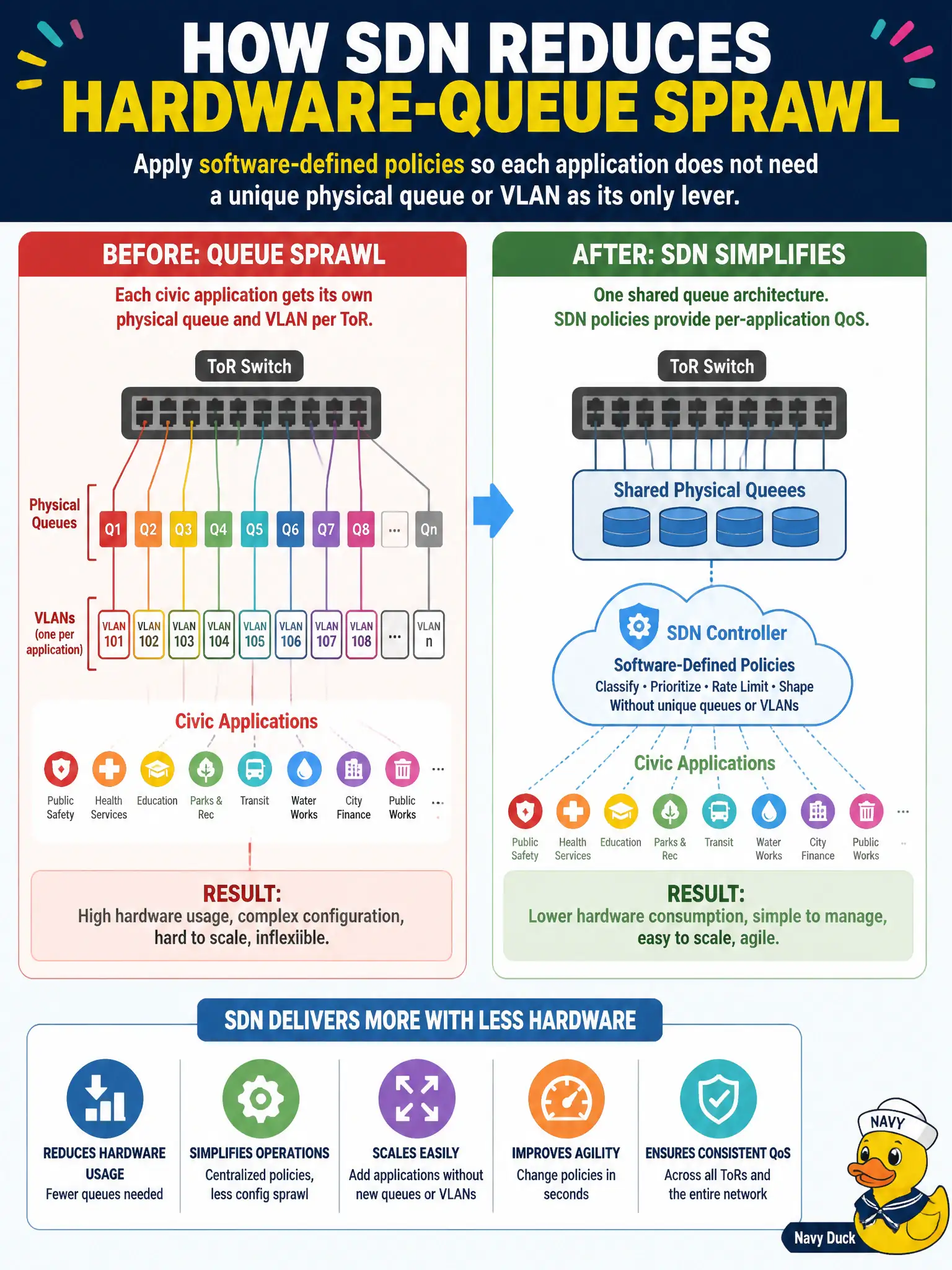
A vendor asked the library for a unique physical QoS queue on every ToR for each civic application. How does software-defined networking reduce that hardware-queue sprawl?
Select an answer to reveal the explanation.
Short Explanation
A unique ToR queue per library app is like a reserved checkout lane for every book title. Software policy classifies and treats those apps without carving a hardware lane on every switch. Horizon protocol profiles and per-vNIC queues just grow the sprawl.
Full Explanation
Software-defined policies reduce hardware-queue sprawl so each civic application does not need a unique physical QoS queue or VLAN as its only lever. Library vendors asking for a unique ToR queue per app are describing the traditional classification explosion SDN avoids by applying policy closer to workloads and simplifying underlay markings. Creating one hardware queue per VM vNIC on every ToR is not an NSX-T requirement. Mapping each app to a Horizon desktop protocol profile does not solve data-center queue sprawl. Disabling overlay encapsulation so ToRs classify inner MACs directly reintroduces scale and coupling problems. Exam caveat: underlay QoS may still exist for outer tunnel traffic classes; the win is not proliferating per-app physical queues. Operational check: classify two library apps with NSX/policy constructs and confirm the ToR QoS map stays coarse rather than one-queue-per-app. Keep municipal naming and change tickets aligned with the software objects so civic audits can trace intent. Prefer verifying with a non-production agency workload before promoting the same pattern to life-safety systems. Record realization state and underlay health in the runbook used by on-call city operators.