
Public-works staff assume an NSX-T overlay removes the need for a physical IP fabric. What does virtual networking actually solve versus what the underlay must still provide?
Select an answer to reveal the explanation.
Short Explanation
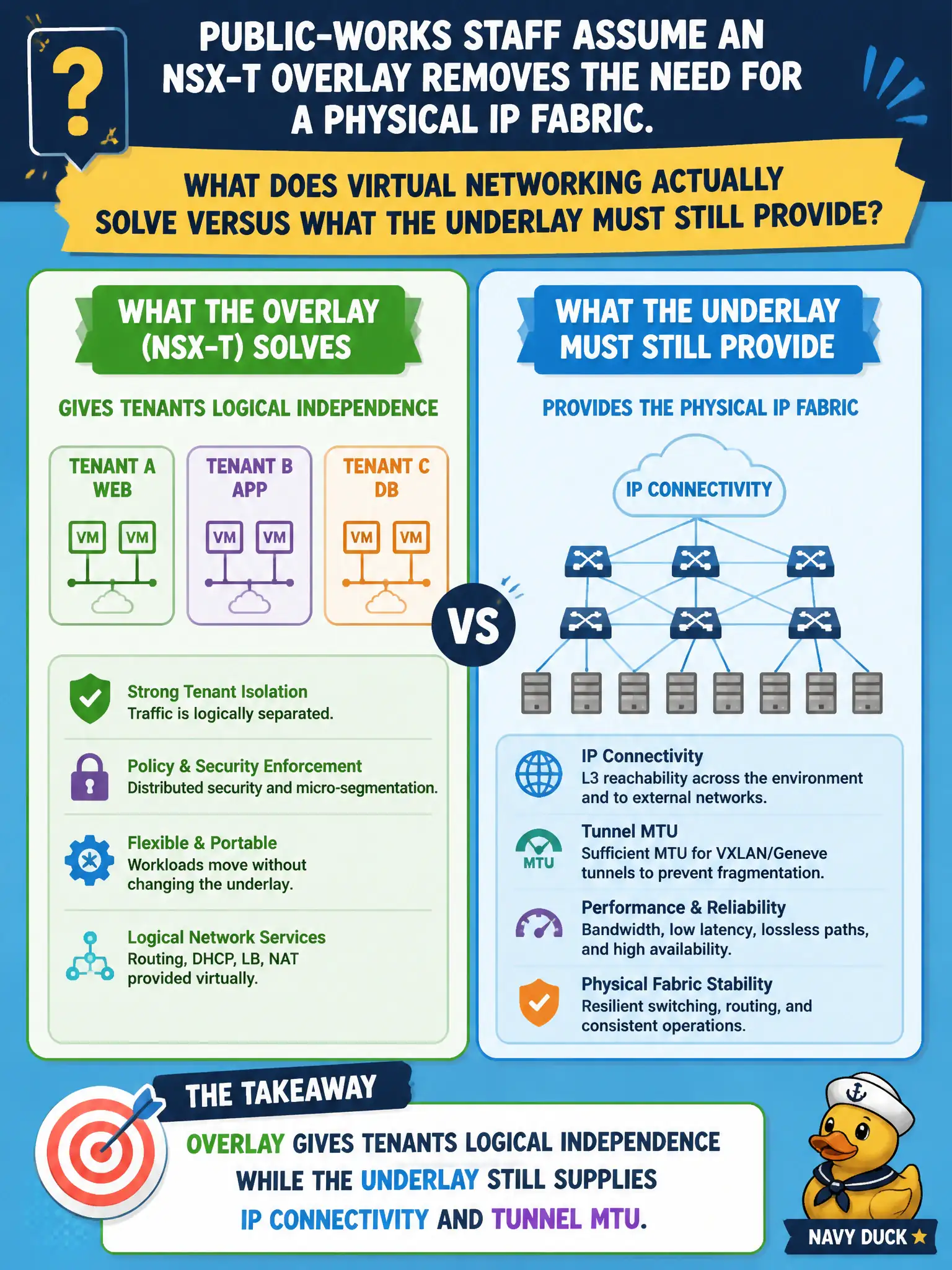
Overlay is a new set of named streets drawn on top of the real roads—it does not pave over the roads. Tenants get their own logical networks, but the underlay still needs IP reachability and enough MTU for the tunnels. HA admission control and Carbon Black are different jobs.
Full Explanation
Overlay gives tenants logical independence while the underlay still supplies IP connectivity and tunnel MTU. Public-works staff who assume NSX-T removes the need for a physical IP fabric are incorrect: VTEPs still need routed IP reachability and correct MTU for Geneve overhead. Overlay does not replace the underlay entirely. Overlay is not limited to encrypting Carbon Black sensor traffic. Overlay does not make the underlay optional once ESXi is clustered for HA. Exam caveat: underlay design (ECMP, MTU, MTU mismatches, VTEP subnets) remains a top operational failure domain. Operational check: validate VTEP ping and path MTU between public-works transport nodes and document underlay VLANs/subnets even though tenant networks are overlay-backed. Keep municipal naming and change tickets aligned with the software objects so civic audits can trace intent. Prefer verifying with a non-production agency workload before promoting the same pattern to life-safety systems. Record realization state and underlay health in the runbook used by on-call city operators. Keep municipal naming and change tickets aligned with the software objects so civic audits can trace intent. Prefer verifying with a non-production agency workload before promoting the same pattern to life-safety systems.