
Courts still treat IP subnet, VLAN, and security zone as the same object, so a two-VM evidence app burns a whole subnet. Which virtual-networking approach loosens that rigid coupling?
Select an answer to reveal the explanation.
Short Explanation
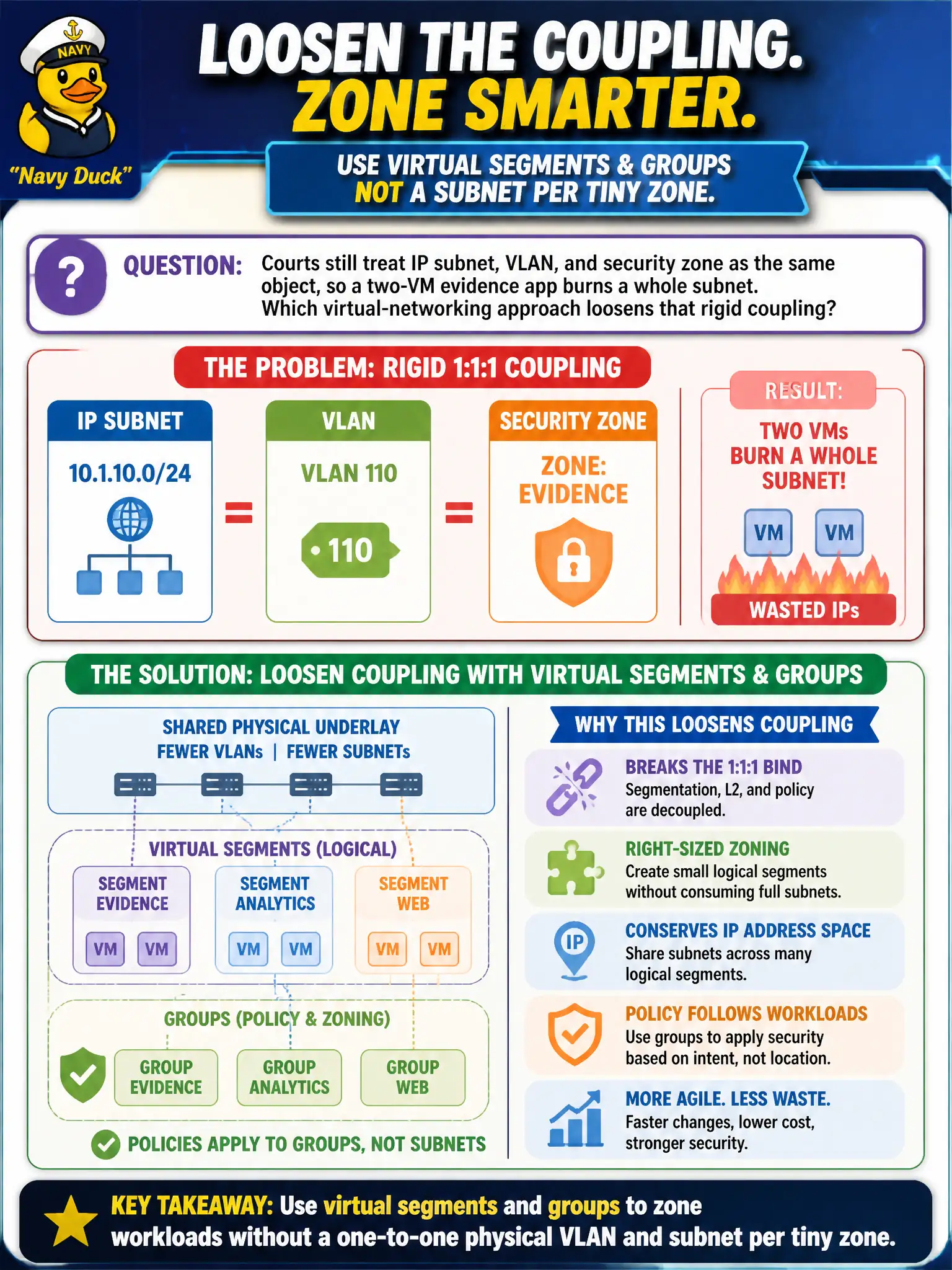
VLAN equals subnet equals zone is like giving every two-person team its own city block. Groups and virtual segments can fence the evidence VMs without burning a whole civic /24. VLAN 1 or a Workspace ONE org group is not that fence.
Full Explanation
Virtual segments and groups zone workloads without a one-to-one physical VLAN and subnet per tiny zone, loosening the courts' rigid coupling of IP subnet, VLAN, and security zone. A two-VM evidence app should not burn a whole subnet merely to get a zone boundary. Allocating a /24 on the core for every two-VM zone preserves the wasteful coupling. Collapsing all court VMs into VLAN 1 reduces subnet count by destroying isolation. Binding each zone only to a Workspace ONE organization group does not create network zoning. Exam caveat: IPAM discipline still matters; overlays give flexibility but do not excuse overlapping or undocumented addressing. Operational check: place the two-VM evidence app on an overlay segment with group-based DFW and confirm isolation without allocating a dedicated core /24 VLAN package. Keep municipal naming and change tickets aligned with the software objects so civic audits can trace intent. Prefer verifying with a non-production agency workload before promoting the same pattern to life-safety systems. Record realization state and underlay health in the runbook used by on-call city operators. Keep municipal naming and change tickets aligned with the software objects so civic audits can trace intent.