
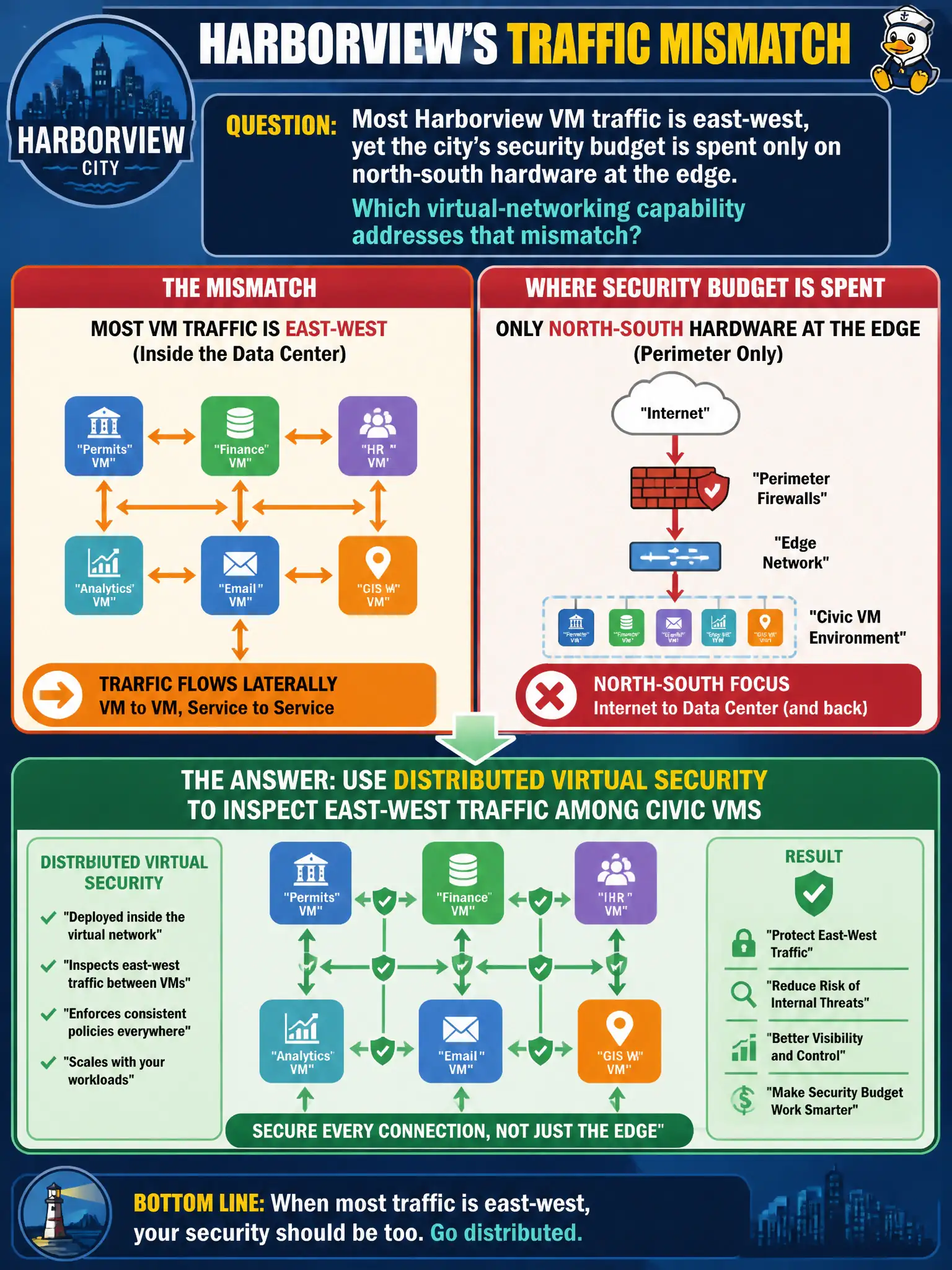
Most Harborview VM traffic is east-west, yet the city's security budget is spent only on north-south hardware at the edge. Which virtual-networking capability addresses that mismatch?
Select an answer to reveal the explanation.
Short Explanation
Spending only on the front door while most chatter is room-to-room is the civic mismatch. Distributed virtual security sits next to each VM and sees east-west talk that never hits the edge. Another perimeter pair just buys a bigger front door.
Full Explanation
Distributed virtual security inspects east-west traffic among civic VMs, addressing the mismatch when most Harborview traffic is lateral yet budget focuses only on north-south edge hardware. Micro-segmentation and distributed firewall bring controls to the traffic that never hits the perimeter. Adding a second perimeter pair does not inspect host-local east-west. Hairpinning all host-local traffic to the edge recreates trombones. Replacing NSX-T with Horizon Cloud does not solve server east-west inspection. Exam caveat: perimeter spend remains relevant for internet north-south; the exam point is not eliminating edge firewalls but covering east-west. Operational check: identify top east-west civic flows and show DFW rules enforcing them without forcing packets to the edge firewall. Keep municipal naming and change tickets aligned with the software objects so civic audits can trace intent. Prefer verifying with a non-production agency workload before promoting the same pattern to life-safety systems. Record realization state and underlay health in the runbook used by on-call city operators. Keep municipal naming and change tickets aligned with the software objects so civic audits can trace intent.