
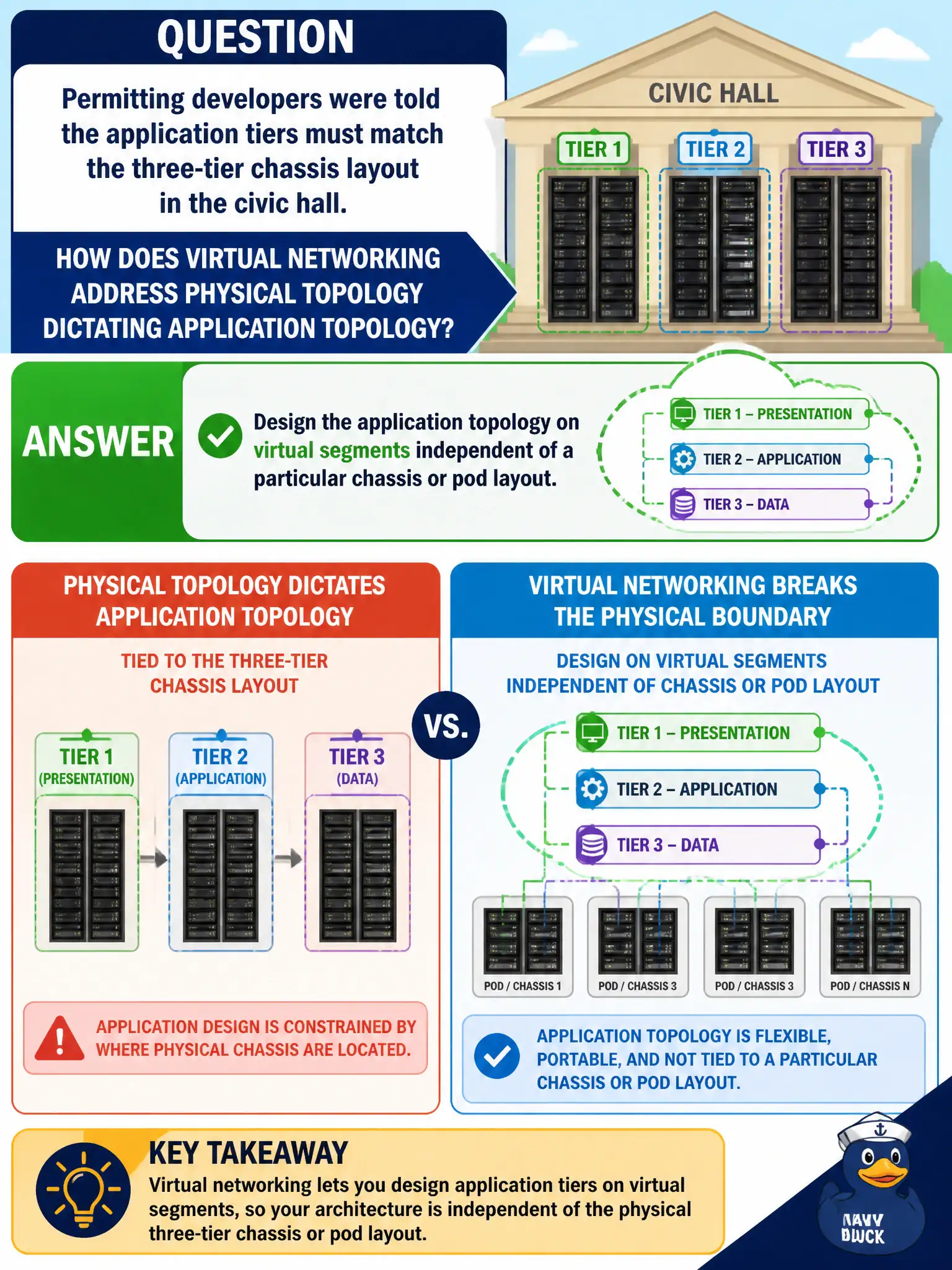
Permitting developers were told the application tiers must match the three-tier chassis layout in the civic hall. How does virtual networking address physical topology dictating application topology?
Select an answer to reveal the explanation.
Short Explanation
Forcing the app to look like the chassis is like designing a permitting office around the elevator shafts. Virtual segments let web, app, and database talk as the application needs, even if the VMs sit in different pods. Cabling and Workspace ONE groups do not become the network diagram.
Full Explanation
Virtual networking lets permitting developers design application topology on virtual segments independent of a particular chassis or pod layout in civic hall. Web, app, and database tiers follow logical architecture rather than three-tier chassis cabling. Keeping all tiers in the same rack so cabling remains the security model reasserts physical topology control. Requiring a dedicated physical chassis per tier is unnecessary for logical separation. Mapping chassis slots to Workspace ONE smart groups confuses device grouping with network design. Exam caveat: rack affinity may still be used for performance or failure domains, but it should be a placement choice—not the only way to draw the app network. Operational check: deploy permitting tiers on separate overlay segments across hosts and confirm policy-based isolation without matching a chassis slot diagram. Keep municipal naming and change tickets aligned with the software objects so civic audits can trace intent. Prefer verifying with a non-production agency workload before promoting the same pattern to life-safety systems. Record realization state and underlay health in the runbook used by on-call city operators. Keep municipal naming and change tickets aligned with the software objects so civic audits can trace intent.