
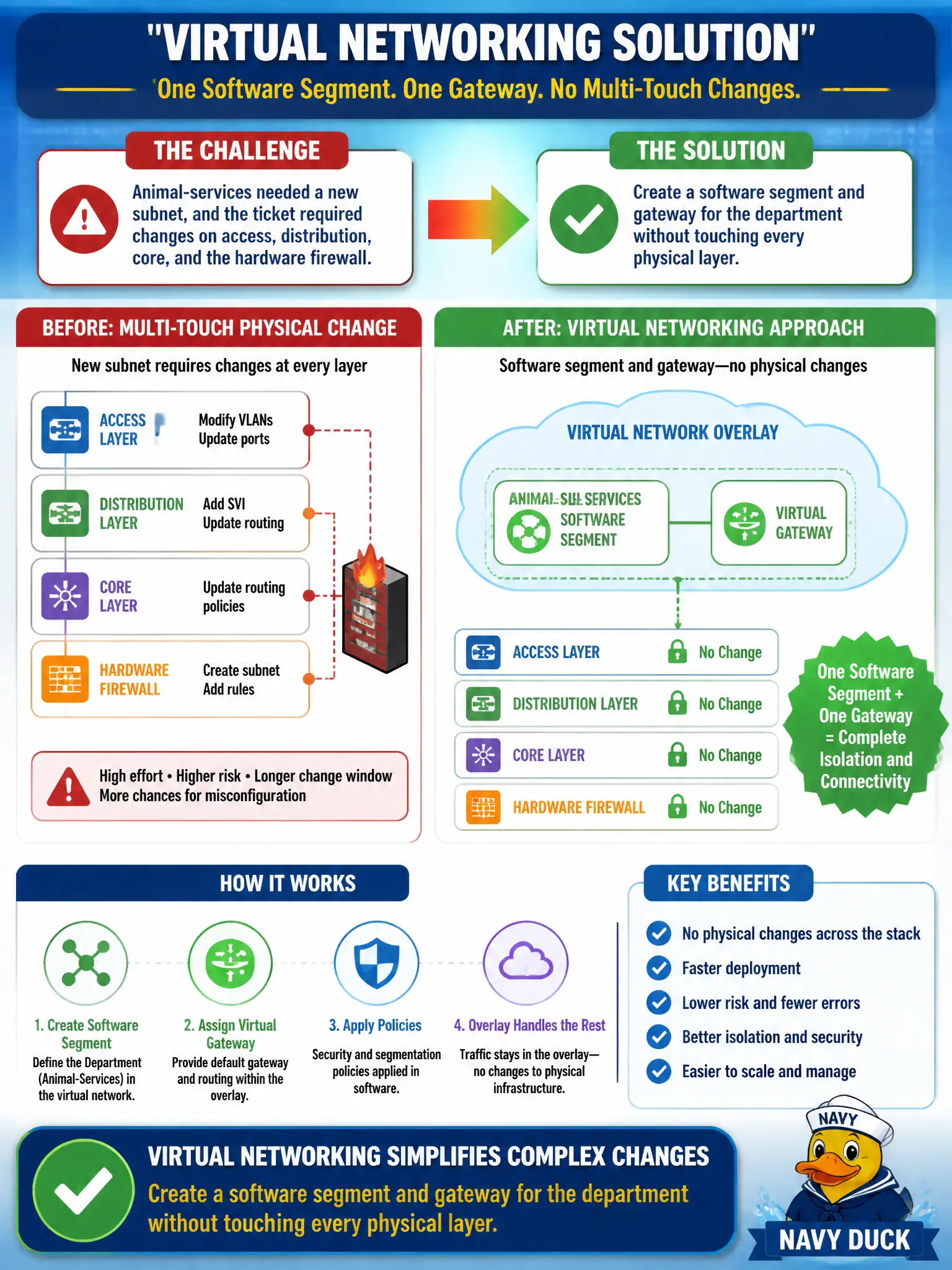
Animal-services needed a new subnet, and the ticket required changes on access, distribution, core, and the hardware firewall. How does virtual networking address that multi-touch physical change?
Select an answer to reveal the explanation.
Short Explanation
The old way is a four-stop parade—closet, distribution, core, and firewall—just to give animal-services an address. A software segment and gateway is like adding a floor plan on the whiteboard without ripping up the streets. Workspace ONE entitlements do not create that subnet.
Full Explanation
Creating a software segment and gateway for animal-services avoids multi-touch changes across access, distribution, core, and hardware firewall for a new subnet. Virtual networking collapses that traditional ticket fan-out into software objects on a prepared fabric. Ordering a matching hardware firewall pair for every department does not solve multi-touch underlay change. Recabling into the GIS VLAN avoids a subnet by creating a worse shared-domain risk. Publishing a subnet through Workspace ONE Access as an entitlement confuses identity access with IP networking. Exam caveat: north-south advertisement or Edge configuration may still be needed for external reachability; the win is not touching every physical layer for routine department networks. Operational check: deliver an animal-services test subnet as an NSX segment/gateway without access/distribution/core VLAN tickets. Keep municipal naming and change tickets aligned with the software objects so civic audits can trace intent. Prefer verifying with a non-production agency workload before promoting the same pattern to life-safety systems. Record realization state and underlay health in the runbook used by on-call city operators.