
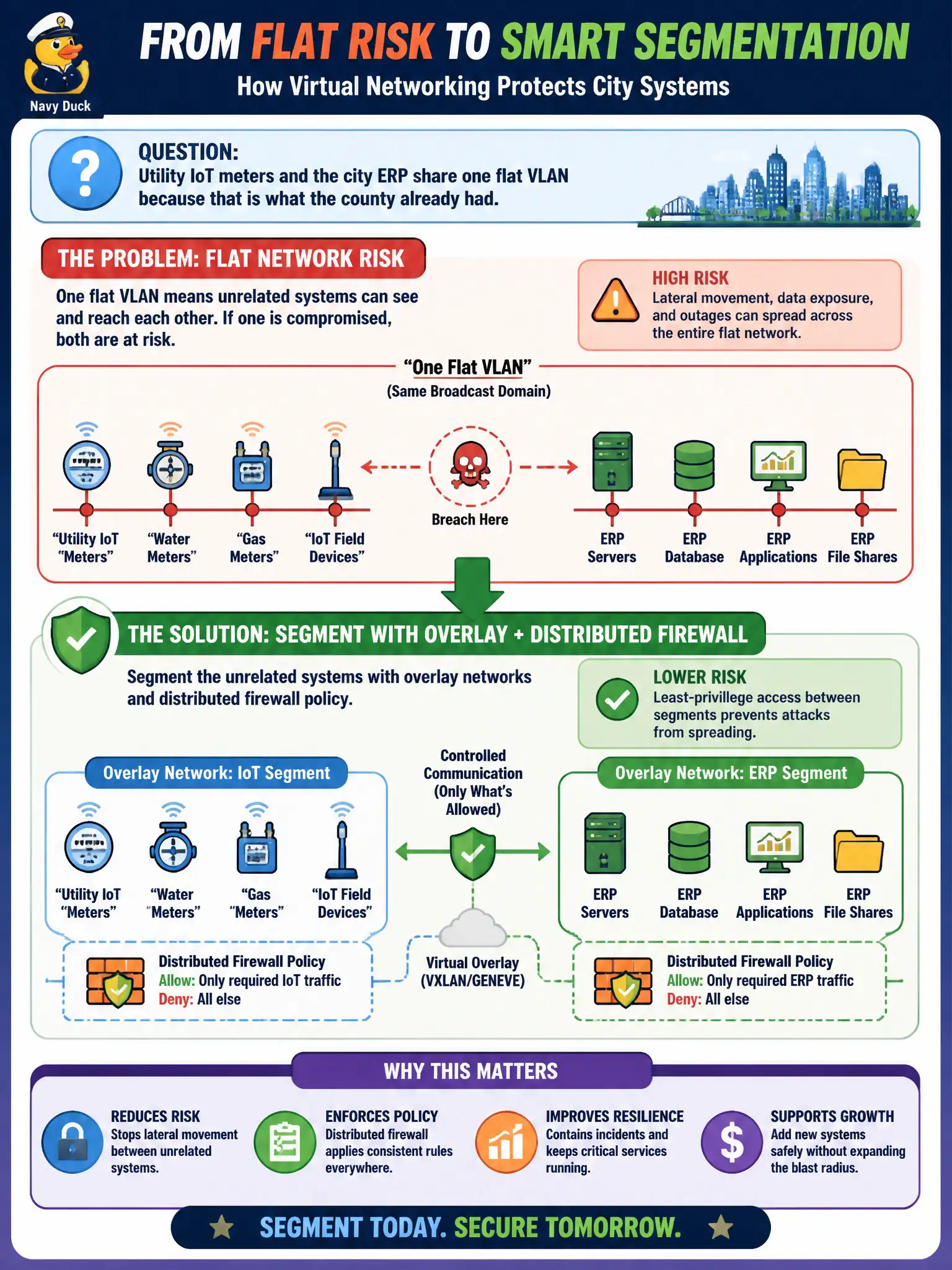
Utility IoT meters and the city ERP share one flat VLAN because that is what the county already had. Which virtual-networking approach addresses that traditional flat-network risk?
Select an answer to reveal the explanation.
Short Explanation
Meters and ERP on one VLAN is like leaving the water-plant keys on the same hook as payroll. Overlay segments plus a distributed firewall put them in separate rooms without waiting for a new physical LAN. A bigger MTU or a Horizon pool just keeps them in the same hallway.
Full Explanation
Segmenting unrelated systems with overlay networks and distributed firewall policy addresses the traditional flat-network risk of utility IoT meters sharing one VLAN with city ERP. Logical separation reduces blast radius and enforces who can talk to whom. Enlarging VLAN MTU does not create security segmentation. Placing both in the same Horizon desktop pool does not fix server flat-network risk. Disabling the distributed firewall keeps east-west exposure on the flat VLAN. Exam caveat: OT/IoT segmentation often needs especially strict default-deny and change control. Operational check: move meter head-end and ERP test endpoints onto separate segments with explicit allow rules only for required flows and confirm all other east-west is denied. Keep municipal naming and change tickets aligned with the software objects so civic audits can trace intent. Prefer verifying with a non-production agency workload before promoting the same pattern to life-safety systems. Record realization state and underlay health in the runbook used by on-call city operators. Keep municipal naming and change tickets aligned with the software objects so civic audits can trace intent. Prefer verifying with a non-production agency workload before promoting the same pattern to life-safety systems.