
Harborview still applies firewall policy as whatever jack the VM is plugged into. Which virtual-networking model replaces that traditional location-based security?
Select an answer to reveal the explanation.
Short Explanation
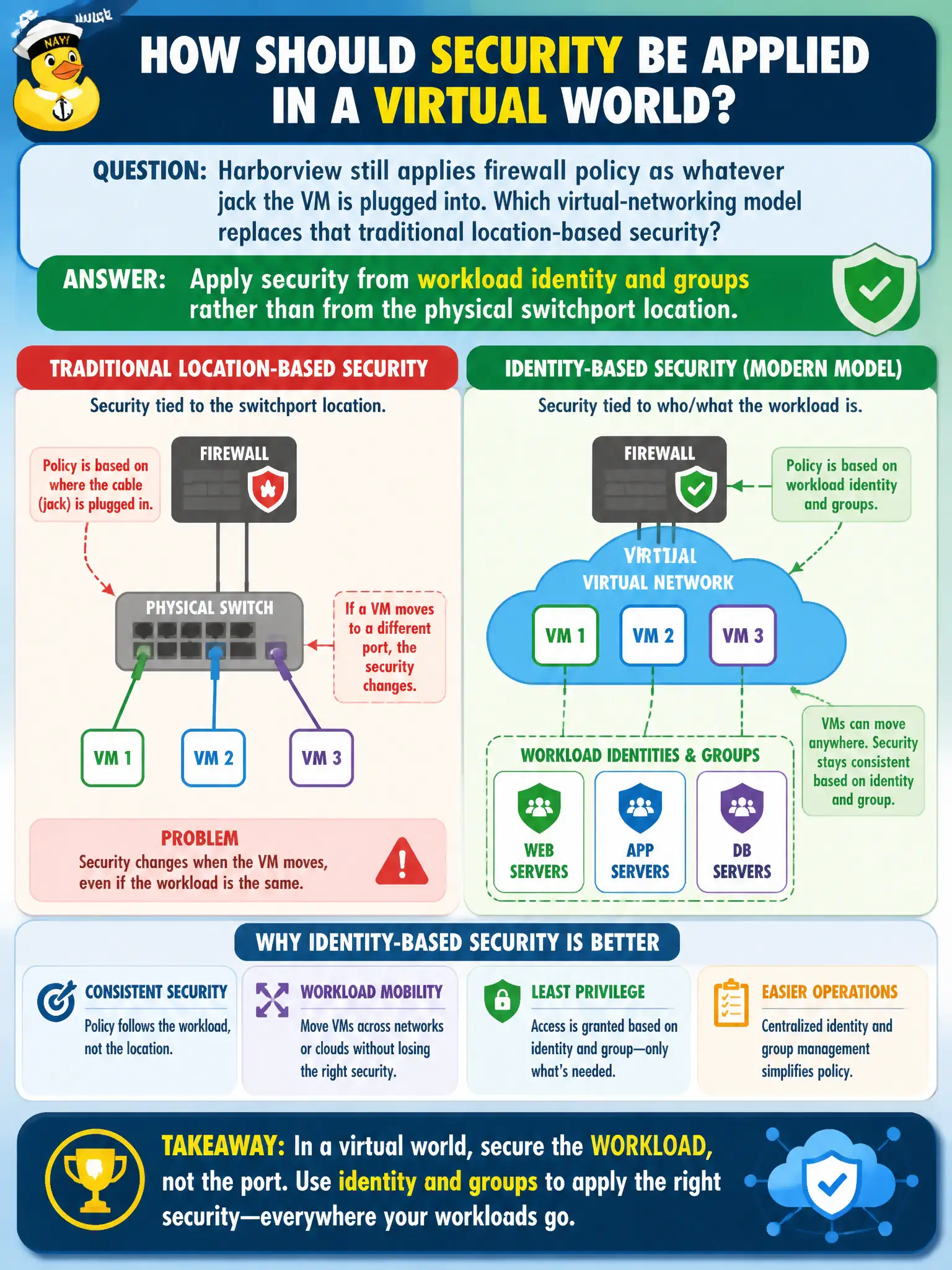
The wall jack is a parking space, not a security badge. Virtual networking lets policy follow the workload's identity and groups, so a permitting VM keeps the same rules after it moves hosts. Horizon VLANs and Carbon Black alerts are not that badge.
Full Explanation
Workload-identity and group-based security replaces location-based policy that follows whatever jack a Harborview VM is plugged into. Virtual networking applies firewall rules from groups and tags so policy survives host moves. Trusting only the physical switchport VLAN of the current ESXi uplink recreates location coupling. Moving the VM to a Horizon instant-clone pool changes EUC boundaries, not server workload identity policy. A Carbon Black sensor producing alerts is not the distributed firewall. Exam caveat: identity-based policy requires accurate inventory and tag hygiene; wrong groups are still wrong policy. Operational check: move a Harborview test VM between hosts and verify DFW based on groups still matches intent without editing switchport ACLs. Keep municipal naming and change tickets aligned with the software objects so civic audits can trace intent. Prefer verifying with a non-production agency workload before promoting the same pattern to life-safety systems. Record realization state and underlay health in the runbook used by on-call city operators. Keep municipal naming and change tickets aligned with the software objects so civic audits can trace intent. Prefer verifying with a non-production agency workload before promoting the same pattern to life-safety systems.