
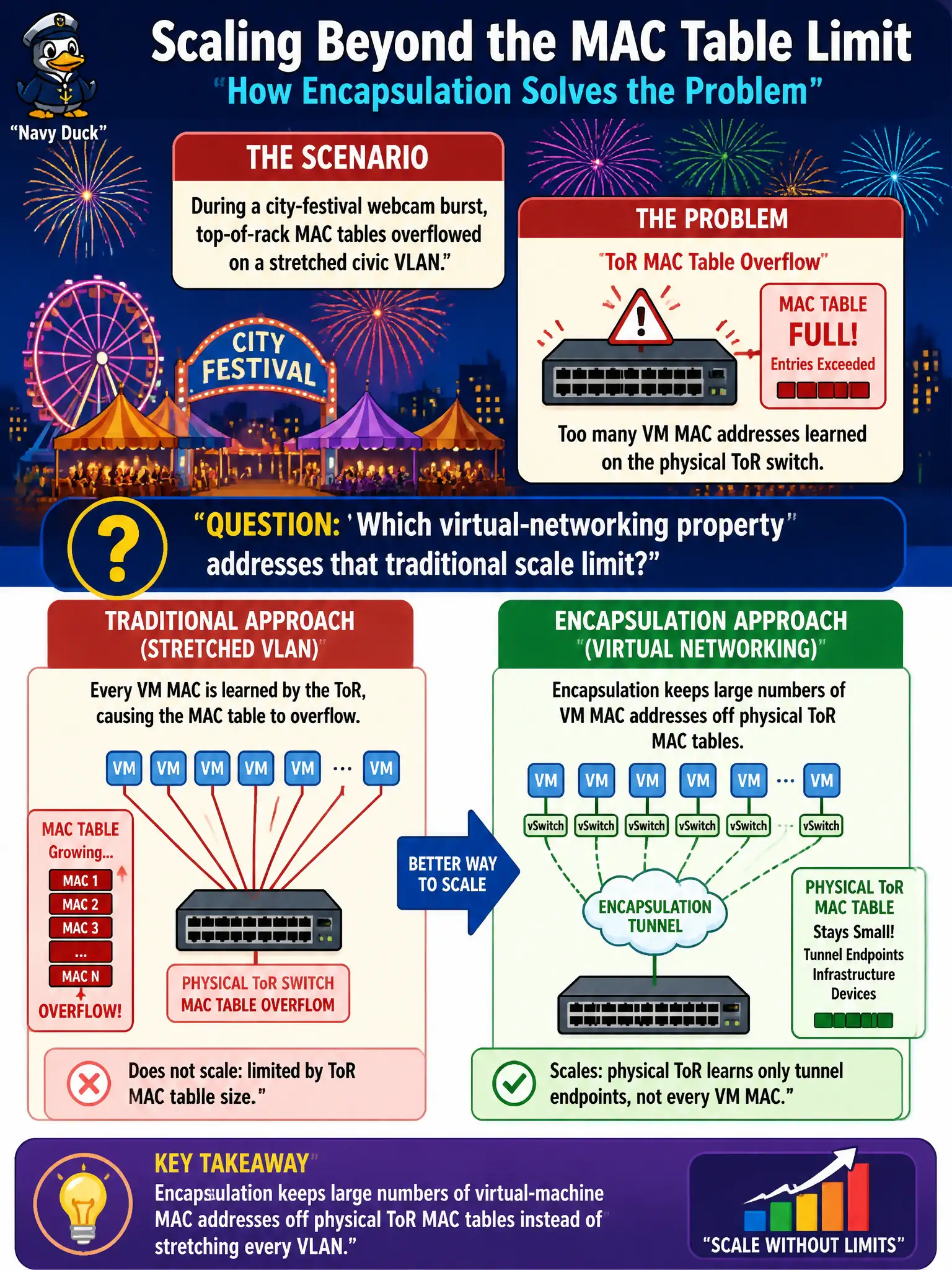
During a city-festival webcam burst, top-of-rack MAC tables overflowed on a stretched civic VLAN. Which virtual-networking property addresses that traditional scale limit?
Select an answer to reveal the explanation.
Short Explanation
A stretched VLAN is like stuffing every festival-camera nametag into the ToR's tiny pocket. Encapsulation wraps those MACs inside tunnel packets so the physical switch mainly needs the host tunnel endpoints, not every webcam. Pinning VMs or using Workspace ONE does not empty that pocket.
Full Explanation
Encapsulation keeps large numbers of virtual-machine MAC addresses off physical ToR MAC tables instead of stretching every VLAN. During a city-festival webcam burst, that property prevents ToR MAC overflow that stretched civic VLANs invite. Pinning each webcam VM to a unique physical access port does not scale and is not the virtual-networking answer. Workspace ONE UEM enrollment does not replace Ethernet MAC learning on the ToR. NSX-V VXLAN multicast flooding that still stores every guest MAC on ToRs is not the NSX-T scale goal. Exam caveat: underlay still learns VTEP outer addresses; the win is shielding ToRs from inner guest MAC explosion. Operational check: compare ToR MAC table growth for overlay-backed webcam VMs versus an equivalent stretched VLAN test. Keep municipal naming and change tickets aligned with the software objects so civic audits can trace intent. Prefer verifying with a non-production agency workload before promoting the same pattern to life-safety systems. Record realization state and underlay health in the runbook used by on-call city operators. Keep municipal naming and change tickets aligned with the software objects so civic audits can trace intent. Prefer verifying with a non-production agency workload before promoting the same pattern to life-safety systems.