
Parks-and-recreation cutover took the civic VLAN down when spanning tree reconverged on the physical fabric. How does overlay virtual networking address that traditional Layer-2 challenge?
Select an answer to reveal the explanation.
Short Explanation
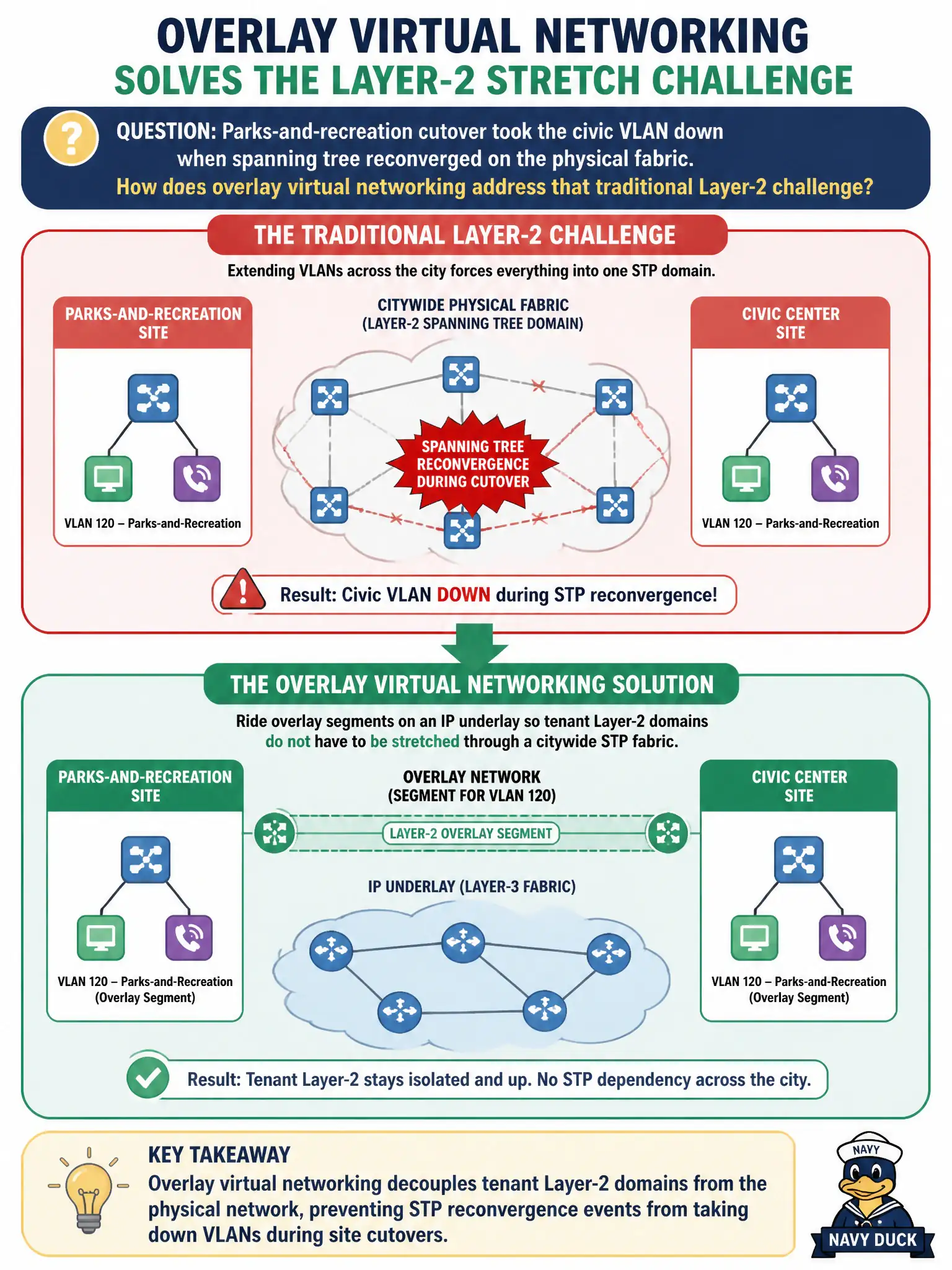
Spanning tree is like one citywide drawbridge: when it lifts for a parks cutover, the whole VLAN waits. Overlay tunnels hop an IP street grid instead of stretching one giant Layer-2 island, so tenant networks no longer live and die with STP reconvergence. Carbon Black and Horizon do not replace that overlay design.
Full Explanation
Traditional stretched VLANs depend on Spanning Tree Protocol to keep Layer-2 loops from flooding the physical fabric. An NSX-T overlay encapsulates tenant frames and forwards them across a routed IP underlay, so each logical segment does not require a citywide STP domain. That reduces reconvergence outages during civic cutovers—such as parks-and-recreation—without turning the physical core into a Layer-2 mesh for every department. Extending the parks VLAN across every ToR enlarges the STP domain rather than fixing it. Carbon Black isolation is endpoint control, not the SDN overlay that avoids stretched STP. Horizon desktop pools are not where tenant Layer-2 should "live" to avoid physical switching. Exam caveat: underlay still needs loop-free L2 for its own VLANs, but tenant overlays should not ride citywide STP. Operational check: place parks-rec test VMs on an overlay segment across hosts and confirm no dependency on stretching that tenant VLAN through STP. Keep municipal naming and change tickets aligned with the software objects so civic audits can trace intent. Prefer verifying with a non-production agency workload before promoting the same pattern to life-safety systems. Record realization state and underlay health in the runbook used by on-call city operators.