
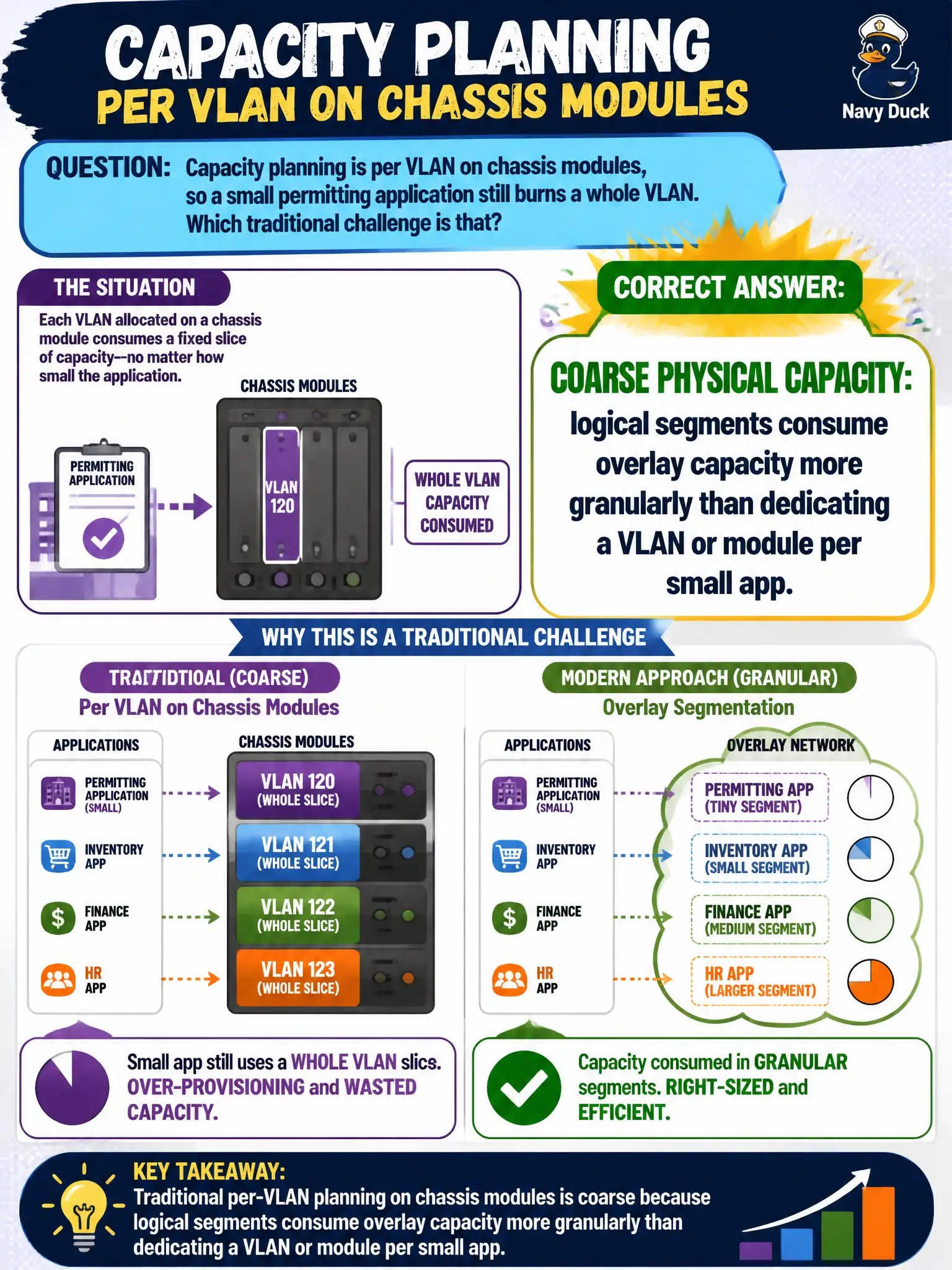
Capacity planning is per VLAN on chassis modules, so a small permitting application still burns a whole VLAN. Which traditional challenge is that?
Select an answer to reveal the explanation.
Short Explanation
Dedicating a whole VLAN and module to a tiny permitting app is using a city bus for two riders. Logical segments are sized to the app, not to the chassis. Overlay capacity is granular; chassis slots are not.
Full Explanation
Coarse physical capacity planning—per VLAN on chassis modules—means a small permitting application still burns a whole VLAN. Logical segments consume overlay capacity more granularly than dedicating a VLAN or module per small app. Every NSX-T segment does not need a dedicated chassis module and VLAN. Overlays can be smaller than a chassis slot abstraction. Horizon application pools are not the capacity unit that replaces VLANs for permitting networks. Exam caveat: overlay scale limits and IPAM still exist; granularity improves packing, not infinite capacity. Operational check: host multiple small permitting environments on distinct overlay segments without allocating a unique core VLAN or module per app. Keep municipal naming and change tickets aligned with the software objects so civic audits can trace intent. Prefer verifying with a non-production agency workload before promoting the same pattern to life-safety systems. Record realization state and underlay health in the runbook used by on-call city operators. Keep municipal naming and change tickets aligned with the software objects so civic audits can trace intent. Prefer verifying with a non-production agency workload before promoting the same pattern to life-safety systems.