
Public-safety computer-aided dispatch VMs cannot vMotion to a new cluster because the destination has no matching VLAN. Which traditional challenge is that?
Select an answer to reveal the explanation.
Short Explanation
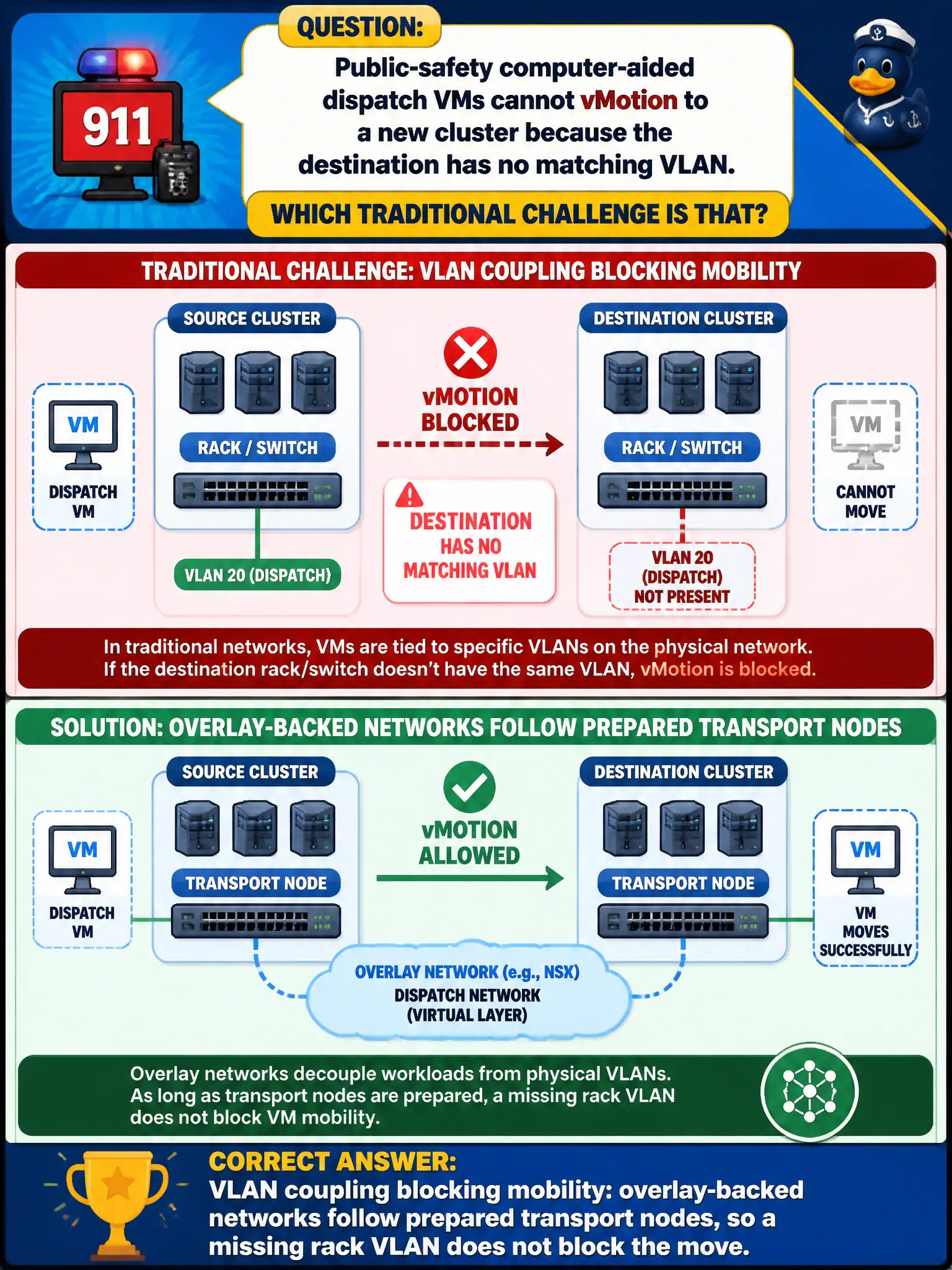
If the network is glued to a rack VLAN, vMotion is a locked door on the new cluster. Overlay segments live on prepared transport nodes, not on that missing VLAN. Dispatch should move with the city, not wait on a switchport.
Full Explanation
VLAN coupling blocks mobility when public-safety CAD VMs cannot vMotion because the destination lacks a matching VLAN. Overlay-backed networks follow prepared transport nodes, so a missing rack VLAN does not block the move the way traditional port-group VLAN coupling does. Overlays do not still require the destination rack VLAN before any CAD VM can move when the network is overlay-backed. Horizon Cloud Pod VLAN matching is not the requirement here. Carbon Black sensor version matching is unrelated to the VLAN coupling problem. Exam caveat: destination clusters must be NSX-prepared in the correct transport zones; "no VLAN" does not mean "unprepared host." Operational check: vMotion a CAD test VM to a prepared cluster without creating a matching destination rack VLAN and confirm connectivity on the overlay segment. Keep municipal naming and change tickets aligned with the software objects so civic audits can trace intent. Prefer verifying with a non-production agency workload before promoting the same pattern to life-safety systems. Record realization state and underlay health in the runbook used by on-call city operators. Keep municipal naming and change tickets aligned with the software objects so civic audits can trace intent.