
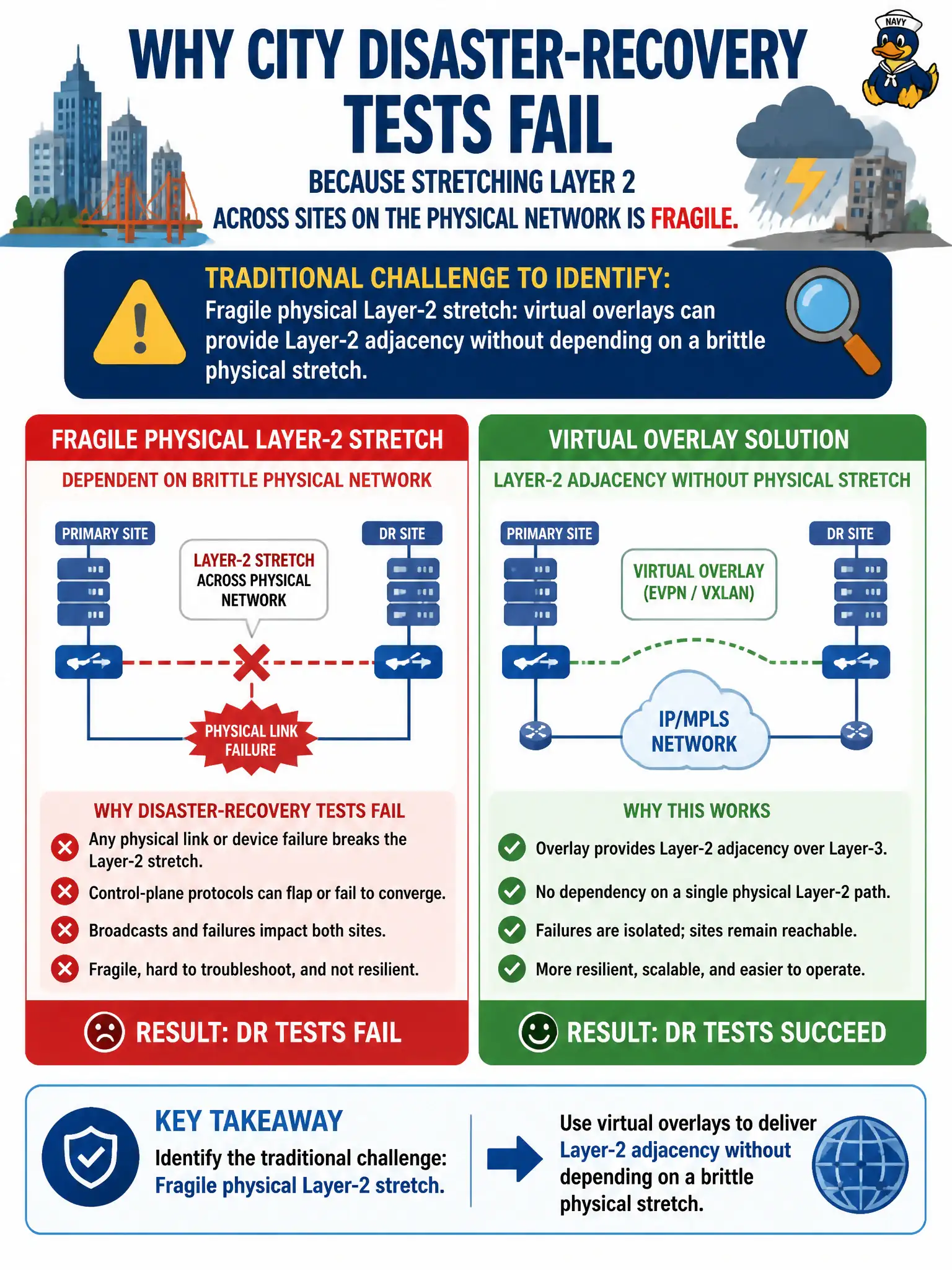
City disaster-recovery tests fail because stretching Layer 2 across sites on the physical network is fragile. Which traditional challenge should the operator identify?
Select an answer to reveal the explanation.
Short Explanation
Stretching a VLAN across two civic sites on the physical plant is a long, brittle extension cord. Overlays can keep Layer-2 adjacency without that physical stretch. Disaster-recovery tests should not depend on spanning tree and flooded VLANs surviving the WAN.
Full Explanation
Fragile physical Layer-2 stretch across sites breaks city disaster-recovery tests. Virtual overlays can provide Layer-2 adjacency without depending on a brittle physical stretch, improving DR network recreation and mobility patterns. Physical L2 stretch is not the required NSX-T design for every DR test. Horizon Cloud Pod Architecture is not the city's only supported L2 stretch mechanism for server networks. vSAN iSCSI is not what must stretch L2 for DR in place of overlays. Exam caveat: multi-site designs still need careful latency, failure domain, and gateway considerations; overlays reduce fragile physical stretch but do not make distance irrelevant. Operational check: demonstrate L2 adjacency for a DR test segment across prepared sites using overlay without enabling a fragile campus-wide physical stretch. Keep municipal naming and change tickets aligned with the software objects so civic audits can trace intent. Prefer verifying with a non-production agency workload before promoting the same pattern to life-safety systems. Record realization state and underlay health in the runbook used by on-call city operators. Keep municipal naming and change tickets aligned with the software objects so civic audits can trace intent.