
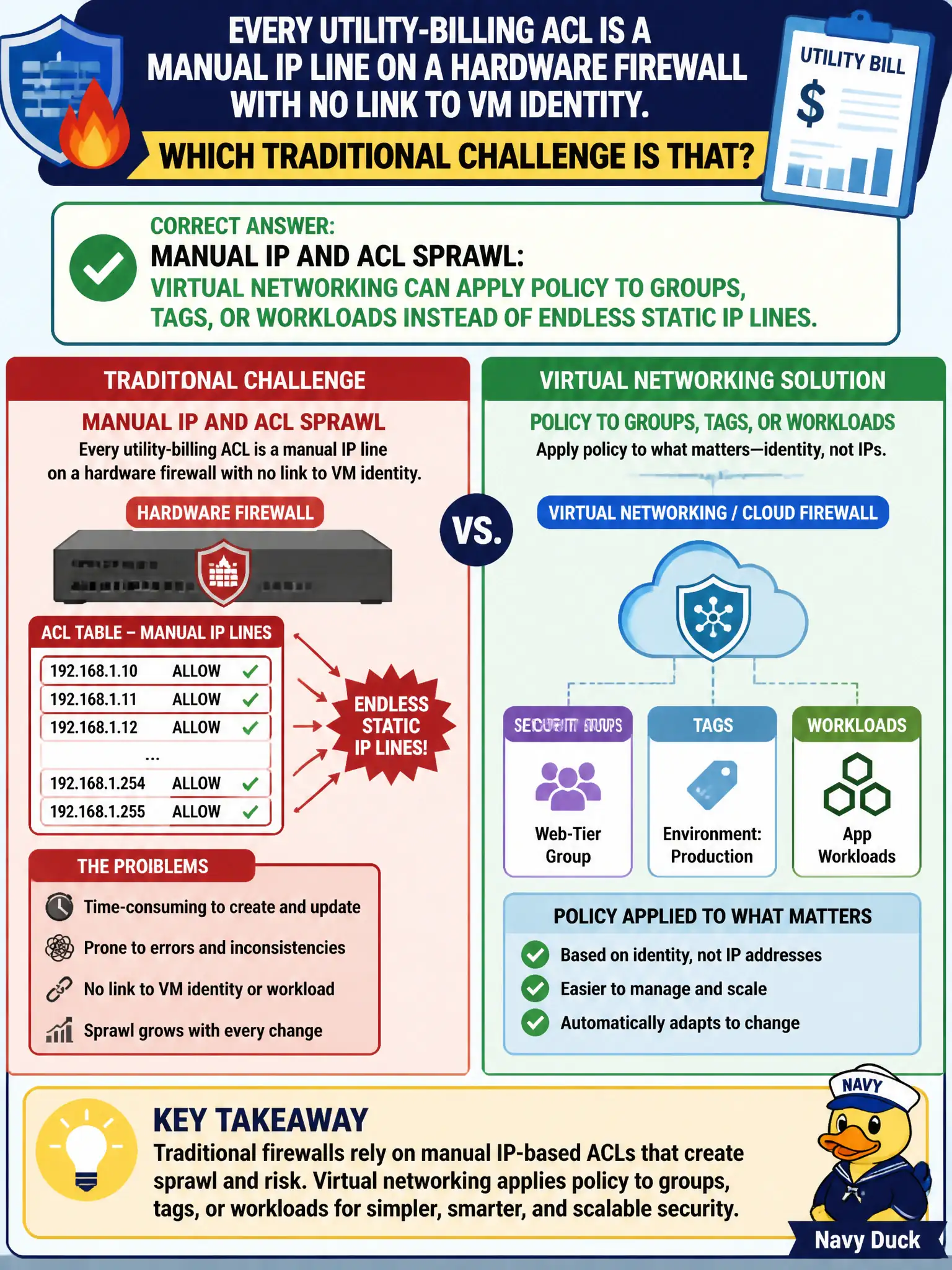
Every utility-billing ACL is a manual IP line on a hardware firewall with no link to VM identity. Which traditional challenge is that?
Select an answer to reveal the explanation.
Short Explanation
Static IP ACLs are a handwritten phone book that goes stale when a billing VM moves. Groups and tags follow the workload. The utility should not rewrite the hardware firewall every time an IP changes.
Full Explanation
Manual IP and ACL sprawl appears when every utility-billing ACL is a static IP line on a hardware firewall with no link to VM identity. Virtual networking can apply policy to groups, tags, or workloads so rules survive IP changes and inventory churn. NSX-T distributed firewall is not limited to static IPs with no groups. Horizon entitlements are not the replacement for server firewall ACLs. Carbon Black reputation lists are not the NSX method for billing-VLAN ACLs. Exam caveat: poor group hygiene recreates sprawl in software; identity-based policy still needs lifecycle discipline. Operational check: convert a sample billing ACL to a group-based DFW rule and verify it remains correct after a VM IP change. Keep municipal naming and change tickets aligned with the software objects so civic audits can trace intent. Prefer verifying with a non-production agency workload before promoting the same pattern to life-safety systems. Record realization state and underlay health in the runbook used by on-call city operators. Keep municipal naming and change tickets aligned with the software objects so civic audits can trace intent. Prefer verifying with a non-production agency workload before promoting the same pattern to life-safety systems.