
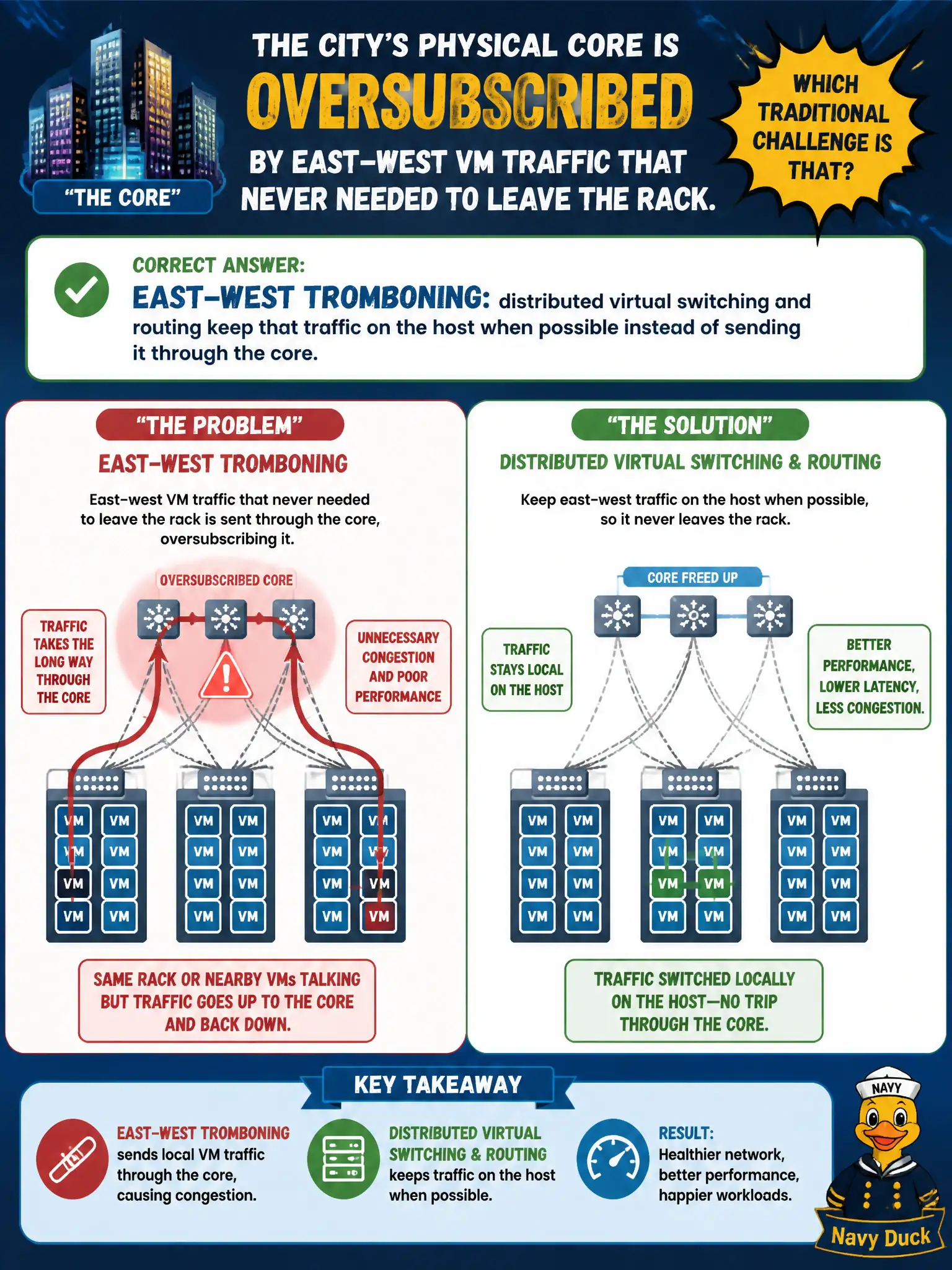
The city's physical core is oversubscribed by east-west VM traffic that never needed to leave the rack. Which traditional challenge is that?
Select an answer to reveal the explanation.
Short Explanation
Tromboning is sending two neighbors' traffic downtown and back. If both VMs are on the host or rack, the core should not be the meeting point. Distributed switching and routing keep east-west local when they can.
Full Explanation
East-west tromboning oversubscribes the physical core when VM traffic that never needed to leave the rack is forced through it. Distributed virtual switching and routing keep that traffic on the host when possible instead of sending it through the core. NSX-T does not require all east-west traffic to trombone through the physical core for inspection when distributed services are used. vSAN witness traffic is not the only east-west flow that can oversubscribe a core. Horizon display-protocol issues are a different troubleshooting track. Exam caveat: north-south and inter-segment routed flows may still traverse Edges; the goal is eliminating unnecessary host-local trombones. Operational check: capture whether same-host or same-rack civic east-west flows leave the host unnecessarily and remediate with distributed switching/routing/DFW as appropriate. Keep municipal naming and change tickets aligned with the software objects so civic audits can trace intent. Prefer verifying with a non-production agency workload before promoting the same pattern to life-safety systems. Record realization state and underlay health in the runbook used by on-call city operators. Keep municipal naming and change tickets aligned with the software objects so civic audits can trace intent.