
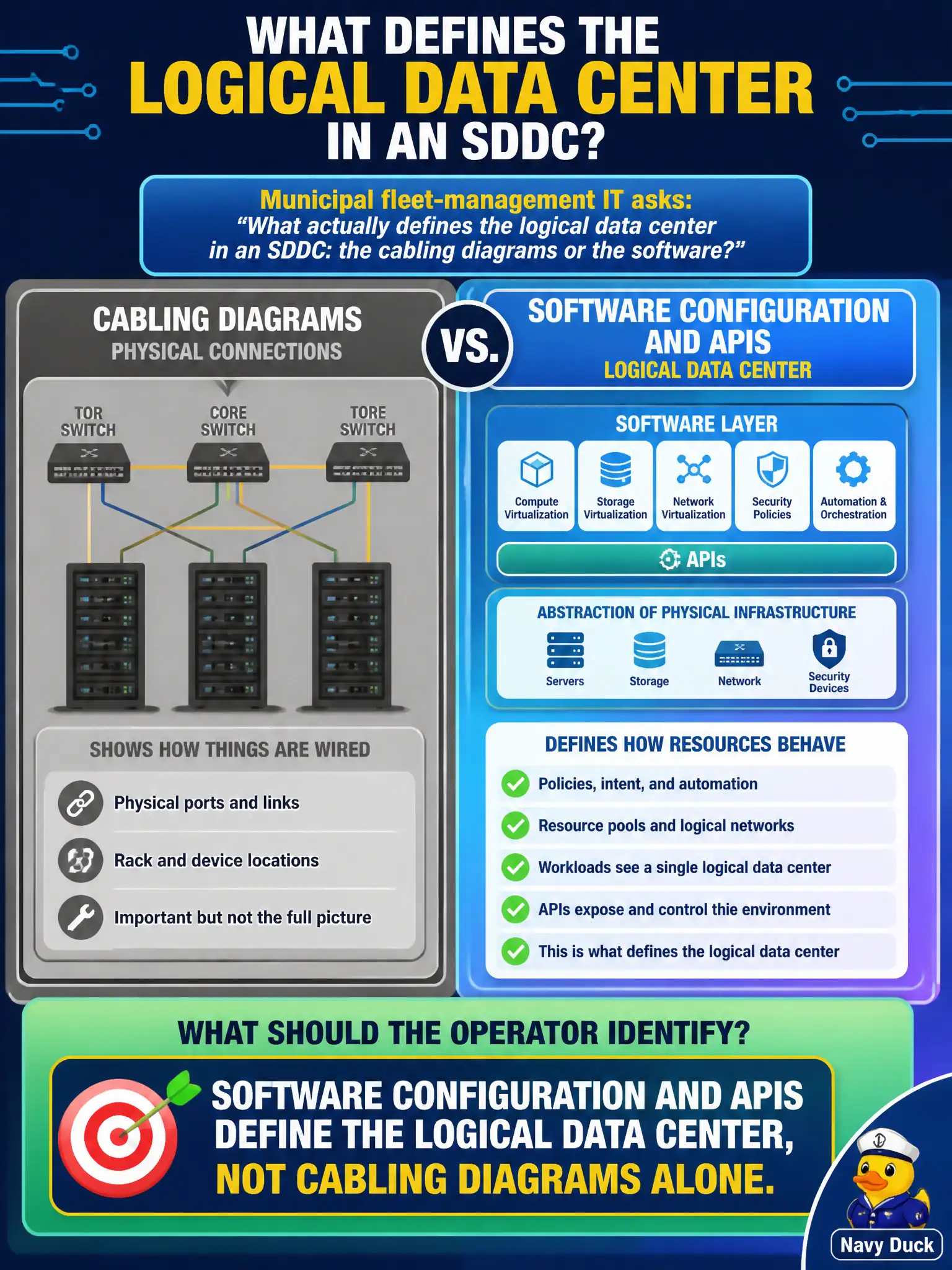
Municipal fleet-management IT asks what actually defines the logical data center in an SDDC: the cabling diagrams or the software. What should the operator identify?
Select an answer to reveal the explanation.
Short Explanation
In an SDDC the map of the city is the config and the API, not the binder of patch-cable photos. Cabling still matters for the underlay. The logical networks fleet apps sit on are declared in software.
Full Explanation
Software configuration and APIs define the logical data center in an SDDC, not cabling diagrams alone. Fleet-management IT should treat segments, gateways, and policies as the living definition of civic connectivity, with cabling as underlay plumbing. Physical diagrams alone are insufficient. Horizon image catalogs do not define data-center network topology. Top-of-rack serial numbers in a CMDB identify assets, not the logical network model. Exam caveat: cabling and CMDB still matter for underlay troubleshooting; they are not the source of truth for overlay intent. Operational check: recover a logical path description for a fleet app from NSX configuration/API output and show it matches intent even if a cable label differs. Keep municipal naming and change tickets aligned with the software objects so civic audits can trace intent. Prefer verifying with a non-production agency workload before promoting the same pattern to life-safety systems. Record realization state and underlay health in the runbook used by on-call city operators. Keep municipal naming and change tickets aligned with the software objects so civic audits can trace intent. Prefer verifying with a non-production agency workload before promoting the same pattern to life-safety systems.