
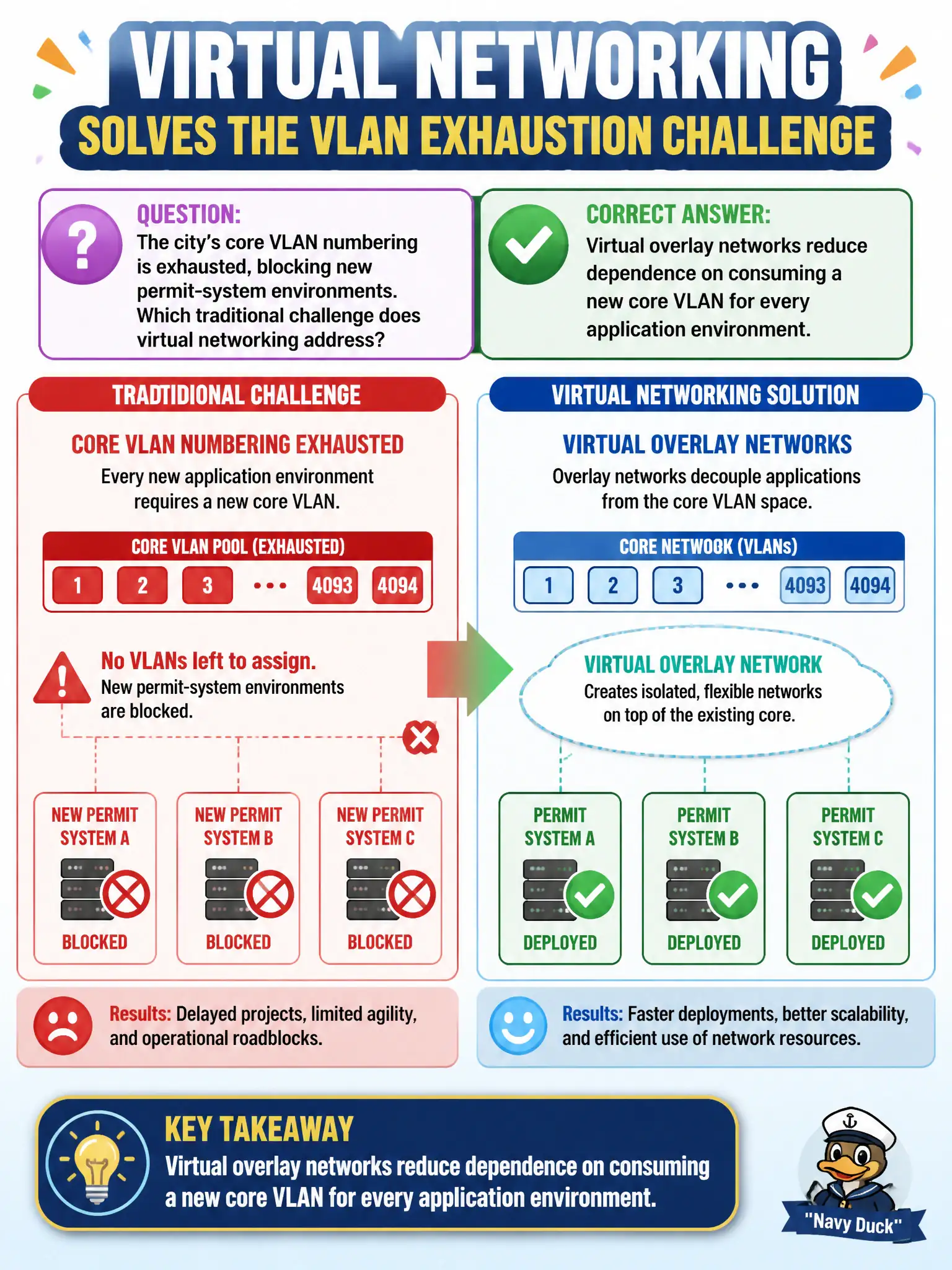
The city's core VLAN numbering is exhausted, blocking new permit-system environments. Which traditional challenge does virtual networking address?
Select an answer to reveal the explanation.
Short Explanation
VLAN IDs are a scarce parking-permit series on the core. Overlays let many logical networks ride a simpler underlay instead of burning a new citywide VLAN for every permit-system test bed. That is how you stop VLAN sprawl without begging for ID 4095.
Full Explanation
Virtual overlay networks reduce dependence on consuming a new core VLAN for every application environment. When city VLAN numbering is exhausted, permit-system environments can use overlay segments that do not each burn a scarce core VLAN ID the way traditional designs do. Overlays do not require a new core VLAN per environment as their defining model. Adding another hardware firewall pair does not replenish VLAN IDs. Horizon instant clones are not what prevents hitting the 4094 limit. Exam caveat: underlay still uses some VLANs for VTEPs or VLAN-backed segments, so overlays reduce—not always eliminate—VLAN pressure. Operational check: create a permit-system test environment on an overlay segment without allocating a new scarce core VLAN ID from the exhausted pool. Keep municipal naming and change tickets aligned with the software objects so civic audits can trace intent. Prefer verifying with a non-production agency workload before promoting the same pattern to life-safety systems. Record realization state and underlay health in the runbook used by on-call city operators. Keep municipal naming and change tickets aligned with the software objects so civic audits can trace intent. Prefer verifying with a non-production agency workload before promoting the same pattern to life-safety systems.