
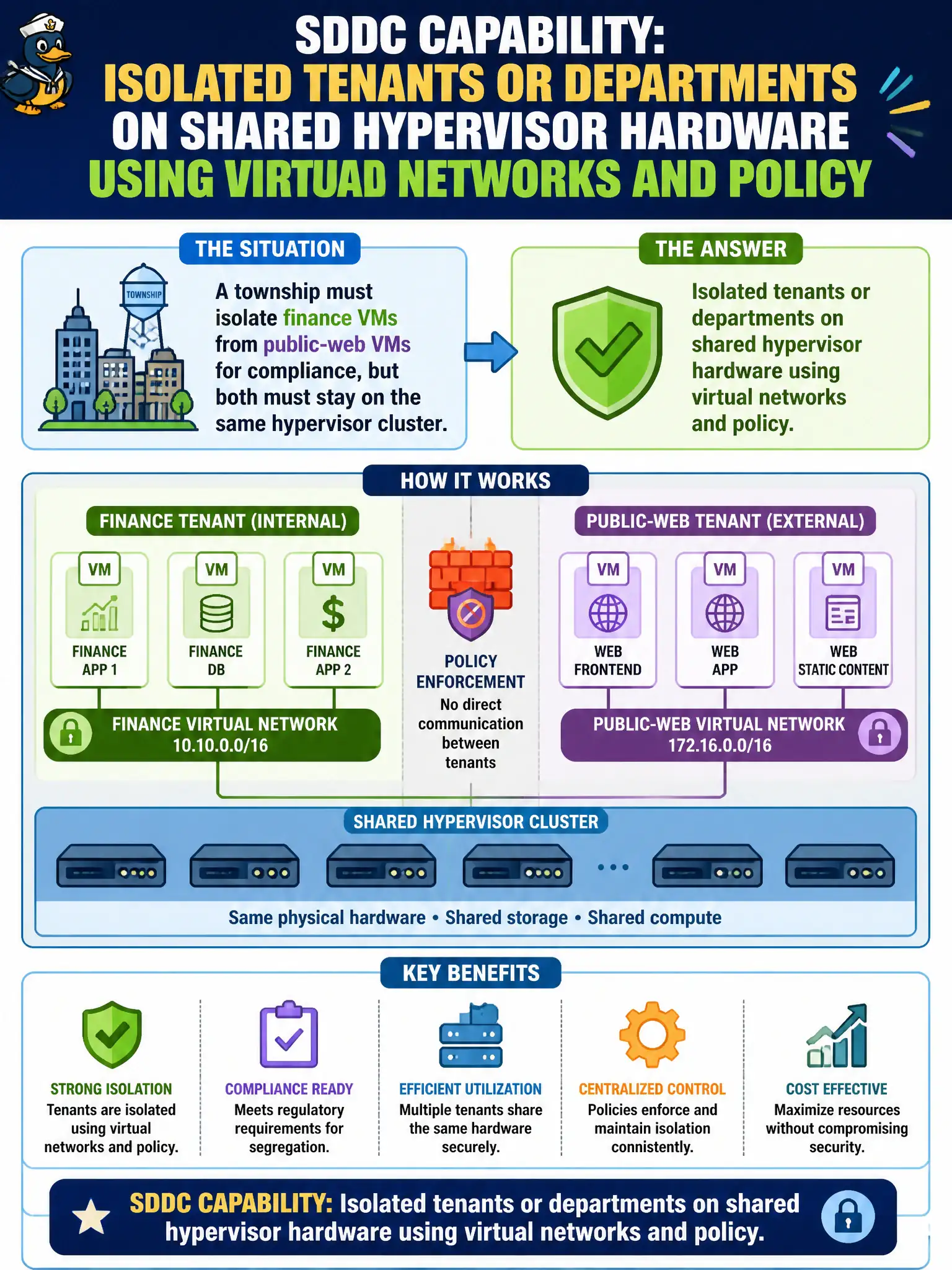
A township must isolate finance VMs from public-web VMs for compliance, but both must stay on the same hypervisor cluster. Which SDDC capability is that?
Select an answer to reveal the explanation.
Short Explanation
Shared hosts do not have to mean a shared hallway. Virtual networks and DFW policy can keep finance off the public-web path on the same cluster. The township does not need a second building of servers just to satisfy the auditor.
Full Explanation
Isolated tenants or departments on shared hypervisor hardware using virtual networks and policy is the SDDC capability a township needs when finance and public-web VMs must remain isolated on one cluster. Overlay segments and distributed firewall provide separation without buying a separate physical cluster for finance. Horizon entitlements alone do not provide that server-side network isolation. A dedicated Carbon Black org key per department does not create network tenancy. Exam caveat: shared clusters still need clear tagging, RBAC, and capacity governance so isolation is intentional. Operational check: place finance and public-web test VMs on the same cluster on different segments and verify denied east-west traffic unless policy allows it. Keep municipal naming and change tickets aligned with the software objects so civic audits can trace intent. Prefer verifying with a non-production agency workload before promoting the same pattern to life-safety systems. Record realization state and underlay health in the runbook used by on-call city operators. Keep municipal naming and change tickets aligned with the software objects so civic audits can trace intent. Prefer verifying with a non-production agency workload before promoting the same pattern to life-safety systems.