
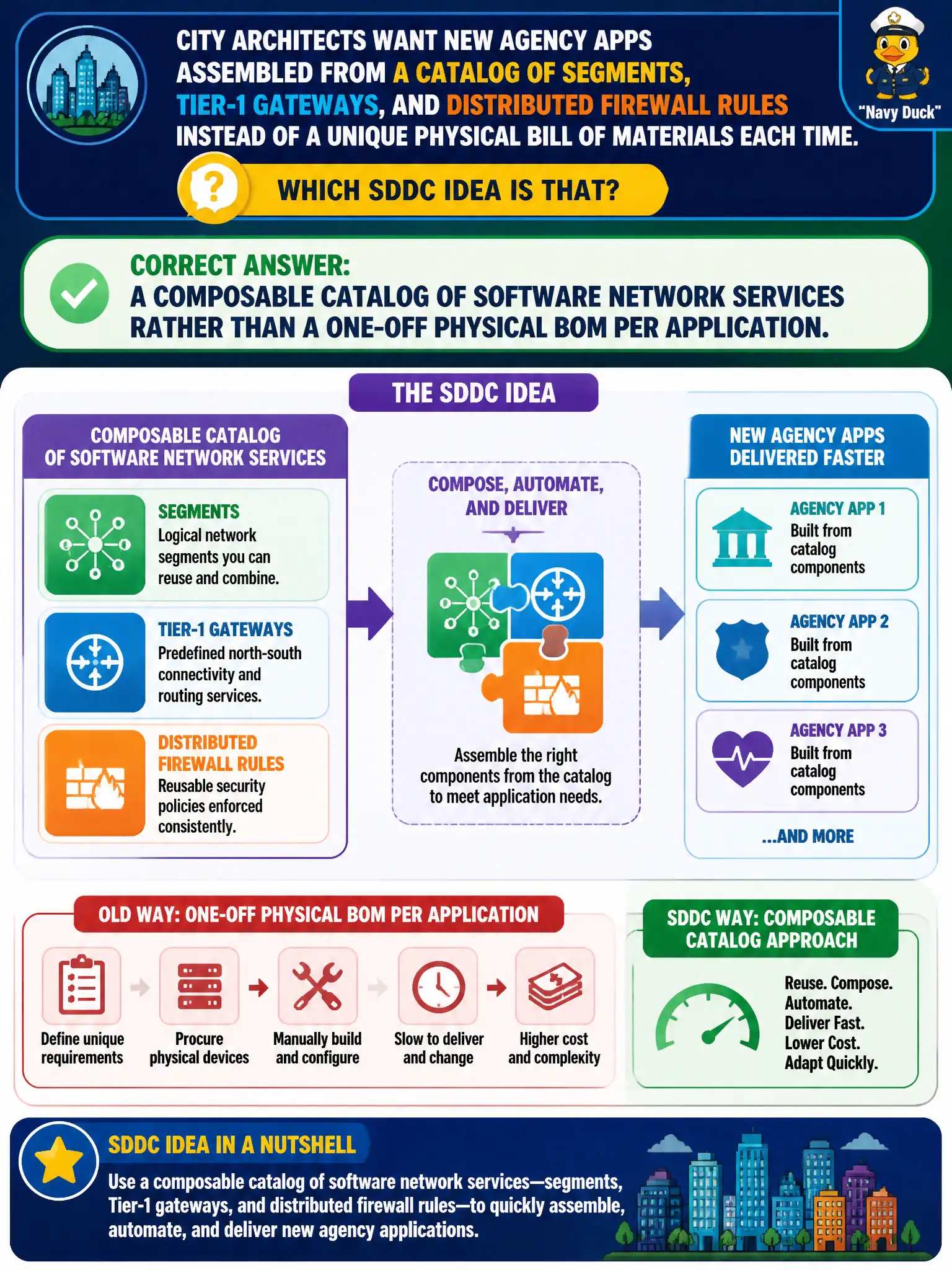
City architects want new agency apps assembled from a catalog of segments, Tier-1 gateways, and distributed firewall rules instead of a unique physical bill of materials each time. Which SDDC idea is that?
Select an answer to reveal the explanation.
Short Explanation
Think city services menu, not a custom hardware order for every permit counter. Segments, Tier-1s, and DFW rules are catalog items you compose. Nobody should have to buy a new switch stack just to stand up one more agency app.
Full Explanation
City architects wanting apps assembled from a catalog of segments, Tier-1 gateways, and distributed firewall rules are describing a composable catalog of software network services rather than a one-off physical BOM per application. That SDDC idea standardizes civic application onboarding as software building blocks. Buying a unique hardware chassis and VLAN module per agency app is the traditional alternative. Horizon App Volumes packages deliver app bits to desktops; they do not replace NSX segments. Carbon Black sensor groups are endpoint security constructs, not network isolation segments. Exam caveat: catalogs still need standards for IPAM and Tier-0 connectivity; composition is not free-form chaos. Operational check: publish a reference catalog entry (segment + Tier-1 + DFW set) and onboard a pilot agency app from that catalog without a unique physical BOM. Keep municipal naming and change tickets aligned with the software objects so civic audits can trace intent. Prefer verifying with a non-production agency workload before promoting the same pattern to life-safety systems. Record realization state and underlay health in the runbook used by on-call city operators. Keep municipal naming and change tickets aligned with the software objects so civic audits can trace intent.