
Municipal elections IT virtualizes the network in the city's SDDC and asks whether east-west and north-south traffic still apply. What should the operator identify?
Select an answer to reveal the explanation.
Short Explanation
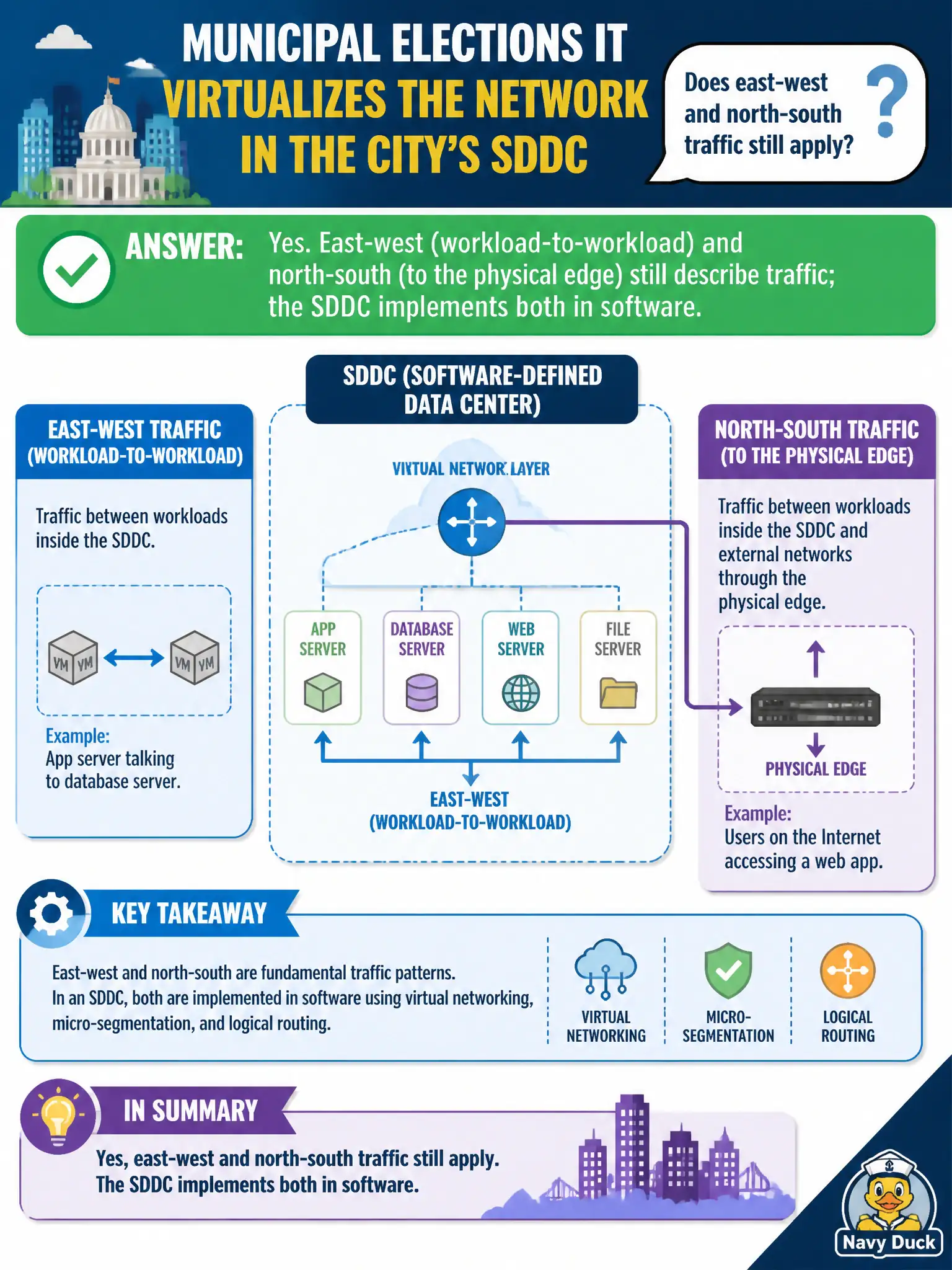
Virtualizing the network is like putting the city's streets in software—it does not erase "across town" versus "out the city limits." East-west is still VM-to-VM; north-south is still in and out. The maps just live in NSX instead of only on the core chassis.
Full Explanation
East-west (workload-to-workload) and north-south (to the physical edge) still describe traffic in an SDDC; the platform implements both in software. Municipal elections IT should keep using those directions when designing distributed firewall for lateral traffic and gateway firewall for edge-bound flows. The directions do not disappear into a single north-south hardware-core path. East-west is not merely a vSAN replication term. Overlay traffic still has directionality relative to workloads and the edge. Exam caveat: NSX can inspect both paths, but rule placement differs—distributed firewall for host-local east-west versus gateway services for north-south—so vocabulary remains operationally useful. Operational check: classify a sample elections flow as east-west or north-south and confirm which NSX enforcement point should see it before go-live. Keep municipal naming and change tickets aligned with the software objects so civic audits can trace intent. Prefer verifying with a non-production agency workload before promoting the same pattern to life-safety systems. Record realization state and underlay health in the runbook used by on-call city operators. Keep municipal naming and change tickets aligned with the software objects so civic audits can trace intent.