
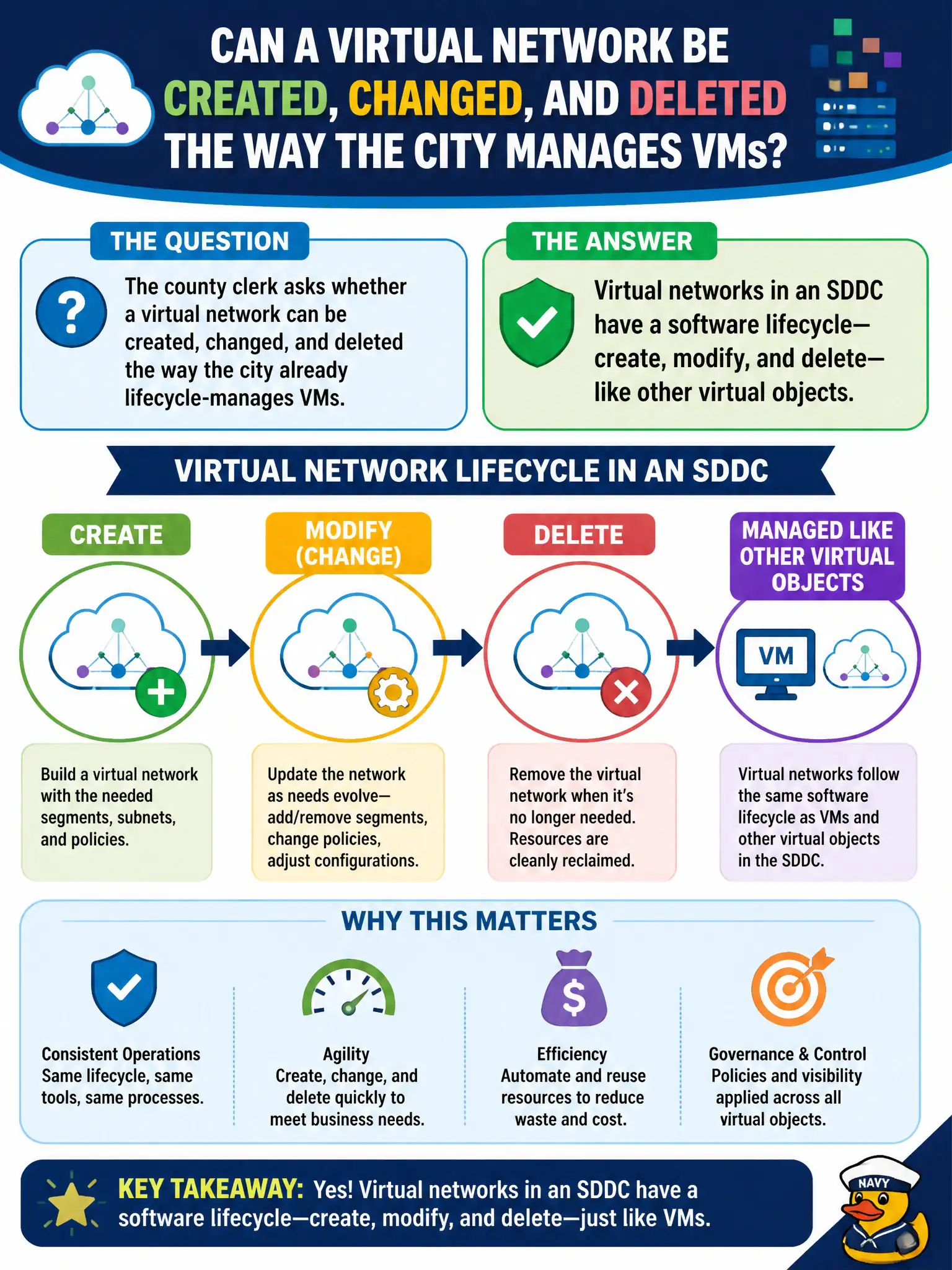
The county clerk asks whether a virtual network can be created, changed, and deleted the way the city already lifecycle-manages VMs. What should the operator identify?
Select an answer to reveal the explanation.
Short Explanation
A virtual network is more like a VM folder than a welded pipe. You can stand it up, change it, and tear it down in software. The clerk is not signing a forever-cable work order every time a new case-management net appears.
Full Explanation
Virtual networks in an SDDC have a software lifecycle—create, modify, and delete—like other virtual objects. The county clerk's question is answered by treating segments and related services as managed configuration with the same lifecycle mindset used for VMs. They are not permanent physical installs that cannot be deleted once a VLAN is assigned. Lifecycle is not limited to vSAN datastores while networks remain cabling diagrams. Horizon Administrator is not the system of record for creating NSX networks that then require a core-switch visit to delete. Exam caveat: production deletions still need change control and dependency checks (attached VMs, gateways, firewall rules). Operational check: create, modify, and delete a non-prod civic segment in NSX and confirm the underlay is unchanged throughout the lifecycle. Keep municipal naming and change tickets aligned with the software objects so civic audits can trace intent. Prefer verifying with a non-production agency workload before promoting the same pattern to life-safety systems. Record realization state and underlay health in the runbook used by on-call city operators. Keep municipal naming and change tickets aligned with the software objects so civic audits can trace intent.