
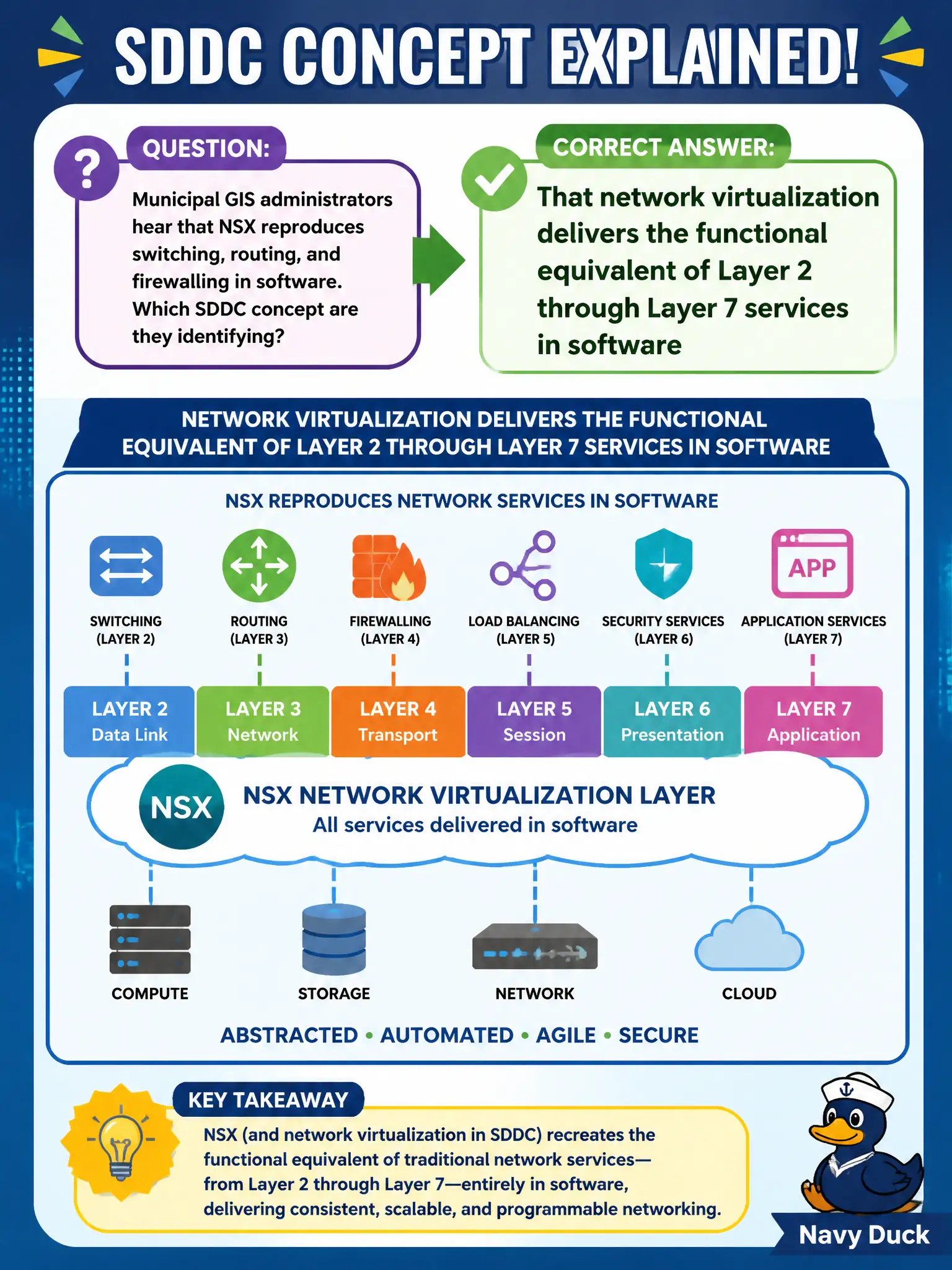
Municipal GIS administrators hear that NSX reproduces switching, routing, and firewalling in software. Which SDDC concept are they identifying?
Select an answer to reveal the explanation.
Short Explanation
NSX is the network closet rebuilt in software: switches, routers, and firewalls as services, not as three more boxes. GIS traffic still gets Layer 2 through Layer 7 functions; they just live in the overlay.
Full Explanation
Network virtualization in an SDDC delivers the functional equivalent of Layer 2 through Layer 7 services—switching, routing, load balancing, and firewalling—in software. When municipal GIS administrators hear that NSX reproduces those functions without a unique appliance for every service, they are identifying that software-defined networking pillar. Overlay segments provide L2 adjacency, gateways provide routing, and distributed or gateway firewalls enforce policy, all as managed objects on the civic fabric. Rewriting GIS as a Horizon published application changes how users consume the app; it does not supply overlay switching or routing. Removing physical firewalls before any VM can start is unnecessary and unsafe; virtualization moves functions into software rather than abolishing security controls. Carbon Black Cloud replaces neither Geneve overlays nor logical switching. Exam caveat: NSX does not eliminate the need for underlay connectivity or thoughtful edge design; it virtualizes the network services that sit on that underlay. Operational check: verify GIS can obtain a segment, Tier-1 connectivity, and a distributed firewall rule set without ordering a new physical switch or firewall SKU for that project alone.