
A township clerk says the city already has a software-defined data center because email was moved to a SaaS vendor. What distinction should the candidate draw?
Select an answer to reveal the explanation.
Short Explanation
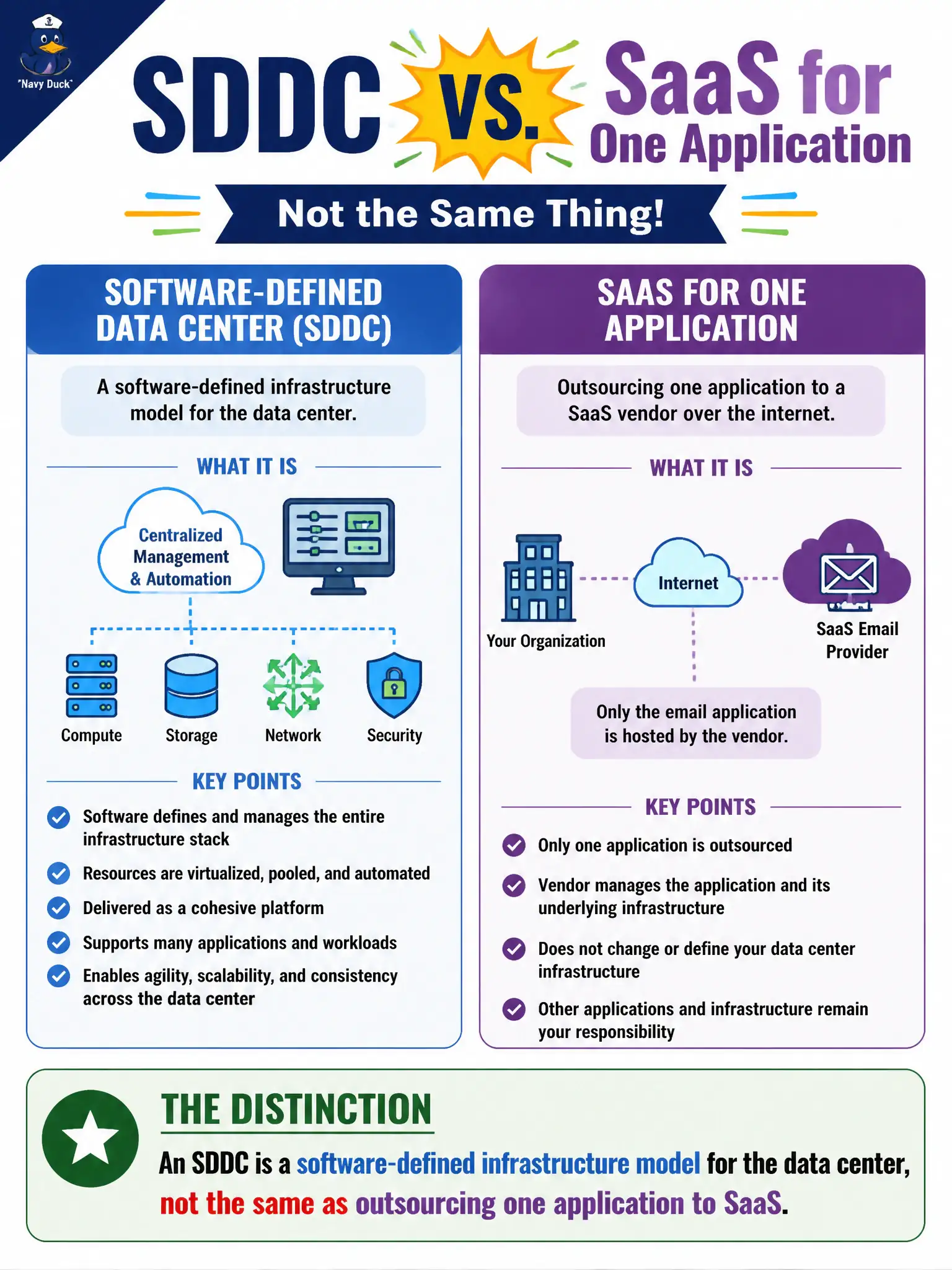
Renting the city's mailbox is not the same as turning the civic data center into software. SaaS is someone else's app. An SDDC is how you virtualize compute, storage, and networking for the infrastructure you still run.
Full Explanation
An SDDC is a software-defined infrastructure model for the data center—virtualized compute, storage, and networking operated with policy and APIs. Moving the township's email to a SaaS vendor outsources one application; it does not convert the civic machine room into software-defined infrastructure. The clerk conflates application hosting with data-center architecture. SaaS email does not automatically virtualize on-premises compute, storage, and networking, so it cannot prove an SDDC exists. Equating SaaS email with the NSX-T distributed firewall confuses a mailbox tenant with east-west micro-segmentation. Treating SaaS email as the only VMware definition of SDDC is false; VMware SDDC messaging centers on software-defined pillars such as vSphere, vSAN, and NSX. Exam caveat: cities often run hybrid estates with SaaS for some apps and an on-prem SDDC for regulated or latency-sensitive systems; those choices are complementary, not identical. Operational check: list whether the city can define segments, storage policies, and VM placement in software independent of the email tenant; if infrastructure changes still mean only chassis and VLAN tickets, SaaS email did not create an SDDC. Document the finding in the municipal change record so auditors can see the software-defined control was verified on civic workloads.