
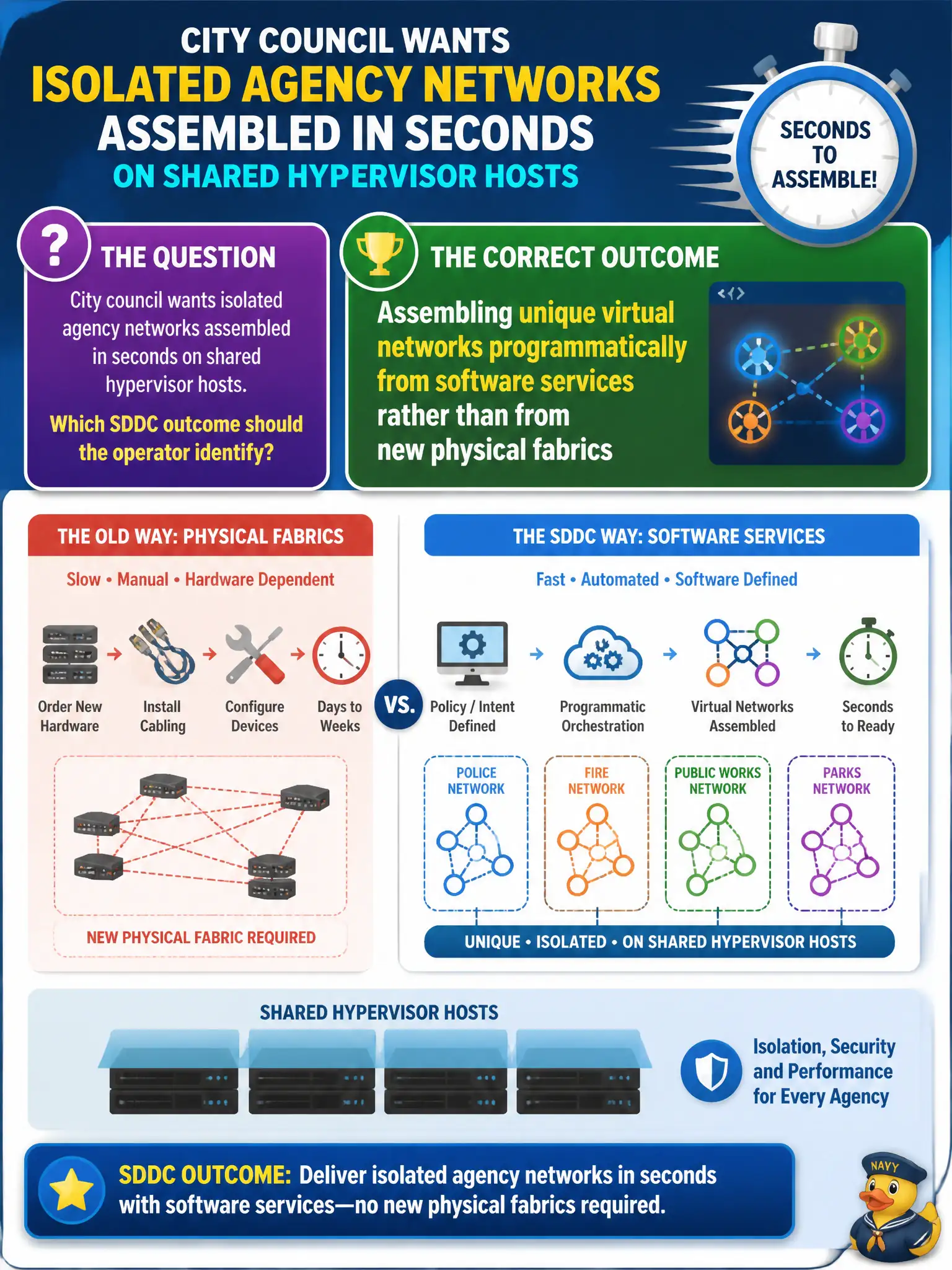
City council wants isolated agency networks assembled in seconds on shared hypervisor hosts. Which SDDC outcome should the operator identify?
Select an answer to reveal the explanation.
Short Explanation
Council wants separate agency hallways on the same building, not a new building per department. SDDC network virtualization stitches isolated virtual networks from software in seconds on shared hosts.
Full Explanation
City council wants isolated agency networks assembled in seconds on shared hypervisor hosts. The SDDC outcome is assembling unique virtual networks programmatically from software services rather than from new physical fabrics. Overlay segments and policy isolate agencies on shared ESXi capacity so each department gets logical separation without a dedicated chassis per agency. That pattern lets Harborview densify hosts while still meeting tenancy expectations between departments. Buying a dedicated chassis switch per agency before placement is the traditional hardware silo model the SDDC replaces. Publishing desktops through Horizon may isolate user sessions but does not create the agency virtual networks council asked for. Flattening every agency into one VLAN and relying only on the internet edge leaves east-west exposure and abandons per-agency isolation. Exam caveat: shared hardware still requires transport-node preparation, IP underlay health, and clear tenancy policy; speed comes from software objects, not from skipping design. Operational check: create two agency segments on the same cluster, place a test VM in each, and confirm they cannot communicate unless an explicit policy allows it—without adding a physical switch per agency.