
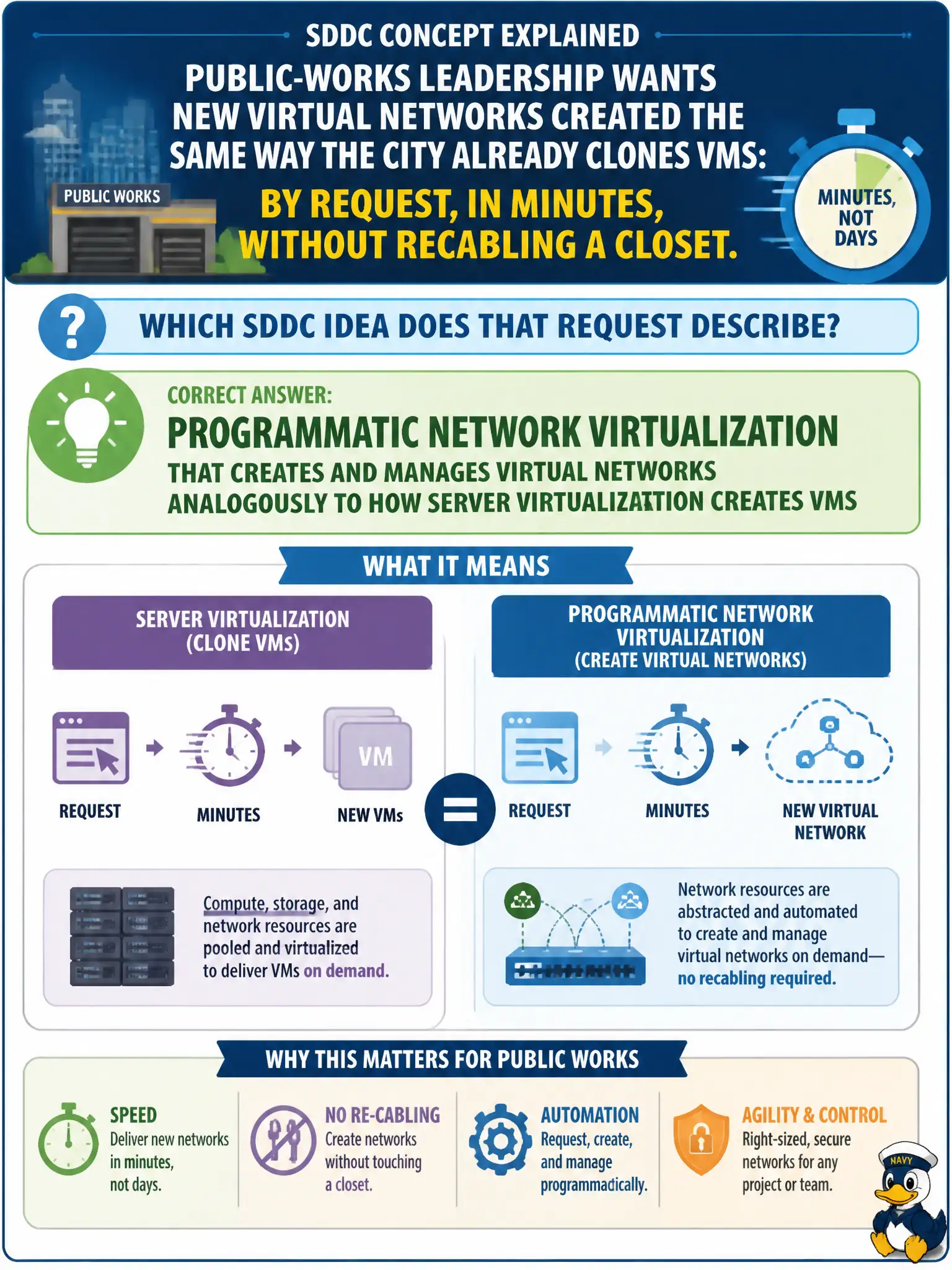
Public-works leadership wants new virtual networks created the same way the city already clones VMs: by request, in minutes, without recabling a closet. Which SDDC idea does that request describe?
Select an answer to reveal the explanation.
Short Explanation
Cloning a VM does not mean dragging a new server into the closet. Cloning a network in an SDDC should work the same way: software spins up the virtual network on request, without a recable.
Full Explanation
Public-works wants virtual networks created the same way the city already clones VMs: on request, in minutes, without recabling a closet. That is programmatic network virtualization—software creates and manages virtual networks analogously to how server virtualization creates machines. In an SDDC, segments, gateways, and related services are API- and UI-driven objects, so operators assemble connectivity without a physical change order for every agency hallway. The operational value for municipal teams is that network topology becomes a software lifecycle item alongside VM clones, snapshots, and templates. Replacing every top-of-rack switch before any VM can be cloned is a hardware-first constraint, not the SDDC idea. Moving email to SaaS removes one application from the data center; it does not give public-works self-service virtual networks. Enrolling laptops in Workspace ONE addresses device management, not fabric provisioning. Exam caveat: physical underlay still matters for MTU, IP reachability, and capacity, but tenant networks should not require a recable for routine creates. Operational check: time a request to create an isolated test segment for public-works; if it completes through NSX without a core VLAN ticket, the city is exercising the intended SDDC network model.