
County finance proposes buying only more ESXi hosts and leaving storage and networking as dedicated hardware. Why is that purchase not yet a software-defined data center (SDDC)?
Select an answer to reveal the explanation.
Short Explanation
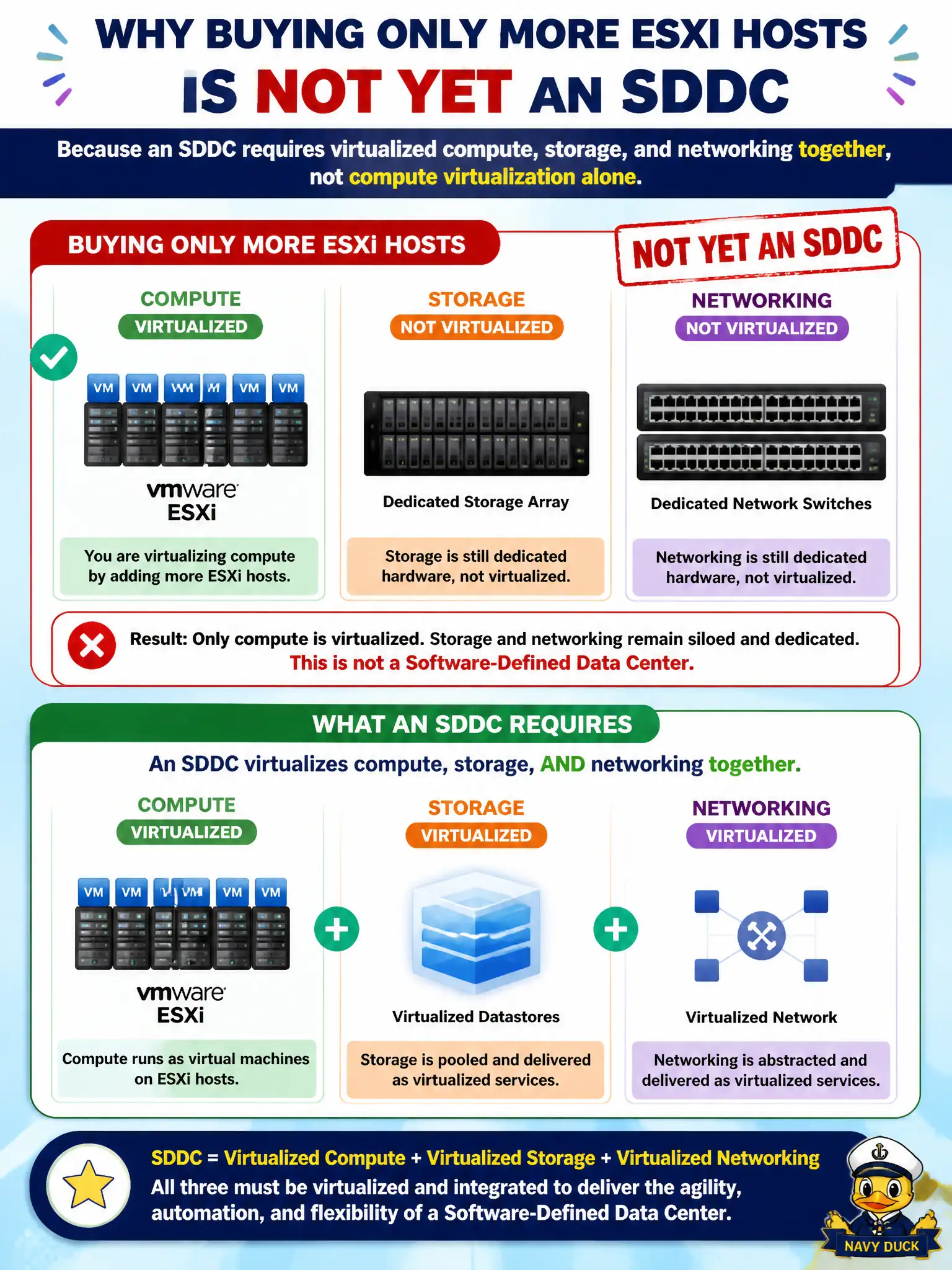
More hypervisors is still just a bigger server closet. An SDDC needs all three pillars—compute, storage, and networking—virtualized together, not ESXi hosts sitting on leftover arrays and chassis switches.
Full Explanation
An SDDC is complete only when compute, storage, and networking are virtualized together and operated as software services. Adding more ESXi hosts expands virtualized compute capacity, but leaving storage and networking as dedicated hardware silos leaves two of the three pillars outside the software-defined model. County finance therefore has a larger hypervisor footprint, not yet a software-defined data center. Claiming ESXi cannot run municipal VMs until Carbon Black is installed confuses endpoint security with hypervisor capability; Carbon Black is not a prerequisite for compute virtualization. Requiring every workload to run in a public cloud region conflates SDDC with a cloud-only placement strategy; an on-premises civic SDDC is valid. Forbidding vSphere until Horizon is licensed mixes EUC licensing with the SDDC definition. Exam caveat: partial virtualization is common during municipal migrations—compute first is fine as a phase—but exam questions treat SDDC as the three-pillar end state, not as hypervisor consolidation alone. Operational check: ask whether storage and network services can be created and governed as software objects on the same policy timeline as VMs; if those still require forklift hardware or chassis tickets per change, the purchase is not yet an SDDC.