
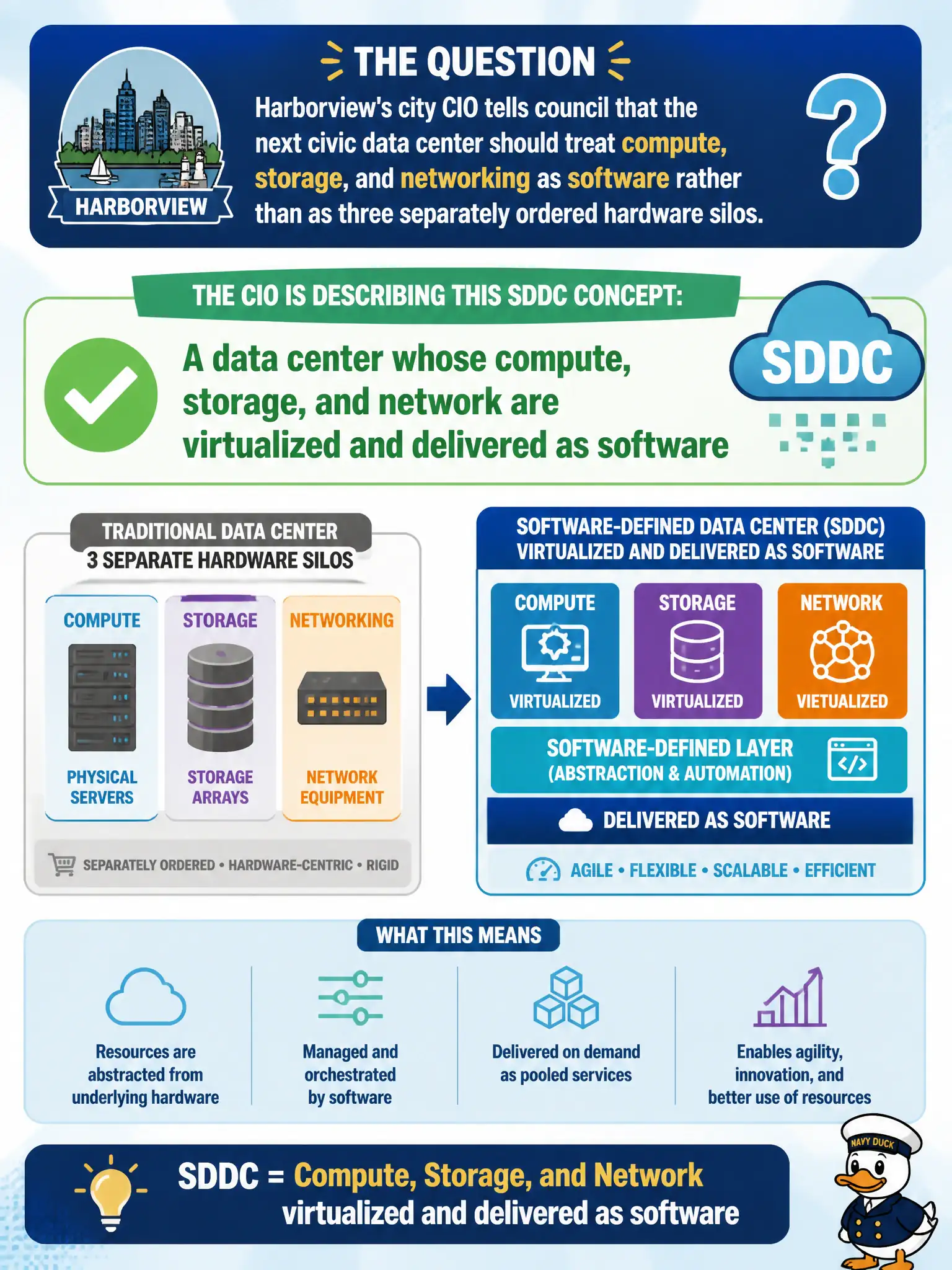
Harborview's city CIO tells council that the next civic data center should treat compute, storage, and networking as software rather than as three separately ordered hardware silos. What software-defined data center (SDDC) concept is the CIO describing?
Select an answer to reveal the explanation.
Short Explanation
Think of the civic data center as three software factories, not three hardware catalogs. An SDDC virtualizes compute, storage, and networking and delivers them as software, instead of ordering a server silo, a storage silo, and a switch silo.
Full Explanation
In a software-defined data center, compute, storage, and networking are virtualized and delivered as programmable services rather than as three separately ordered hardware silos. Harborview's CIO is describing that three-pillar model: hypervisors pool servers, software-defined storage abstracts arrays or disks, and network virtualization delivers switching, routing, and security as software. That is what turns a civic machine room into an SDDC operating model instead of a catalog of chassis purchases. Renting a public SaaS mailbox outsources one application tenant; it does not virtualize the city's on-premises compute, storage, and fabric, so it is not the SDDC definition. A Horizon desktop pool addresses end-user computing and session delivery; it does not redefine the data-center pillars. A Carbon Black agent inspects endpoints for threats and does not virtualize switching or storage. Exam caveat: VMware SDDC discussions map naturally to vSphere, vSAN, and NSX-T, but the concept itself is the three software-defined pillars, not a requirement that every municipal workload already run in public cloud. Operational check: confirm the city can provision or change compute, storage, and network services through software and APIs without a unique physical BOM for each agency request.