
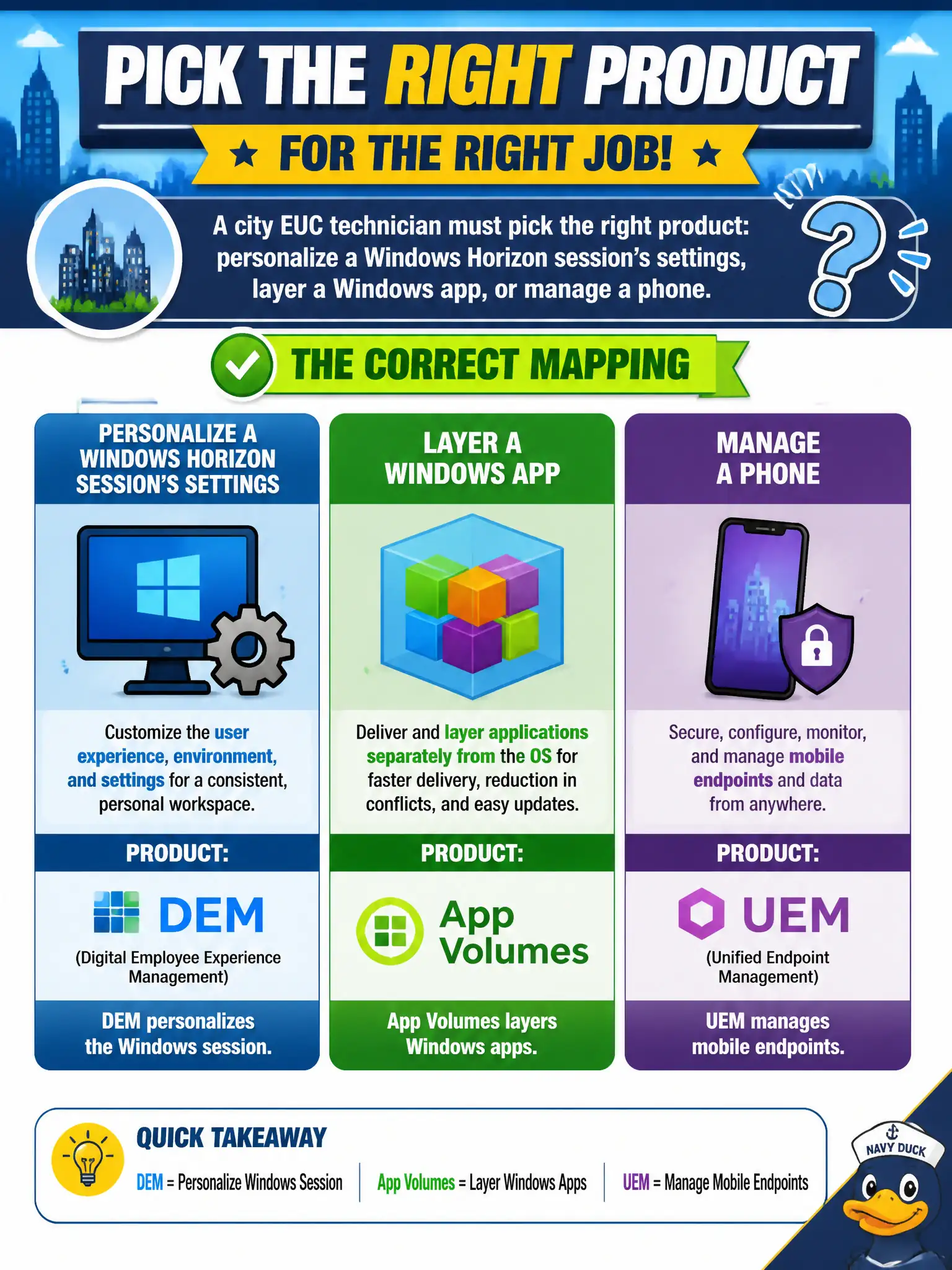
A city EUC technician must pick the right product: personalize a Windows Horizon session's settings, layer a Windows app, or manage a phone. Which mapping is correct?
Select an answer to reveal the explanation.
Short Explanation
Three lockers, three keys. DEM dresses the Windows session, App Volumes snaps on the apps, UEM babysits the phone. Swap those jobs and the 311 floor lights up with tickets.
Full Explanation
The correct product mapping for a city EUC technician is: Dynamic Environment Manager personalizes the Windows Horizon session, App Volumes layers Windows applications, and Unified Endpoint Management manages mobile endpoints. That three-way split is foundational associate knowledge for municipal digital workspace designs spanning clerks, inspectors, and field tablets. It is wrong that DEM layers Windows apps, App Volumes personalizes settings, and UEM brokers Horizon. It is wrong that DEM enrolls phones, App Volumes is the Horizon broker, and UEM attaches AppStacks. It is wrong that DEM replaces vSphere, App Volumes replaces UAG, and UEM replaces Connection Server. Exam caveat: exam items often swap these roles deliberately; slow down and match personalize, layer, and manage-mobile to DEM, App Volumes, and UEM before selecting an answer. Operational check: write a one-page civic reference card—DEM for printers and signatures, App Volumes for Windows packages, UEM for phones—validate the next three change requests against that map, and coach junior technicians who open the wrong console first. Keep civic diagrams labeled so help-desk and network teams do not swap these products during incidents.