
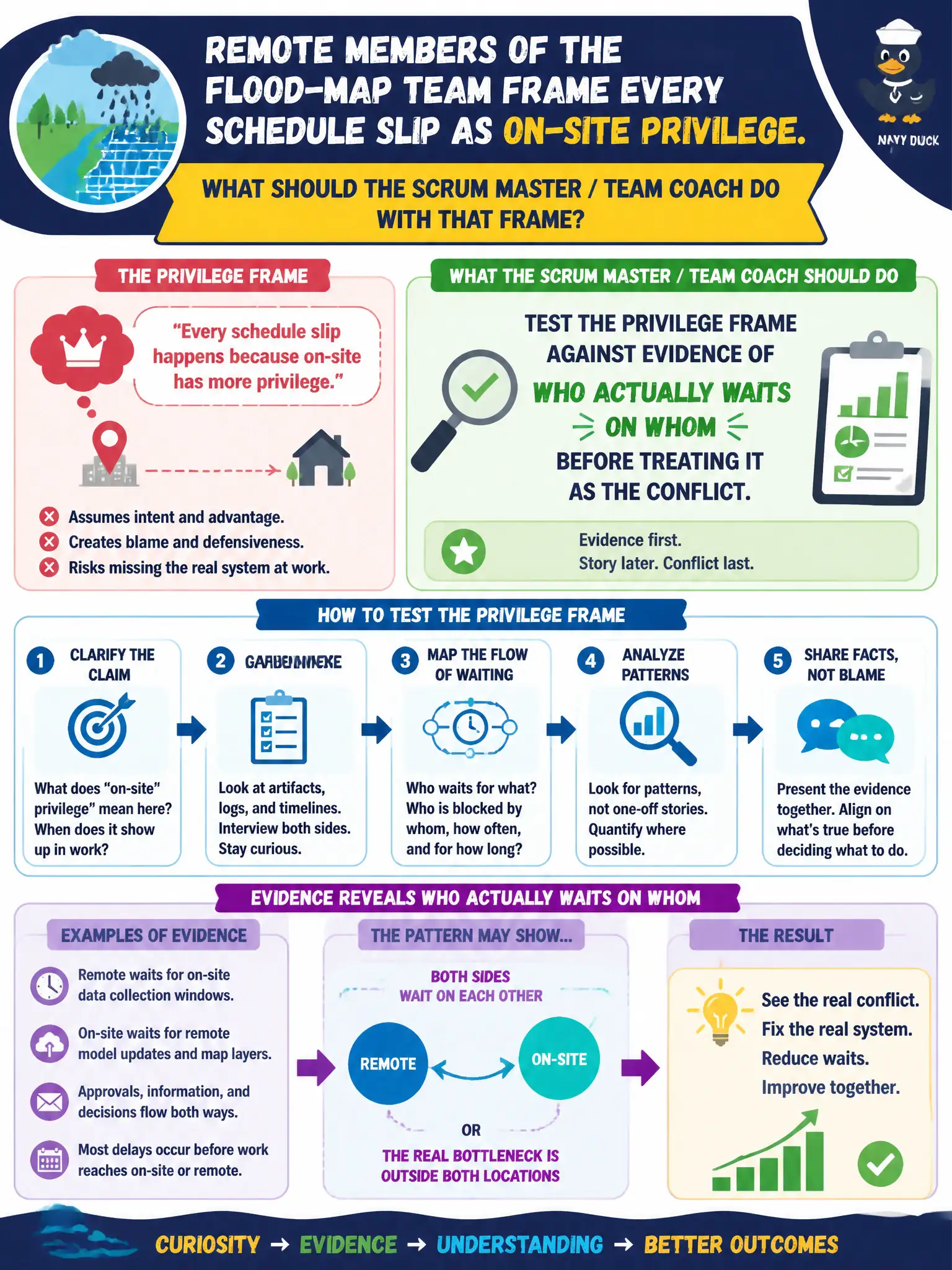
Remote members of the flood-map team frame every schedule slip as on-site privilege. What should the Scrum Master / Team Coach do with that frame?
Select an answer to reveal the explanation.
Short Explanation
The loudest story is not automatically the map. Remote flood-map folks may be right—or the waits may live in a queue nobody named. Check who actually waits on whom before buying the privilege frame.
Full Explanation
Frames in conflict are hypotheses, not facts. Remote members of a flood-map team may correctly sense on-site privilege—or the real waits may sit in queues, environments, and unclear handoffs. The Scrum Master / Team Coach tests the privilege frame against evidence of who waits on whom before adopting it as the conflict. Evidence-based reframing keeps the civic mapping team on the real system problem instead of punishing a loud story or dismissing a real inequity without data, which matters when emergency maps must ship reliably.
Automatically adopting the loudest remote frame skips inspection and can misdirect facilitation. Banning remote work dissolves the argument by force and may destroy talent without fixing waits. Publishing badge-swipe reports as the only schedule metric reduces a flow problem to attendance theater.
Exam caveat: listen to equity frames, then verify with flow evidence; do not treat volume as proof. Operational check: map the last three flood-map slips to waiting parties and blockers before deciding the conflict is “privilege” alone.
In municipal ARTs, residents experience conflict outcomes as delayed permits, missed benefits, unsafe shelter conditions, or opaque public data—so the Scrum Master / Team Coach keeps facilitation tied to service flow, safety, and transparent inspection rather than positional wins. Document the chosen frame or strategy, the evidence used, and the next check date so the team can see whether the intervention improved civic delivery.