
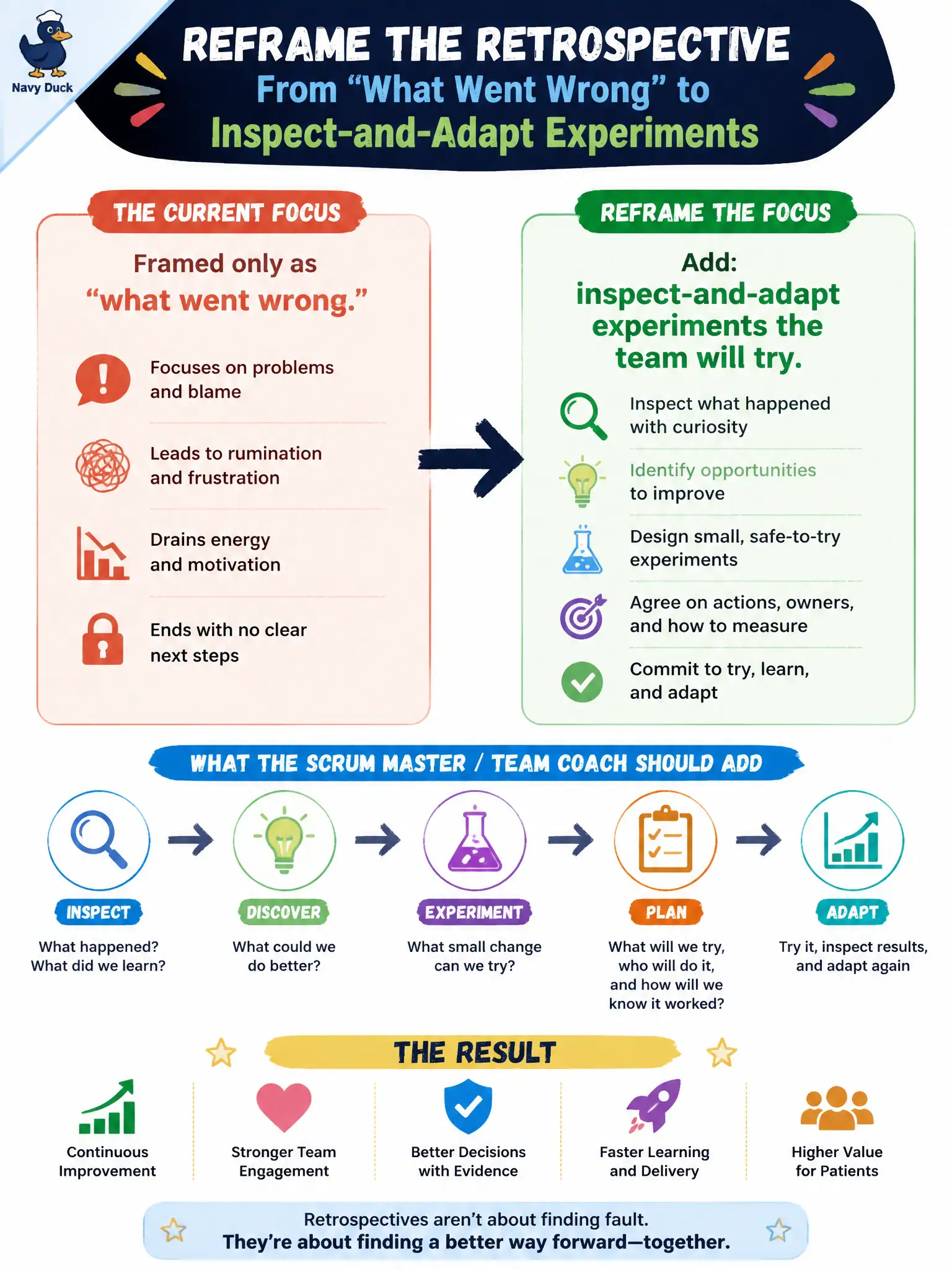
The clinic-scheduling team’s retrospective is framed only as “what went wrong.” What should the Scrum Master / Team Coach add to reframe the event?
Select an answer to reveal the explanation.
Short Explanation
A retro that only lists what went wrong is a wake with no next of kin. Clinic scheduling still has a next iteration. The coach adds “what should we try?” so inspection turns into adaptation.
Full Explanation
Inspect and Adapt requires both looking at what happened and choosing a change. A clinic-scheduling retrospective framed only as “what went wrong” produces rumination and blame without an improvement backlog item. The Scrum Master / Team Coach reframes the event toward experiments the team will try next iteration—hypothesis, owner, and check—so inspection becomes adaptation for appointment access. Civic scheduling teams need that forward move for patients, not a longer wake that leaves the next iteration unchanged.
Keeping the retro as a complete blame record preserves history without improving flow for patients. Canceling retrospectives until morale improves removes the team’s primary improvement loop. Handing the retro to the Release Train Engineer avoids team ownership of local experiments the ART cannot run for them.
Exam caveat: problem talk without experiments is incomplete inspect-and-adapt practice. Operational check: end every clinic retro with at least one named, timeboxed experiment on the improvement board before people leave.
In municipal ARTs, residents experience conflict outcomes as delayed permits, missed benefits, unsafe shelter conditions, or opaque public data—so the Scrum Master / Team Coach keeps facilitation tied to service flow, safety, and transparent inspection rather than positional wins. Document the chosen frame or strategy, the evidence used, and the next check date so the team can see whether the intervention improved civic delivery.