
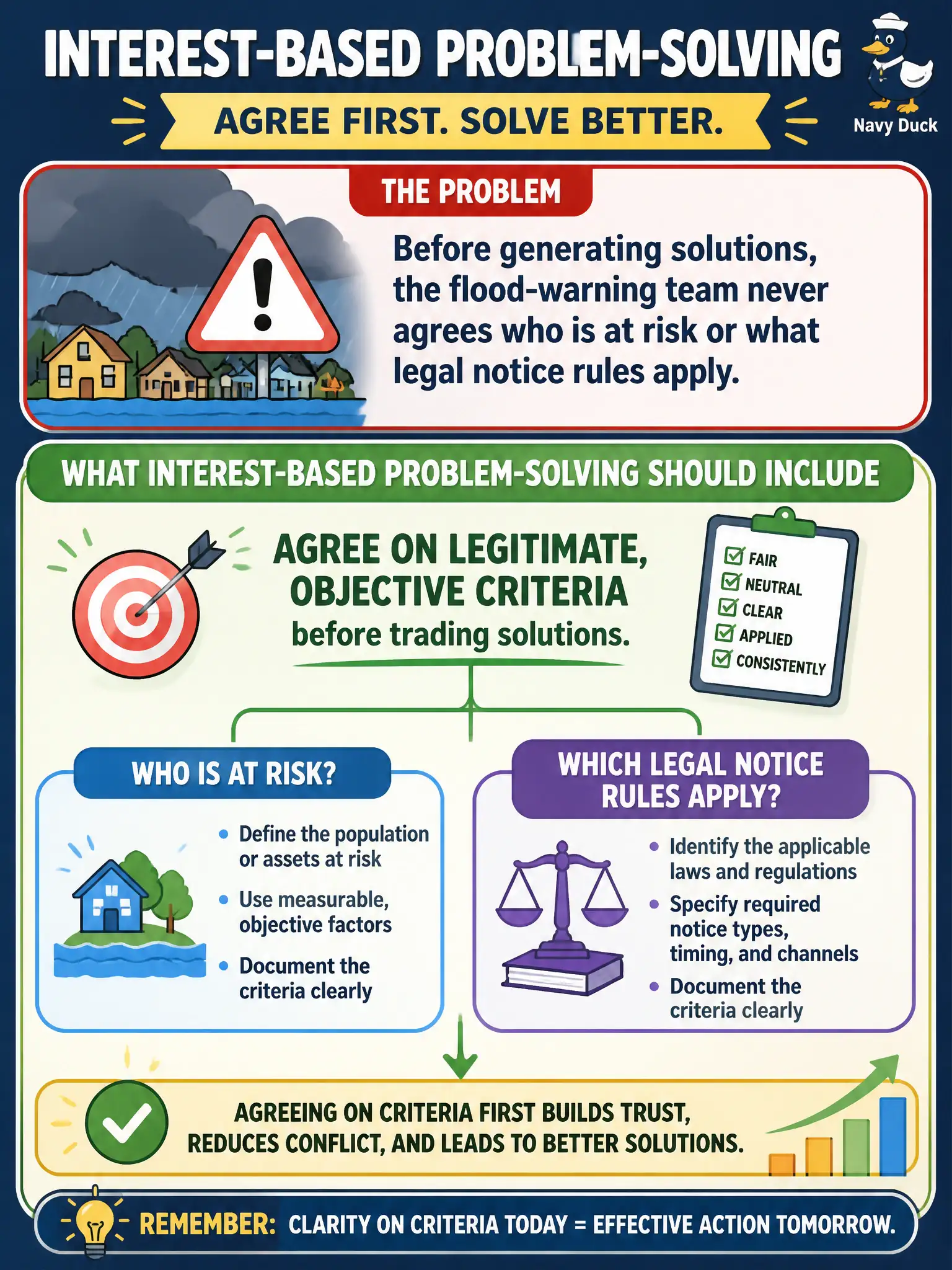
Before generating solutions, the flood-warning team never agrees who is at risk or what legal notice rules apply. What should interest-based problem-solving include?
Select an answer to reveal the explanation.
Short Explanation
You do not bid on a levee height before you agree whose houses sit in the floodplain. Criteria first: who is at risk, what the notice law says. Then solutions have a yardstick.
Full Explanation
Interest-based solving uses fair, legitimate criteria rather than only bargaining. Before generating solutions, when the flood-warning team never agrees who is at risk or what legal notice rules apply, interest-based problem-solving should include agreeing on legitimate, objective criteria—who is at risk and which legal notice rules apply—before trading solutions. Without those criteria, options for municipal flood notice cannot be compared fairly or lawfully.
Bargaining first so criteria can be invented after a winner emerges fails by concept: post-hoc criteria ratify power, not legitimacy. Skipping criteria because they slow municipal teams down fails by concept: speed without lawful criteria risks invalid notices to residents. Asking the RTE to classify flood risk as a train metric the team must not discuss fails by concept by removing necessary criteria from the team's problem-solving.
Exam caveat: SASM interest-based problem-solving includes objective criteria alongside interests and options; bargaining-only paths are distractors. Legal counsel may inform criteria—the team still needs explicit agreement before trading flood-warning solutions.
Operational check: pause solution trading, document at-risk populations and applicable notice rules with the right experts, post criteria visibly, only then compare options, and verify subsequent flood-warning decisions cite those criteria rather than pure bargaining.